

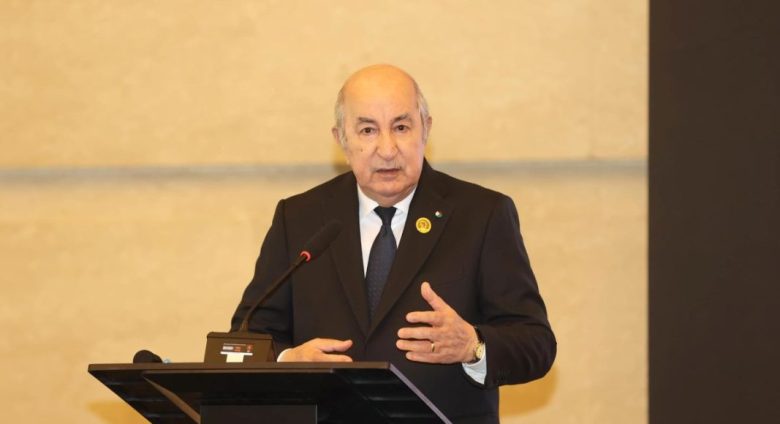
The President of the Republic, Abdelmadjid Tebboune, reaffirmed Algeria’s commitment to social justice, solidarity, and human development. He emphasized the importance of the global meeting dedicated to promoting social development worldwide during his speech, read on his behalf by the President of the Council of the Nation, Azouz Nasri, this Tuesday at the opening of the 2nd World Summit on Social Development in Doha.
The President stated that Algeria has made food security a national priority. The country is committed to protecting its natural resources and encouraging agricultural investment to ensure sustainable and safe supply for its entire population. He declared that through its participation in this summit, “Algeria’s path in the field of social development” is presented, specifying that “this path is based on a national vision that has made social justice, protection of vulnerable populations, and promotion of inclusion the fundamental pillars of its public policies, in accordance with the commitments of the 1995 Copenhagen Declaration and the Sustainable Development Goals.”
President Tebboune highlighted the constitutional foundation of this policy, which enshrines equality for all citizens and ensures the integration of persons with disabilities as well as disadvantaged groups. He explained that the State’s action revolves around dynamic institutions dedicated to youth, civil society, human rights, and environmental sustainability.
In this regard, several major economic and social reforms have been implemented since 2019, including the increase of the national minimum wage, the creation of an unprecedented unemployment benefit for young job seekers, the revision of salaries and pensions, tax exemption for low incomes, and the extension of the solidarity allowance to people with disabilities and vulnerable families. Elderly people benefit from free transport and healthcare, as well as a national day of recognition set for April 27.
The Head of State added that, in the interest of territorial equity, Algeria launched, in 2020, a vast development plan for “shadow zones” aimed at opening up disadvantaged regions and guaranteeing them equitable access to essential services. This policy has notably improved access to water, electricity, health, and education services while eradicating more than 45,000 precarious housing units.
The State has also worked to generalize social coverage and free healthcare for students, unemployed people, and those with chronic illnesses, all within a framework of solidarity and social justice.
Furthermore, President Tebboune assured that Algeria has “introduced comprehensive reforms guaranteeing equal pay and opportunities, political participation, and parity in nationality granting.” Key measures also include extending maternity leave to 150 days, creating a support fund for divorced mothers with custody of minor children, and strengthening the role of women in decision-making positions, trade unions, and entrepreneurship.
Regarding childhood, the State guarantees free education for nearly 12 million pupils, accompanied by a support system including transport, meals, and health coverage. The establishment of the National Authority for the Protection and Promotion of Childhood reinforces this protective framework.
Moreover, facing the challenges of unemployment, Algeria has tirelessly worked to establish a strategy focused on economic diversification and youth employment promotion. A new investment code, based on transparency and simplification of procedures, now favors start-ups, innovative projects, and alignment between training and market needs.
Additionally, the State encourages the creation of businesses by young project leaders, supported by appropriate financing mechanisms. The President also reaffirmed the priority given to national food security through the protection of natural resources and modernization of the agricultural sector.
Regarding technological development and institutional modernization, he recalled that Algeria proclaimed 2023 the “National Year of Artificial Intelligence,” marking its commitment to digital transition and adopting international principles of ethical digital governance, including algorithmic justice and data sovereignty.
In conclusion of his message, the Head of State reiterated Algeria’s loyalty to its founding values of peace, peaceful coexistence, and respect for international law, affirming that faithful to its history and principles, Algeria continues to defend “the right of peoples to self-determination,” a fundamental pillar of universal justice and human rights. He added that in this context, “the current international situation requires us to strengthen dialogue and cooperation to build policies capable of guaranteeing human dignity and equity among peoples.” The speech ended with President Tebboune’s commitment that “Algeria will continue its role as an active and responsible partner in international efforts aimed at building a fairer, more solidaristic, and more humane world, respecting national sovereignties and the principle of cooperation based on equality and mutual respect.”
Thus, by reaffirming this vision, Algeria firmly positions itself among the nations that see social development as a lever of sovereignty and stability. It claims a human-centered approach to progress based on justice and solidarity, far from imposed models. Faithful to its values, it relentlessly pursues its advocacy for a fairer world where every people can freely chart their path with dignity and mutual respect.