

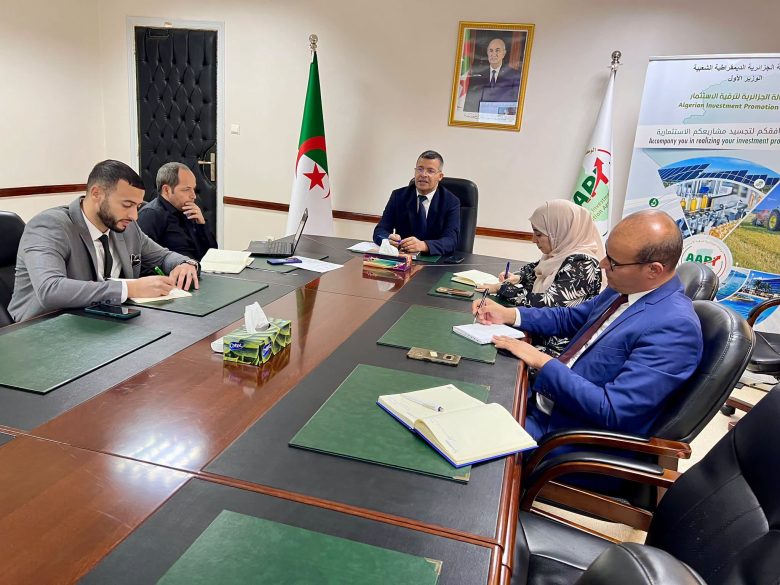
The Algerian Investment Promotion Agency (AAPI) launched, Sunday in Algiers, the formulation mission of the “EU–Algeria For Business” project, designed to strengthen the alliance between Algeria and the European Union (EU) in the domains of enhancing the business climate and expanding sustainable bilateral economic relations.
Provided with a fund of 16 million euros, this project will span 84 months, including 60 devoted to its practical implementation, in compliance with the financial allocation agreement signed last July 8 between the European Commission, the Ministry of Foreign Affairs and the AAPI. In his address on the occasion of launching this assignment, the chief executive officer of the AAPI, Omar Rekkache, emphasized the value of this initiative for the diversification and resilience of the Algerian economy, through the reinforcement of collaboration with the EU, the improvement of investment conditions and the growth of sustainable bilateral economic ties.
The project aims specifically to boost European capital commitments in Algeria, smooth commercial transactions and support Algerian firms in gaining access to European markets. The realization of these targets requires, according to Rekkache, consistent actions regarding the appeal of destination Algeria, the upgrading of operating conditions for commercial operations and the easing of trade.
For the AAPI, these ambitions align directly with its duties of investment promotion, notably through highlighting economic possibilities, enhancing the visibility of Algeria among capital providers and facilitating networking among corporate entities, in order to encourage the emergence of productive ventures and commercial alliances.
Scheduled from October 12 to 14, the formulation assignment is intended to allow translating the general ambitions of the project into an actionable roadmap detailing the interventions to select, the assets to mobilize, the execution timetable and the anticipated outcomes. The planning must also guarantee a match between the deployed means and the set targets, while meeting the requirements expressed by agencies and corporations.
The efforts center around three complementary axes. The first concerns the commercial environment, investment promotion and the advancement of economic alliances between the EU and Algeria. It will involve specifically pinpointing the hurdles encountered by capital providers, highlighting sector opportunities and encouraging industrial alliances built on joint production, subcontracting and technology transfer. Special focus will be given to mechanisms allowing the alignment of investment opportunities with the capabilities and expectations of Algerian and European enterprises.
The second axis deals with trade easing, digitalization and regional commerce, notably within the framework of the African Continental Free Trade Area (AfCFTA). The simplification and paperless transition of commercial and customs protocols are among the levers retained to diminish operational constraints on firms and boost their reach to regional and global markets.
The third axis covers quality, access to the European market and the ecological transition. Discussions pertain to conformity requirements, quality infrastructure, certification as well as guidance for enterprises facing environmental benchmarks, particularly those linked to the carbon border adjustment mechanism of the European Union. These requirements will likewise be examined through the lens of corporate support needs and fresh avenues for cooperation and investment.
The scheduled multilateral sessions will be followed by bilateral consultations with specialized institutions, notably in the fields of corporate support, electronic commerce and environmental capacity building.
The diversity of gathered actors, comprising the EU Delegation in Algeria, experts from the International Trade Center, employer organizations and representatives of public institutions and departments, represents an asset to evaluate analyses, identify private sector requirements and pinpoint synergies among envisaged interventions.
In this regard, Rekkache expressed the desire to see this assignment yield a cohesive, pragmatic program focused on quantifiable results. He notably stressed the need to convert mobilized assets into concrete actions benefiting investors and firms, through improved visibility of possibilities, the growth of economic alliances, effective trade easing and strengthened guidance to enter markets.
Furthermore, the chief executive officer reiterated the commitment of the AAPI to fully contribute to this process, within the framework of its duties and responsibilities inside the governing framework of the project. The Agency will notably ensure the coordination of Algerian stakeholders and the consideration of requirements related to investment promotion.