

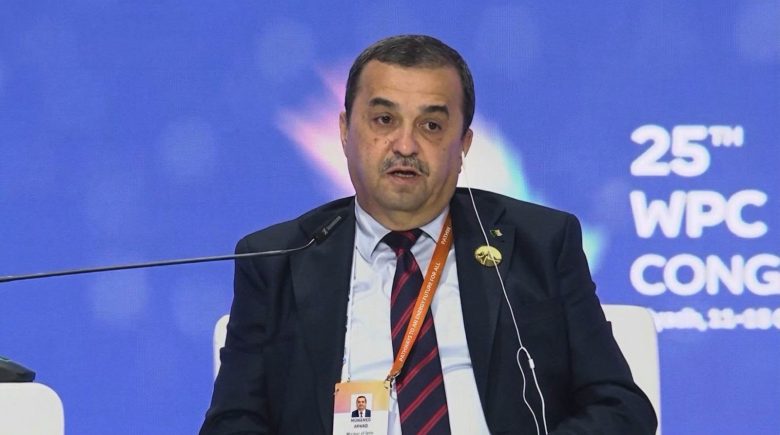
The horizon for oil and gas remains bright given a landscape shaped by escalating geopolitical risks and shifting dynamics between supply and demand, with demand projected to sustain its upward trajectory, stated Minister of State, Minister of Hydrocarbons Mohamed Arkab on Sunday. Speaking at the opening of the 25th edition of the “WPC Energy 2026” World Petroleum Congress in the Saudi capital Riyadh on Sunday, he highlighted the shortfall in sector investments and its direct repercussions on market fundamentals and pricing structures.
The outlook for global oil and gas markets—against a backdrop of intensifying geopolitical risks, investment uncertainty, and shifting balances between supply and demand—formed the core focus of the high-level ministerial session, which brought together prominent energy executives, including the OPEC Secretary General.
In his remarks, Arkab underscored that global oil and gas demand is set to expand continuously over coming decades, propelled by “demographic expansion,” “economic advancement,” “urbanization, and industrial growth,” particularly across emerging markets, according to an official statement issued on Sunday by the Ministry of Hydrocarbons. Pointing out that Asia, Africa, and the Middle East will represent the primary centers of future energy demand expansion, the minister clarified that global energy transitions do not necessarily signal a uniform drop in oil consumption, but rather an evolution in demand patterns, geographic distribution, and end uses. He specifically noted sustained demand growth in aviation, heavy transport, and petrochemical industries, running parallel to rising consumption across emerging markets.
Underlining forecasts projecting higher global energy demand through 2050 and sustained growth for natural gas and LNG through 2055—with LNG potentially capturing 65% of global gas trade—the minister nevertheless sounded the alarm over insufficient investment levels and their severe consequences. Such capital shortfalls risk tightening supply-demand pressures and sparking extreme market volatility, he warned.
Algeria Pursues Hydrocarbon Expansion
According to Arkab, sustained investment constitutes a “critical pillar” for energy security, adding that the central hurdle facing energy markets lies in “mobilizing the capital required to convert available resources into operational production, transport, processing, and export capacities.”
Capital allocation must encompass the entire spectrum of energy infrastructure, including pipelines, liquefaction units, port terminals, storage facilities, refining assets, and energy grids, the minister explained, stressing the need for a “clear and predictable” long-term strategy.
“Energy security relies on adequate and timely capital investment, a transparent long-term perspective, and balanced international cooperation connecting producing and consuming nations,” Arkab declared.
The minister detailed Algeria’s ongoing efforts to develop its hydrocarbon reserves, upgrade infrastructure, and bolster its appeal for international exploration and production investment. In this regard, Arkab highlighted the competitive bidding initiative, the “Algeria Bid Round 2026,” noting that it serves as a central mechanism in this national strategy by putting seven exploration blocks up for tender.
Reiterating the vital role played by producer cooperation and the OPEC+ alliance in preserving oil market equilibrium and stability, the minister further highlighted the strategic weight of the Trans-Saharan Gas Pipeline (TSGP) project, framed as a major African energy corridor designed to strengthen regional integration and energy security.
During his opening speech at the ministerial meeting, the minister also focused on boosting domestic processing capabilities and value chains. Arkab insisted on expanding local refining and petrochemical capacities to maximize the added value extracted from domestic resources.