

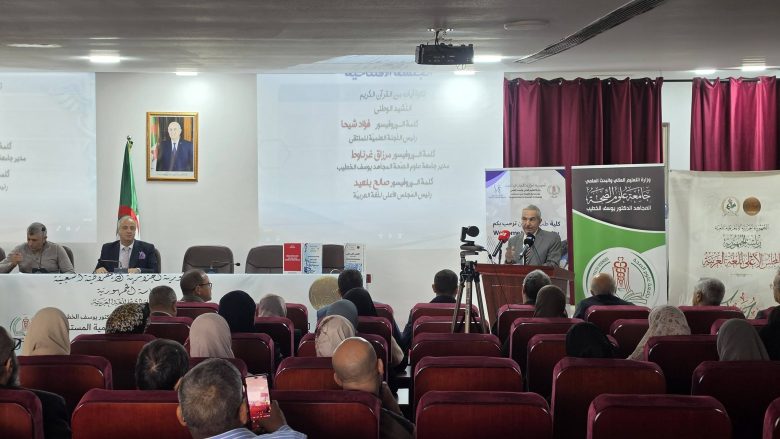
The utilization of the Arabic language in medical instruction, the transmission of clinical knowledge, and the drafting of healthcare documents formed the core of the inaugural national symposium organized by the High Council of the Arabic Language, in coordination with the Moudjahid Dr. Youssef El-Khatib University of Health Sciences. This initiative aims to elevate Arabic into a vital instrument for transferring medical expertise and enhancing communication between healthcare practitioners and patients.
The standing of the Arabic language within the medical sector and its capacity to keep pace with scientific developments dominated discussions at the first colloquium dedicated to generalizing its application in medicine, held on Wednesday in Algiers. This event seeks to initiate dialogue on strategies to solidify the presence of Arabic across all facets of medical practice, spanning academic training to direct patient care.
Opening the proceedings, the President of the High Council of the Arabic Language, Salah Belaïd, outlined that the conference brings together physicians from various domestic universities, regional specialists from across the Arab world, surgical professors, linguists, and pharmacists. The objective remains merging expertise, cultivating partnerships, and delivering consensus recommendations regarding Arabic usage in medical sciences.
According to the council leader, this undertaking extends well past mere linguistic considerations. He emphasized that it represents a cultural endeavor reflecting commitment to national identity and scientific self-reliance. Consequently, he advocated for Arabic to regain its full stature in the medical arena, asserting that its lexical derivation and expansion capabilities position it to meet the demands of modern scientific terminology.
Welcoming existing initiatives pioneered by select national universities and medical laboratories incorporating Arabic into their operations, Salah Belaïd urged stakeholders to consolidate these pilot experiences and broaden their overall reach.
A Challenge for Professional Training and Patient Care
The rapid progression of medical sciences renders this inquiry increasingly vital. The chairman of the symposium’s scientific committee, Fouad Chiha, noted that the twenty-first century is witnessing profound transformations across medical and paramedical fields, ranging from breakthroughs in genomics and targeted therapies to applications of artificial intelligence.
This acceleration of knowledge presents a distinct hurdle for researchers engaged in the Arabization of medical sciences: how to assimilate these emerging advances and integrate them seamlessly into the Arab scientific and cultural ecosystem.
Beyond scientific literature, employing Arabic in clinical explanations, diagnostic reasoning, and health documentation forms a practical necessity. Fouad Chiha stressed its importance in establishing a foundation of trust between healthcare providers and patients, simplifying the comprehension of medical details, and enhancing overall care quality.
This perspective was similarly highlighted by the Rector of the University of Health Sciences, Professor Merzak Ghernaout. He recalled that the Arabic language constitutes a cornerstone of national and cultural identity, backed by a rich historical legacy in scientific and medical domains.
He noted that advancing medical education and scientific research equally requires supporting initiatives that reinforce the presence of Arabic within academic and hospital environments.
Achieving this ambition demands structured coordination among universities, scientific bodies, and researchers. It specifically requires compiling specialized medical reference works in Arabic, standardizing scientific terminology, and spurring intellectual output, translation, and publication of specialized literature.
The conference proceedings featured several presentations exploring different facets of this issue. Speakers focused on the impact of teaching medicine in Arabic, the phrasing of medico-legal reports when detailing forensic evidence, the hurdles associated with contemporary Arabic medical terminology, and the potential offered by artificial intelligence to assist in translating and standardizing medical terms.