

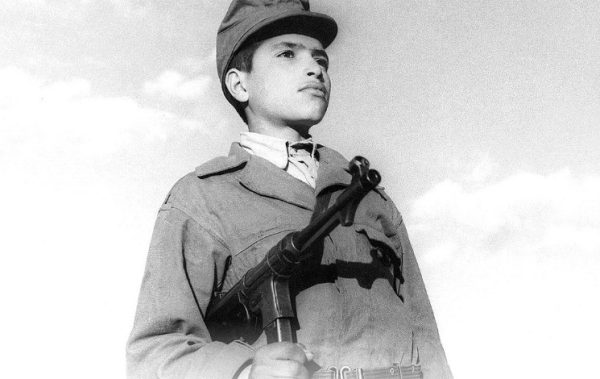
Thousands of children, if not millions, bore the full brunt of French colonial violence. Torn from their innocence, confronted with fear, suffering, and occasionally the loss of loved ones, their childhoods were shattered by the atrocities of the French colonizer. Deep trauma, whose scars have endured through time, bears witness today to the heavy price these innocent souls paid to colonialism.
At the Tazaghart camp, Ouardia Ahmed Khodja, now in her seventies, recalls the dark hours experienced in Tigrine, her native village in Azeffoun. She shares that she was barely six years old when the French military, in retaliation for the burning of the village school, turned violently against the inhabitants. She remembers that constant dread, “of soldiers whom a child could only understand as an endless threat.” In her own words, her family was among the first targeted; their home was torched before the entire village was forcibly herded into Tazaghart in extreme hardship, clothed only in meager, tattered rags.
In her account, Ouardia highlights the courage and heroism of her mother, Hasna, who managed to escape the camp after just fifteen days. “At the time, the French army sporadically allowed a few detainees to visit the weekly market in Azeffoun under tight guard,” she explains. “Hasna seized this brief window, obtaining permission to leave with three other women and a man on the pretext of buying provisions with what little money she had. An outing that became the opportunity for a daring escape,” she adds. Weakened at the time by a severe illness caused by contaminated water in the camp, Ouardia speaks of the daily terror. “Executed Algerians were subsequently dumped into the camp’s well,” she recounts with outrage.
“Taking advantage of the trip to the market, my mother turned that moment into a plan for flight. Once in Azeffoun, we managed to hide with relatives and stayed there for two full weeks without our disappearance being noticed by the soldiers,” she continues. “After the fire, we fled to relatives in Azeffoun. We were completely lost, with no news of my father who lived in Algiers. Fortunately, a man from the village—one of the few who knew how to read and write—agreed to help us. He penned an urgent note to my father, pleading with him to obtain a travel pass so he could come retrieve us.
For two long weeks, we waited every single day in fear that soldiers would discover us. Then, at last, he arrived. I still remember the journey toward Algiers… it was terrifying! At every checkpoint: searches, interrogations, piercing stares scanning you as if you were guilty of something. Every time, I wondered whether we would make it through or if someone would denounce us,” she confides. Ouardia’s voice breaks as she recalls the ordeal of her brother, “arrested at just 16 years old.” According to her, his sole “crime” was bearing the name Ahmed Khodja, a name the French army regarded as a threat in Tigrine. “Brutally tortured, then transferred successively to Tizi Ouzou and the Mustapha Pacha hospital in Algiers, he was detained there in utter secrecy. My father discovered his location only by chance, thanks to a fellow villager.
He rushed to the hospital to bring him back home,” she relates. Yet, in her view, the deepest scars remained unseen. “My brother healed from his physical wounds, but his spirit was broken,” Ouardia recounts with profound grief. “What he endured marked him forever, preventing him from returning to a normal life,” she emphasizes. Finally, Mrs. Ahmed Khodja also recounts a scene etched forever in her memory: a peasant from the camp begging soldiers to let him reach his wheat field during harvest season while families were starving. “They beat him to death right before our eyes, without the slightest remorse,” she denounces.
MEMORIES OF A NIGHT THAT CHANGED EVERYTHING
Another account comes from Mohamed Dakichich, a native of Batna who lived through the night of November 1, 1954. The witness, whom we met at a cafe in Algiers, relates that he was only nine years old when the initial explosions echoed in the dead of night across the Arris valley.
The gunfire echoing through the Aurès mountains gave him the impression that nature itself was heralding the arrival of a new era, according to his words. He remembers that a few days later, the intensity of colonial French military raids descended upon the village: brutal roundups, screams, houses turned upside down. He confides that the disappearance of his father, hauled away in military trucks, gave birth in his life to another form of torture: “the waiting”—for six months, not a single word.
In this regard, he notes that hunger was not the hardest thing to endure. “It was mostly the waiting that consumed families,” he asserts. His father eventually returned, but the young boy says he searched his father’s eyes for the hero he thought he knew, finding only a silent agony that never truly left. He also recalls the freezing nights and the constant suspicion cast over children. They were accused of acting as messengers for the resistance simply because they spoke a language the colonial soldiers could not comprehend, Mr. Dakichich explained.
In his words, childhood itself was compromised. For Fatma Khellafi, born in 1946 and raised in El-Eulma (Sétif), the colonial military displayed shocking violence toward civilians. “The house was searched top to bottom. Our meager possessions were thrown into the mud, overturned, and trampled… This happened shortly after my father joined the resistance fighters to combat the oppressor,” she indicates with an emotional voice. During her testimony, she recalls the sensation of cold dirt under her bare feet during their flight, the endless long marches, and her empty stomach rumbling like “a drum of war.”
When the war erupted, Hafid Marezki was only eight years old. In the Casbah, he felt that danger lurked around every corner, rendering the environment itself hostile. Raids, meanwhile, dictated daily life, he recounts. He explains that everyone knew people were being seized, but nobody knew how many would return alive. One evening, a neighbor returned from the Serkadji detention facility. “His body was there, but his soul seemed left behind bars,” Hafid reports with a grim gaze.
For her part, Nassima Derrabah, born in 1945 and also a resident of the Casbah, remembers the constant terror gripping families. Yet, she insists, dignity endured. “With every raid, I thought someone would never come back,” she confides, her voice still marked by the anguish of that era. Furthermore, as a student, she shares that she realized very early that reading in the language of the other was “an act of defiance.” “Glory to our martyrs… The sole hero is the people,” she adds. They were neither soldiers nor politically active intellectuals. They held neither rifles nor battle strategies, yet the war grabbed them by the hand and never let go. They share their stories so that this memory—that of the invisible little ones—is never wiped away