

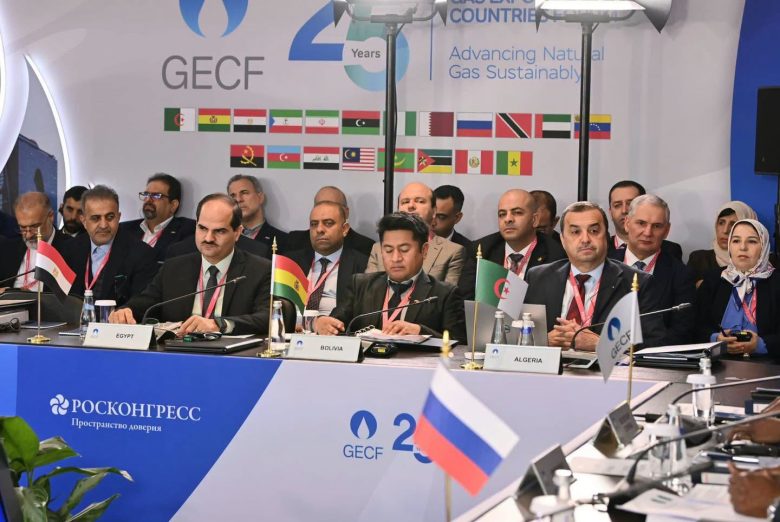
Strengthening investments across the entire gas value chain while intensifying cooperation and knowledge exchange stood at the center of the plea made by the Minister of State, Minister of Hydrocarbons, Mohamed Arkab, on the occasion of the 28th Ministerial Meeting of the Gas Exporting Countries Forum (GECF) in Moscow, reaffirming Algeria’s commitment to consolidating international partnership in the gas domain.
Speaking current day Monday at the opening of this ministerial gathering—held as part of the preparations for the 8th Forum Summit taking place current day in Moscow, Russia—the Minister of Hydrocarbons addressed global gas market priorities, focusing notably on security of supply, energy transition, and gas decarbonization.
Emphasizing “the significance of the Forum as a pivotal platform for dialogue and alignment among member states,” Mr. Arkab highlighted the strategic role of natural gas in “bolstering energy security,” “supporting economic and industrial advancement,” and “delivering a balanced and realistic energy transition” tailored to the specificities and development stages of each country, according to a statement from the Department of Hydrocarbons.
Mr. Arkab accordingly stressed the necessity of boosting capital expenditure throughout the gas value chain, ranging from exploration and production to transport, liquefaction, storage, and reception infrastructure, while underlining the critical role of long-term contracts and enhanced market predictability to back capital-intensive projects and ensure supply stability.
Furthermore, the Hydrocarbons Minister urged for intensified collaboration and expertise sharing, infrastructure development, and accelerated efforts to curb methane emissions and gas flaring. He specifically advocated that environmental standards must not turn into “barriers to trade or drivers of market fragmentation.” In this context, he drew attention to the value of innovation and modern technologies, including carbon capture and storage (CCS), digitalization, artificial intelligence, and the hardening of facility security.
Call to Expand the Gas Research Institute
Delivering his address during the session—presided over by Ekperikpe Ekpo, Minister of State for Petroleum Resources (Gas) of the Federal Republic of Nigeria and President of the Forum’s Ministerial Meeting for 2026, alongside Russian Energy Minister Sergey Tsivilev, Forum Secretary General Philip Mshelbila, and delegation leaders from member states—Mr. Arkab also called for developing the Gas Research Institute. The goal is to establish this institute as “a center of excellence for research, instruction, and technology transfer, thereby enhancing member countries’ capabilities and driving the gas industry forward.”
In addition, he outlined Algeria’s initiatives to expand its hydrocarbons sector, citing the outcomes of the “Algeria Bid Round 2024” licensing cycle—which resulted in five signed hydrocarbon contracts with foreign energy firms—as well as the rollout of the “Algeria Bid Round 2026” licensing campaign covering seven exploration blocks, with bid opening scheduled for early 2027. He likewise reiterated national undertakings to mitigate flaring and methane leaks while fostering low-carbon practices.
Algeria’s commitment to advancing international gas partnerships, respecting state sovereignty over natural wealth, and upholding national rights to determine energy pathways was reaffirmed by Mr. Arkab, who insisted on guaranteeing “equitable” access to technologies, capital markets, and commercial outlets to ensure reliable, affordable energy and foster sustainable development.
The 28th GECF Ministerial Meeting falls within preparations for the 8th Forum Summit, organized on the 25th anniversary of its creation, noted the Ministry of Hydrocarbons. Attendees evaluated activity reports and administrative dossiers, alongside draft preparatory materials for the summit, notably the draft “Moscow Declaration.” Several foundational benchmark reports were also reviewed, including the 2026 Annual Gas Market Report, the Global Gas Outlook 2055, and the 2026 Annual Statistical Bulletin.