

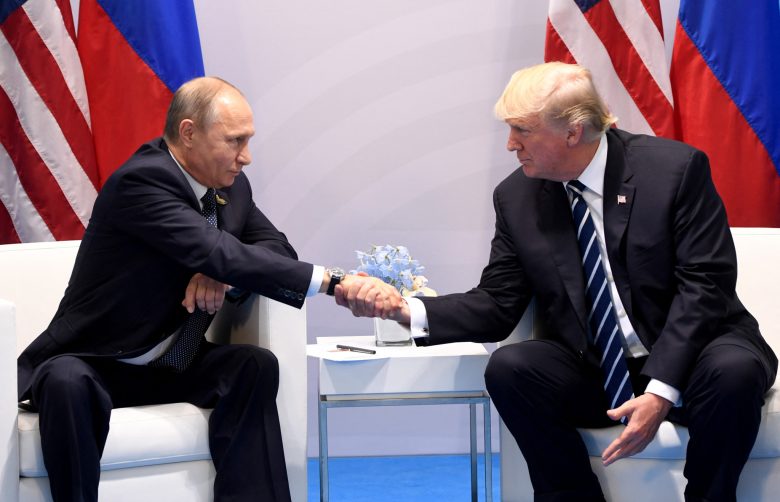
President Trump is proceeding to desert the Ukrainian head of state, who in his view has turned into an encumbrance that must be discarded. Right in the middle of the midterm election campaign, Donald Trump finds the perfect scapegoat to shoulder every hardship faced by the average American, who is set to head to the ballot boxes in a few weeks.
His statement delivered last Saturday has not stopped sending shockwaves. “I suggest they choose themselves a new leader capable of reaching a deal, because he could have concluded many deals and, for one reason or another, he never does,” declared Donald Trump. Killing two birds with one stone, he reassures his electorate by berating Volodymyr Zelensky, whose term expired two years ago, accusing him of refusing to sign for peace and, by extension, holding primary blame for rising fuel costs in the United States! Exit, then, the setback in Iran and the Straits of Hormuz dilemma.
On another front, the American president dispatches a message to Europeans: America First! Only American interests have any right to speak according to him. Here, Trump returns to his base to inform them that distant wars in Europe do not concern the United States, at least not in the manner Europeans understand it.
Already, on Friday, October 9, Trump caught everyone off guard by announcing an energy agreement with Russia. “Russia will immediately supply over 300,000 tons of diesel to the American and global markets, followed by an additional 500,000 tons during the month of November,” Trump stated following telephone conversations with Putin. Exchanges described as very cordial.
Two days later, the American president claimed to have secured from both belligerents a so-called “energy truce” between Russia and Ukraine, an announcement promptly applauded by Europeans, who refrained from criticizing the American stance.
In Kyiv, Zelensky labeled this decision a “gift given to Putin” that “will bring neither peace nor any benefit to the civilized world (sic).” “Permitting Russia to sell petroleum products amounts to investing in a war that ought to cease, not linger. What is required is a genuine de-escalation with Russia, on a mutual foundation,” he emphasized.
In the United States, diesel prices surged following the joint aggression launched by the United States and Israel against Iran on February 28. While wars in Iran and Ukraine both feed the global energy crisis, Donald Trump lays the blame for soaring fuel prices in the United States solely at the feet of Volodymyr Zelensky.
The motive is straightforward. Were Trump to bring up Iran, it would mean highlighting his own failure. According to General Jerome Pellistrandi, a French analyst, “it is certain he cannot attribute this responsibility to Iran, because that would mean acknowledging the collapse of his military operation. Hence, the simplest target is naturally Zelensky.”
To Dominique Simonnet, a political scientist specializing in the United States, “it is not a matter of shortages or domestic supply; it is merely a financial calculation to lower the price per gallon. That way, Donald Trump can declare prior to the midterms: ‘Look, I managed to bring prices down.'”
The American president had previously urged the Ukrainian leader to halt retaliatory strikes targeting Russian oil refineries and other vital infrastructure, arguing that those attacks contributed to the global deficit.
“He wants to create problems for the world. He wants to create problems for our farmers, our ranchers, with diesel,” Trump insisted last Saturday. “And we told him: ‘Do whatever you want, but do not touch diesel, because that is a major issue.’ And what does he do? He goes after diesel,” he added.
This rift between Washington and Kyiv is visible on the ground. The Starlink network of tycoon Elon Musk has stopped transmitting data to the Ukrainian side. According to the Financial Times, citing multiple Ukrainian officials, the Ukrainian army was caught unprepared Saturday by limitations on the Starlink satellite network that disrupted its drone operations on the front lines.
Terminals suffered connection cutoffs at speeds exceeding 160 kilometers per hour, forcing certain units to cancel assignments. These restrictions, imposed without warning according to Kyiv, also strike interceptor drones used against new Russian jet-propelled drones.
On X, Christopher Miller, Financial Times correspondent in Ukraine and author of the article, clarifies that the restrictions emerging overnight involve Starshield, the military variant of the system, placed according to him under Pentagon command, whereas SpaceX, owned by Elon Musk, manages Starlink and can restrict its usage.
Still on the ground, Moscow accused Ukraine Saturday of fresh strikes on two oil facilities. “According to reports from the Energy Ministry and relevant enterprises, two refineries were attacked today by the Kyiv regime,” stated Russian Deputy Prime Minister Alexander Novak, quoted by TASS and Interfax agencies. “We observe that the Ukrainian party is taking no steps toward an energy truce,” he added.
In Moscow, Russian media outlets reported the late Wednesday arrival of FBI Director Kash Patel in the Russian capital. Information that ought to give food for thought both to the Kyiv regime and its European partners.