

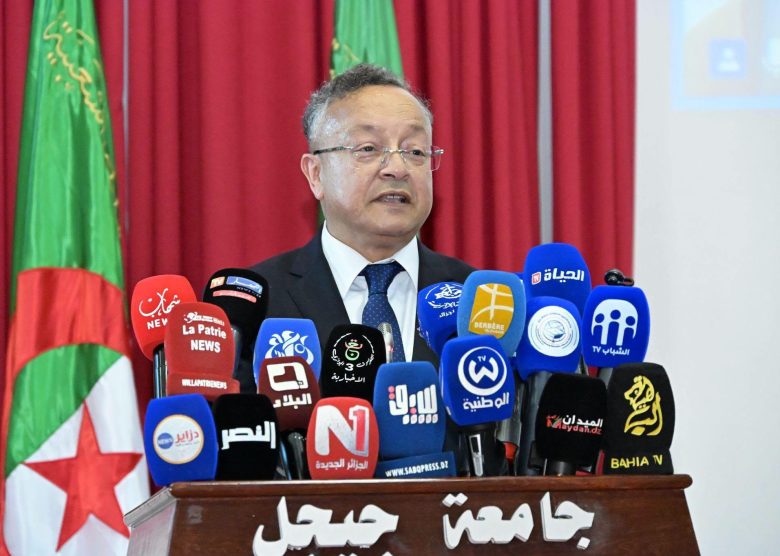
The Minister of Higher Education and Scientific Research, Kamel Baddari, launched Tuesday from the University of Jijel the official start of the 2026–2027 academic year, welcoming nearly two million students returning to campuses with enriched educational tracks featuring artificial intelligence, quantum technologies, space engineering, and advanced health sciences.
Speaking on the occasion, Baddari stated that “the modern university extends beyond delivering a degree; it must cultivate a student equipped with knowledge, skills, and initiative to propose solutions.” Maintaining that the student remains “at the core of ongoing sectoral reforms,” he highlighted educational quality, scientific research, digitization, and entrepreneurship.
The minister further noted that “we want a university that empowers students to undertake, create, and transform ideas into viable projects,” pointing to startups, micro-enterprises, and research commercialization as drivers of this transformation.
This evolution must, he continued, align with technological shifts and future economic needs, adding: “The university should accompany technological transformations and prepare skilled talent required by tomorrow’s economy.” He specifically referenced artificial intelligence, cybersecurity, renewable energy, and biotechnology.
In this context, the minister underscored the quality of the campus environment, asserting that “the quality of university services is integral to the quality of the institution itself.” He announced ongoing renovation work across student residences alongside enhancements in catering, accommodation, hygiene, campus security, and athletic and cultural venues.
He added: “Students must find within the university an environment conducive to knowledge, creativity, and excellence.” Concurrently, he called for accelerating service digitization to “bring services closer to students, streamline administrative procedures, and improve student support.”
Baddari also urged strengthening ties between universities and their socio-economic environment. Asserting that “knowledge and scientific research must drive local and national development,” he advocated for academic tracks and research initiatives closely aligned with practical field needs. Addressing students directly, the minister called on them to transform universities into “hubs for science, research, and initiative.” “You represent the nation’s vital force, and investing in knowledge and learning means investing directly in Algeria’s future,” he told them.
————13 New Specialties in Emerging Professions
The policy directions highlighted in Jijel translate into the launch of 13 new academic specialties focused on future professions. Among these are a state engineering degree in artificial intelligence, an integrated master’s program in quantum technologies, a master’s in information system interoperability, and a master’s in spatial systems mechanics.
The academic year also introduces new healthcare programs developed alongside the Ministry of Health. These include a bachelor’s degree in dental health and hygiene, alongside master’s degrees in genetic counseling, medical artificial intelligence, medical bioinformatics, and addictology. A specialized post-graduate diploma in precision medicine rounds out this new portfolio.
Additionally, six new degree paths open through international partnership and twinning agreements. Curricula expand further to include information and communication sciences taught in the Amazigh language, featuring an audiovisual specialty. Algerian history, along with citizenship and civic education, is now integrated across all study areas. In journalism, an academic master’s in news agency journalism—the first of its kind in Algeria—launches via a partnership between the University of Algiers 3 and sector partners.
Selecting Jijel to host the ceremony carried distinct significance following summer wildfires across the province. The minister’s presence served as “a message of solidarity and support for local residents.”
Nationwide, 1,884,839 students enter higher education institutions and research centers this year. This total includes 2,600 international students representing 36 nationalities welcomed through the “Study in Algeria” initiative.