

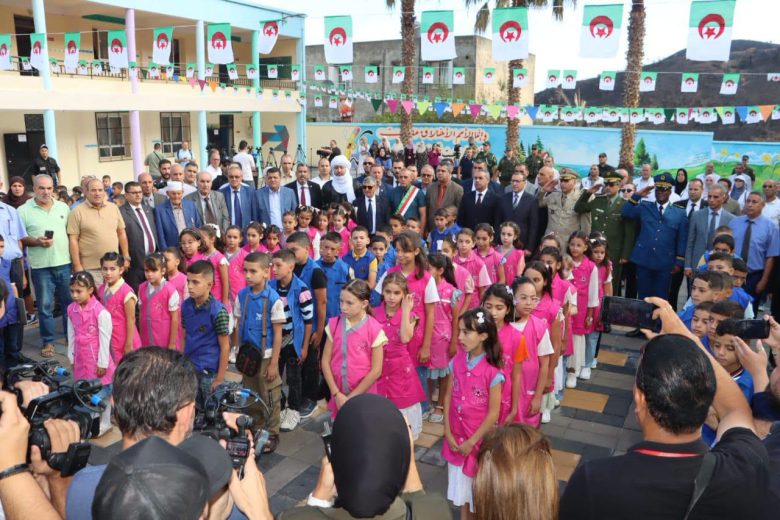
Mohamed Seghir Saadaoui, Minister of National Education, officially launched the 2026/2027 academic year on Sunday from Jijel, marking the return of 12 million students nationwide. This new academic session centers around major structural projects focused on instructional support, innovation, culture, digital technology, and foreign language proficiency, aiming to prepare youth for upcoming scientific and technological challenges.
The primary project directly addresses strengthening pedagogical and administrative supervision. Alongside waves of teacher recruitment and professional examinations designed to reinforce school management, the new framework introduces significant progress by establishing a dedicated educational support role in primary schools. These specialists in sociology, psychology, and educational sciences will closely assist students, providing specialized guidance considered essential for deepening children’s foundational learning.
The second initiative highlights creativity through the second edition of the national school innovation competition. The ministry strongly encourages educators and their classrooms to engage in this event to turn inventive concepts into actionable projects. Building upon the success of the previous edition, particularly in robotics, the goal is to guide promising ideas toward commercial realization. This assistance will pass through the Ministry of National Education’s incubator via the National Institute for Educational Research before connecting with startup dedicated structures.
In a similar vein, the third event features the second edition of the national inter-high school contest, structured as a premier platform for student preparation ahead of critical national exams. Lastly, the fourth focal point reflects a drive to enrich school life through the creation of a national school theater competition. This cultural initiative will provide students with an artistic channel, culminating in a major end-of-year showcase.
Protecting schools from external interference
This deep instructional overhaul coincides with an imperative to preserve the educational environment. The minister stressed the importance of refocusing schools on their primary mission by shielding students from outside disruptions that could hamper concentration or official curriculum delivery. In this context, a close partnership with parents is reaffirmed, viewing families as vital links ensuring educational continuity between school and home.
The academic domain prioritizes futuristic subjects. Computer science coursework now integrates advanced concepts such as artificial intelligence and cybersecurity. Concurrently, modern language instruction receives broader backing. Beyond English, whose standing is further elevated, proficiency in languages like German, French, Spanish, and Italian is actively encouraged to equip students with tools vital for navigating an interconnected global landscape.
Jijel, a return marked by resilience
Selecting the province of Jijel to host the official kickoff carries significant symbolic weight. Impacted by recent wildfires that damaged several educational facilities, the region benefited from widespread mobilization across authorities and public institutions to restore schools within required timeframes. Beyond logistical performance, the ministerial presence served to honor community solidarity extended to affected families and children.
In that same spirit, the inaugural lesson of this academic term addressed the deep connection linking environmental conservation and public health. This topic resonated powerfully in Jijel, where forest fire disasters served as a poignant reminder of how environmental degradation impacts daily living conditions and public well-being.
In closing, Mohamed Seghir Saadaoui called upon the entire educational community to unite around the best interests of students. Characterizing this school year as a period of challenge and perseverance, he set a resolute tone to transform this academic term into a decisive milestone for the success and personal development of Algerian youth.