

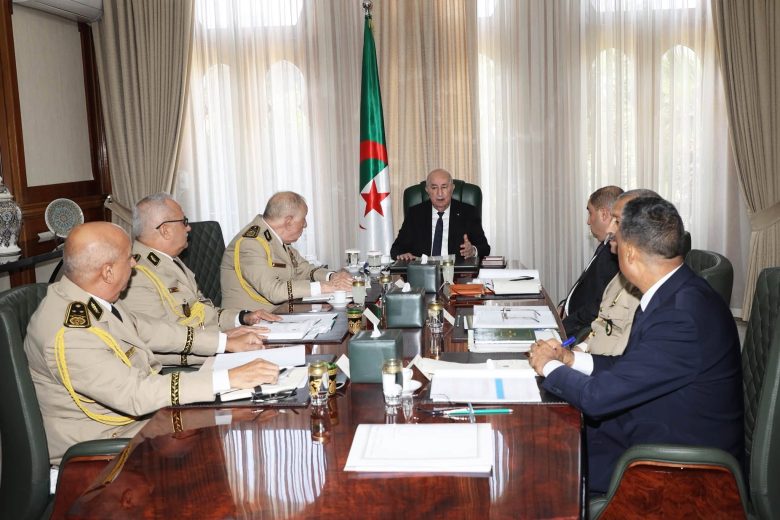
President of the Republic Abdelmadjid Tebboune chaired Tuesday a working session of high strategic importance. This meeting was entirely devoted to evaluating progress on converting the military barracks located in the deep Tanezrouft desert into a high-security penal facility. This closed structure will be exclusively reserved for incarcerating narco-trafficking barons, major hard-drug kingpins, and psychotropic substance distribution networks.
According to an official statement from the Presidency, this security and judicial arbitration session brought together key state figures, including General Saïd Chengriha, Minister Delegate to the Minister of National Defense and Chief of Staff of the National People’s Army (ANP), Lotfi Boudjemaa, Minister of Justice, Keeper of the Seals, alongside senior military commanders and the Director General of Prison Administration. Priority discussions focused on verifying technical and logistical setups, transferring the military site under the exclusive authority of the Ministry of Justice, and establishing a timeline for its imminent operational launch.
The geographical placement of this infrastructure was deliberately chosen. Located in southwestern Algerian Sahara, the Tanezrouft is historically known as the “land of terror” or the “desert of deserts.” Defined by extreme temperatures, complete absence of flora, dense sandstorms, and total geographic isolation hundreds of kilometers away from any urban center, this territory offers impassable natural barriers.
For authorities, establishing this maximum-security detention center fulfills a doctrine of complete isolation. The goal is to permanently cut ties between transnational crime leaders and outside accomplices. Within this airtight setting, inmates will be stripped of all clandestine communication methods, neutralizing their ability to manage supply lines, handle financial flows, or order criminal actions from inside their cells.
This extraordinary executive decision arrives amid an unprecedented crackdown on organized crime, with the city of Oran emerging as a primary battleground. As a major economic and maritime hub in western Algeria, the regional capital witnessed a massive operation on August 25, now dubbed “Algeria Gate.”
That day, Oran security forces and the Research and Intervention Brigade (BRI) dealt a heavy blow to hard-drug networks by intercepting a truck carrying a massive haul of 228 kilograms of pure cocaine. Although the driver initially fled during the inspection, investigators quickly tracked down the logistical ring. Following thorough inquiries, 20 individuals belonging to this syndicate were arrested, while 46 luxury and transport vehicles of various makes—used to move substances or cover operations—were immediately impounded under court order.
Financial Probe and the Role of Influencer “Chouchou”
Beyond the impressive volume of intercepted drugs and regular seizures of psychotropic pills (notably Pregabalin and Ecstasy) across the area, the “Algeria Gate” case unveiled a criminal syndicate possessing a complex financial design. The judicial dossier opened by Algerian courts goes well beyond standard charges of illicit import, possession, transport, and storage of narcotics within an organized transnational ring; it now centers heavily on money laundering and financial crime.
The declared objective for investigators is to strike at the financial backbone by tracing the origin of capital and how narco-profits were funneled into the legitimate economy. Real estate assets, business investments, bank movements, and the suspects’ lifestyles are undergoing detailed forensic audits.
Within this financial angle, media and legal focus zeroed in on the arrest of a social media influencer known online as “Chouchou,” identified by matching sources as Hammadi Chahrazed. Her inclusion among those prosecuted or detained in this judicial inquiry raised widespread questions. Widely followed across digital platforms, displaying a opulent lifestyle, and traveling frequently between Algeria and abroad, her suspected role is under detailed scrutiny to determine whether her public image, accounts, or activities served as a front or conduit to move and legitimize illicit funds. Authorities emphasize, however, that her arrest forms part of a strict judicial procedure where the presumption of innocence applies until a final verdict.
Morocco and the United Arab Emirates as Axis of Harm
For Algeria’s military command and legal apparatus, this influx of hard drugs, cannabis, and synthetic pills exceeds basic street crime; it is categorized as a direct threat to national security and societal stability. Algiers openly denounces the involvement of international networks and regional players accused of deliberately feeding this destabilizing flow.
On one hand, Morocco remains cited in international security dossiers as the primary source country for cannabis resin (charras), brought in by the quintal across western land borders despite monitoring systems, trenches, and heightened ANP border guard deployments. On the other hand, recent probes by intelligence services and financial squads point toward offshore laundering circuits and logistical hubs, specifically citing established branches in the United Arab Emirates. According to investigative elements, Dubai is identified as a major hub for managing illicit financial transactions, moving suspicious capital, and remotely orchestrating synthetic psychotropic supply lines targeting North Africa.
By finalizing the transfer of drug lords, covert criminal financiers, and kingpins to the isolated stronghold of Tanezrouft, the Algerian state reinforces a zero-tolerance stance, combining strict physical isolation in the desert with the complete stripping of fortunes built on narcotics trafficking.