

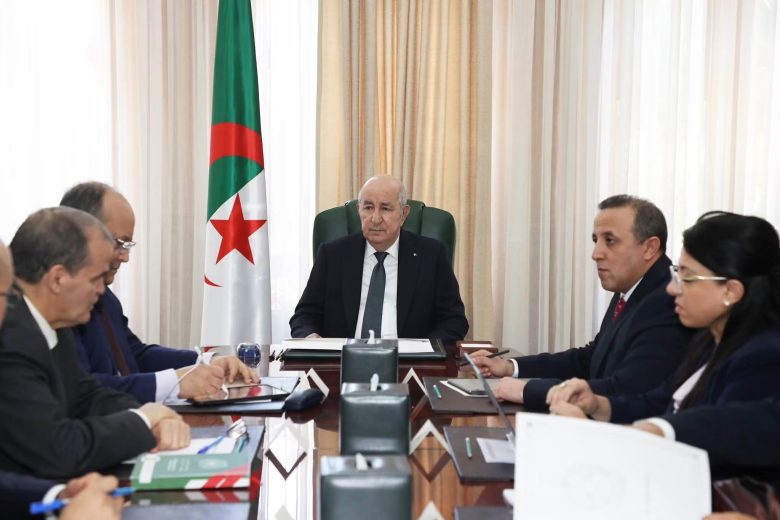
Facing the exposure of massive irregularities in import filings, the head of state urgently assembled the cabinet to thwart what resembles a deliberate attempt to deplete foreign exchange reserves. Digital data processing uncovered thousands of micro-ventures claiming colossal amounts completely out of touch with their actual capacities. A broad ministerial probe and thorough audits are now underway to dismantle these syndicates and permanently clean up foreign trade.
The response from the highest echelon of government came without delay. Upon discovering a staggering $130 billion in import applications clearly disproportionate to the applicants’ profiles, President of the Republic Abdelmadjid Tebboune summoned an emergency meeting this Monday at El Mouradia Palace.
Around the table, the Prime Minister and key cabinet officials received firm instructions to address this strategic issue without compromise, safeguarding economic sovereignty and public finances.
According to an official presidential statement, this emergency session aims to unpack the mechanics of these drastic anomalies and launch uncompromising prosecutions against false declarants. The administration labels the plot a targeted effort to drain state treasury funds and undermine the national economy through illegal capital flight.
This top-level mobilization stems directly from red flags raised during the data review of the provisional import program’s digital platform. The Ministry of Foreign Trade detected an unjustified financial sinkhole: over $130 billion requested by a handful of entities consisting, at best, of a few employees.
Automated statistical cross-referencing quickly unmasked obvious fraudulent tactics, including the repeated submission of identical files to multiply currency allocations. In total, 3,961 micro-enterprises sit at the heart of this scandal. The breakdown of claimed amounts by workforce size highlights the sheer extravagance of the fraud: 149 entities reporting zero declared employees sought to import $484.58 million worth of goods. Even more alarming, 949 single-employee operations claimed an astronomical $21.84 billion. The height of absurdity belongs to 851 two-employee firms whose combined claims reached $88.76 billion. Finally, three-employee businesses (722 operators) requested $15.52 billion, four-employee outfits (641 operators) sought $1.74 billion, and five-employee entities (649 operators) applied for $13.84 billion.
These immense discrepancies between projected transaction volumes and actual physical or human resources reveal a clear intent to siphon funds.
Analyzing this anomaly, economist Brahim Guendouzi notes that procedural digitization acted as a vital filter, exposing practices detached from basic economic logic and real supply chain needs. The expert recalled that the country generates $39 billion to $40 billion in exports, while actual import levels already exceed foreign sales by 20% to 30%.
Approving these unrealistic requests would have meant consuming double the nation’s current foreign exchange reserves.
Determined to shed light on these abuses, the Ministry of Foreign Trade is deploying a comprehensive audit across all relevant government departments.
This detailed scrutiny will cover raw material supplies, equipment, and production inputs imported during the first half of 2026, while extending retroactively to prior fiscal years. Investigators will thoroughly examine the exact match between declared business activities, import volumes, actual payrolls, and real economic output on the ground.
As a formal warning, the ministry emphasized that provisional forecasting cannot serve as a pretext for wild speculation. Strict compliance is now the mandatory standard, and the findings of this nationwide audit will trigger exemplary administrative and legal penalties against all offenders, in full accordance with state laws.