

Once again, the dubious and sinister tactics of the Moroccan regime were unveiled Monday in a explosive investigation published in Spain by the media outlet Infobae. The report, conducted by journalist David Fernandez, shines a spotlight on numerous compromising files implicating the Rabat regime in an aggressive strategy against neighboring nations, including Algeria and Spain.
Large-scale drug trafficking, weaponizing migrants as political and diplomatic leverage, electronic espionage, and various other tactics have become the trademark of the Makhzen—following recent corruption scandals involving European lawmakers and attempts to buy votes from African delegations during African Union assemblies.
The investigation draws on security and intelligence sources, alongside official records and investigative work by multiple journalists exposing the covert activities of the Moroccan administration globally.
Titled “Morocco: A Story of Spies, Hackers, Waves of Migrants, and Thousands of Tons of Hashish,” the report details a strategy of pressure and coercion targeting foreign politicians, diplomats, business figures, intellectuals, civil society advocates, and non-governmental organizations.
According to the article, Moroccan intelligence services launched 768 electronic attacks targeting 250 Spanish phones between May 2018 and June 2019 using the Pegasus spyware suite developed by Israel. These intrusions targeted Spanish executive officials and high-ranking security personnel collaborating with Rabat on counterterrorism, narcotics control, and irregular migration.
Among the victims was Spanish Colonel Alberto Aguilera, whose phone was targeted five times while he served as Interior Attaché at the Spanish Embassy in Rabat and assisted in establishing the Spanish-Moroccan Police Cooperation Center in Tangier. The action was described as a betrayal that highlights long-standing patterns within the Moroccan regime.
Another target was journalist José Bautista, a contributor to the Forbidden Stories investigations that uncovered espionage operations dating back to 2014.
Beyond systematic cyberespionage and hacking operations, the Rabat administration has repeatedly exploited another lever: cannabis. Industrial drug trafficking has been central to its strategy for decades, targeting all of Europe and Algeria. Citing anti-narcotics personnel, Infobae indicates that over 70% of cannabis entering Europe originates from Morocco. The volume of seizures by Madrid illustrates the danger: in 2025 alone, Spanish authorities intercepted nearly 260 tons of cannabis, marking a 29% increase from the previous year.
Orchestrated from within Morocco, this trade is protected and structured by Moroccan authorities, demonstrating links to cross-border criminal networks involving officers of the Moroccan Royal Gendarmerie and intelligence agencies.
In 2019, the report notes that Madrid notified Rabat that seven senior Royal Gendarmerie officials were suspected of collaborating with criminal groups involved in drug trafficking and illegal immigration. The Makhzen responded by promoting these officials to higher ranks, where they remain active.
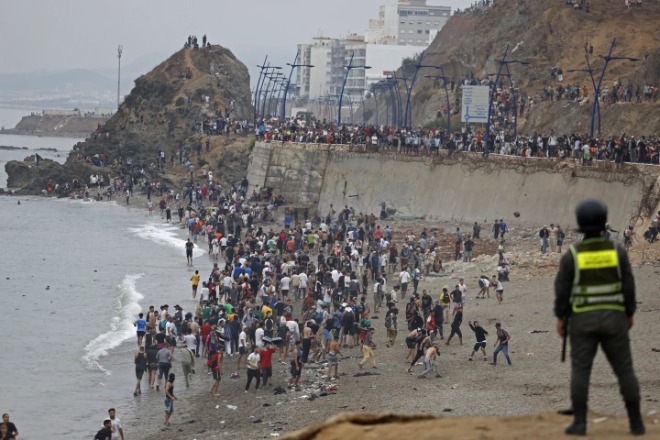
Irregular migration serves as another instrument of pressure. The orchestrated entry into Ceuta confirmed Spanish suspicions. Last July, over 80,000 migrants reached the enclave within two days, facilitated by Moroccan services through online campaigns, social media promotion, and deliberate loosening of border surveillance.
The investigation cites sources from Frontex, the European Border and Coast Guard Agency, who assess that Rabat uses migration to create regional instability and exert geopolitical pressure on European Union nations. Through the exploitation of Moroccan and sub-Saharan migrants, Rabat seeks to extract diplomatic concessions—particularly regarding Western Sahara—and financial compensation.
This multifaceted strategy highlights the gap between Rabat’s official rhetoric and its covert actions, confirming findings from independent international reports.