

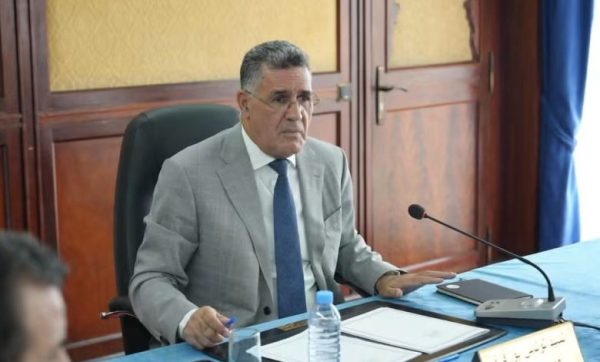
During a working visit to the province of Saida on Friday, Water Resources Minister Lounes Boughezza urged officials to expedite local development initiatives and strictly adhere to scheduled deadlines. He emphasized improving regional management and strengthening water infrastructure to ensure long-term public supply.
The minister reviewed a status report on the regional water sector presented by the local industry director. The detailed assessment covered water reserves, drinking water delivery, sanitation services, and agricultural irrigation.
Saida province depends entirely on underground water reserves, tapped through 156 boreholes and five natural springs. Daily output reaches roughly 98,700 cubic meters, surpassing the estimated daily requirement of 90,957 cubic meters.
Coverage rates for drinking water supply and sewage disposal stand around 98 percent. Storage capacity totals 135,140 cubic meters, supported by 14 operational wastewater treatment plants processing approximately 24,667 cubic meters daily.
For agricultural irrigation, arable farmland spans 307,000 hectares, with nearly 27,500 hectares currently irrigated.
In his address, Boughezza called for enhanced municipal administration, increased storage capacity, crackdowns on illegal connections, universal meter installation, rapid pipe repairs, and comprehensive network overhauls.
He further directed authorities to supply regional facilities with vital equipment and replacement parts to guarantee uninterrupted service and rapid repairs during outages.
Reclaiming treated wastewater emerged as another priority. The minister advocated expanding tertiary treatment and upgrading facilities to broaden irrigated zones and establish new farm areas supplied by recycled water.
A 1,000-Cubic-Meter Reservoir to Boost Water Supply
During the second leg of his inspection tour, the minister inspected the construction of an elevated water tower holding 1,000 cubic meters and standing 45.6 meters high.
The project encompasses connections to main supply lines, distribution network links, structural protection features, and site landscaping.
The structure aims to expand storage capacity and elevate drinking water delivery, particularly for elevated neighborhoods. It will also supply secure access to nearly 3,900 residents in northeastern Saida.
On site, the minister ordered accelerated completion to bring the facility online as soon as possible, targeting better water reliability and expanded storage capacity in the neighborhood.
Finally, Boughezza reiterated the drive to build and reinforce water mobilization assets to secure sustainable supply and fulfill long-term population requirements.