

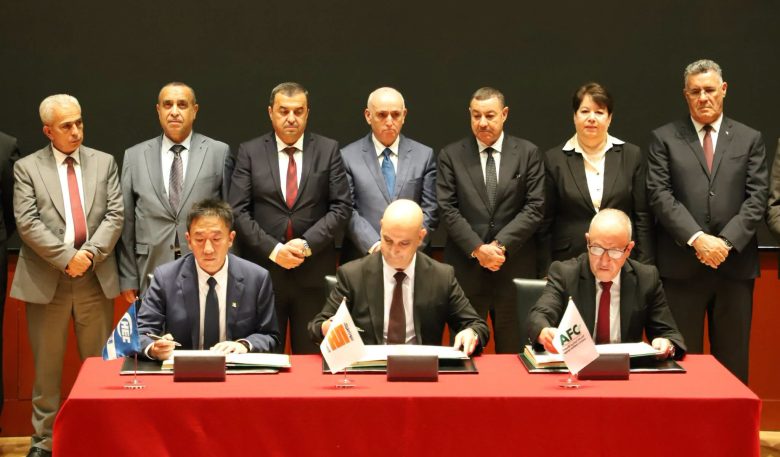
The integrated phosphate project is advancing rapidly. The Sonatrach group executed two strategic contracts on Tuesday designed to propel this large-scale venture—one with a Chinese corporation and the other with an Italian entity—the Algerian group announced in an official statement.
The signing ceremony was chaired by Minister of State and Minister of Hydrocarbons Mohamed Arkab alongside several cabinet members. The initial agreement involves completing port infrastructure in Annaba, finalized between Sonatrach Group and China Harbour Engineering Company (CHEC). The second contract covers the completion of processing facilities for the integrated phosphate scheme across sites at Bled El Hadba in Tebessa province and Oued El Kebrit in Souk Ahras province, sealed between Sonatrach and Italian firm SAIPEM under an accelerated EPC delivery model, the same source specified.
During his address on this occasion, Arkab stated that signing these agreements represents a genuine shift toward field implementation for one of Algeria’s largest structured mining and industrial initiatives. He noted it embodies the directives of President Abdelmadjid Tebboune aimed at upgrading national natural resources, boosting local production, and establishing a high value-added processing industry.
Arkab added that the project serves as a cornerstone of Algeria’s strategy to diversify the national economy, given the vast phosphate reserves in the eastern phosphate basin and the integration of these raw materials with national natural gas capacity. According to the minister, this synergy enables the creation of an integrated industrial supply chain producing fertilizers and related chemicals to satisfy domestic market demands while stimulating non-hydrocarbon exports.
The undertaking rests on integrating four primary components: the Bled El Hadba phosphate mine, phosphate beneficiation plants, the Oued El Kebrit chemical processing complex, and logistical infrastructure—specifically expanding Annaba port facilities and the rail transport network—to guarantee integrated transport management for raw materials and finished products toward domestic and international markets.
In this context, the minister highlighted that adopting a Fast Track format aims to shorten completion timelines under an ambitious schedule, enabling the rollout of enriched phosphate production in the first quarter of 2027, followed by the fertilizer manufacturing phase during the fourth quarter of the same year.
He also emphasized that the project will bolster national food security by supplying various phosphate and nitrogen fertilizers, alongside generating substantial added value, creating thousands of direct and indirect jobs, and supporting economic and social development across eastern provinces.
Concurrently, the project fits within an integrated vision targeting the development of national mineral resources and related processing industries, allowing Algeria to transition from exporting raw materials to manufacturing and marketing high value-added industrial goods while reinforcing its standing across regional and international fertilizer and chemical markets.
Concluding the ceremony, Arkab commended the level of cooperation with Italian and Chinese partners in executing these projects, stressing that Algeria seeks through these partnerships to build balanced cooperation founded on technology transfer, knowledge exchange, national skill development, and local content expansion to serve mutual interests and enhance Algeria’s appeal for major industrial investments.