

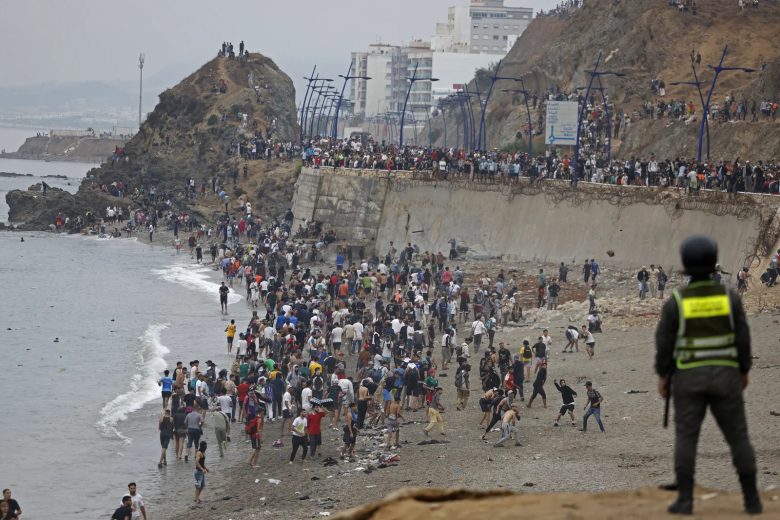
Spain is on high alert. Serious intelligence is circulating within the country indicating that a new surge of Moroccan migrants is being organized for mid-August, directly targeting the enclave of Ceuta as a primary objective. While the situation remains chaotic following the presence of thousands of migrants—including numerous minors—on Spanish soil, news of an impending wave is fueling widespread public concern, even as the government dispatches reinforcements and raises alert levels along the entire land and maritime boundary with Moroccan territory.
According to investigations by Spanish television, the Civil Guard is actively probing the coordination of another mass crossing into Ceuta. The RTVE Data team analyzed 6,000 WhatsApp messages, revealing that several target dates are being considered for the attempt, notably August 15 and subsequent days.
For Spanish analysts, the threat is concrete and raises major questions regarding the Makhzen’s role in this migratory escalation and the future of its bilateral relations with Spain. Multiple political parties have voiced sharp criticism over Madrid’s policy of appeasement, demanding a firm stance against recurrent blackmail from Rabat.
The former director of the Spanish National Intelligence Center (CNI), Jorge Dezcallar, stated that “Morocco must be handled with firmness and clear boundaries must be set,” because “Rabat interprets our friendly stance as weakness, which is unacceptable.”
In public statements, Jorge Dezcallar noted that the scenario of a renewed attempt against Ceuta on August 15 appears plausible given emerging intelligence. He observed that the full truth behind these maneuvers remains undisclosed due to conflicting reports, though he expressed confidence that judicial proceedings will bring facts to light, adding that the CNI maintains deep operational insight into Morocco.
He further noted that “70,000 individuals do not move without attracting notice,” arguing that the crisis remains unresolved despite many recent arrivals returning home. Around 2,000 migrants remain, including many unaccompanied minors, creating friction between the government and opposition parties.
When asked how Spanish intelligence should respond, the former intelligence chief remarked that “the National Intelligence Center is doing what it must: maintaining silence. But the truth will ultimately emerge.” He recalled that 12,000 people breached Ceuta in 2021—a severe failure—and stressed that repeating such an episode would be “far more grave.”
According to Dezcallar, the situation is “unacceptable. If we do not implement strict measures, this will happen again. Morocco will not relinquish its claims on Ceuta and Melilla, even though Spain’s economic output is eight times larger than Morocco’s.”
Finally, Jorge Dezcallar expressed support for King Felipe VI’s stance that such incidents must never recur. He emphasized that the monarch should show solidarity with citizens facing hardship, just as he did during Storm Dana and the forest fires. He considers such actions well within royal prerogatives rather than a critique of the sitting government.
For Jorge Dezcallar, Morocco pursues distinct regional objectives and leverages them strategic advantage. He warned that similar episodes will recur because Morocco holds pressure points and uses them effectively, while Madrid pursues “a policy of appeasement, if not weakness.” He concluded that Spain must “treat Morocco firmly and establish limits, otherwise we appear to possess no leverage whatsoever.”