

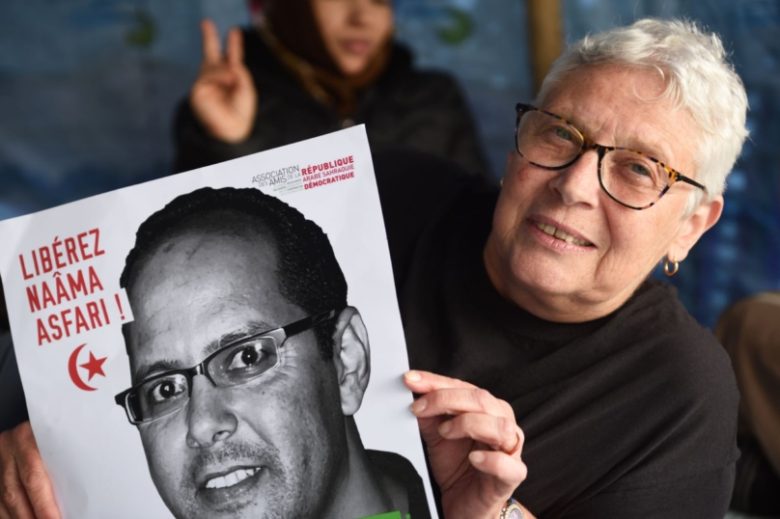
Arbitrarily jailed for fifteen years in Morocco and subjected to intolerable treatment by Moroccan prison authorities, the life of Sahrawi political prisoner Naama Asfari hangs in the balance. Entering the 37th consecutive day of his open-ended hunger strike, the Sahrawi detainee’s health is rapidly failing, triggering an outpouring of regional and international solidarity. His ordeal has sparked a diplomatic standoff, culminating in the launch of a global petition demanding immediate United Nations intervention to save his life.
Dubbed the “strike of dignity,” Asfari’s hunger strike is generating deep concern abroad, prompting action from diplomats, lawmakers, academics, and key political figures.
A detailed report on the plight of Asfari and his fellow Gdeim Izik group members was released two days ago by the National Coordination Mechanism for Human Rights Action. According to the document, Asfari, currently held in isolation at the Kenitra prison clinic north of Rabat, suffers from severe exhaustion that threatens his vital organs. He has reportedly lost over nine kilograms since the start of his protest.
The same source notes that in response to the prison administration’s dismissive attitude toward his grievances, Mr. Asfari has rejected further medical examinations and health monitoring, choosing to remain in his cell.
This report highlights a sprawling campaign of solidarity within Moroccan penitentiaries led by the 19 members of the Gdeim Izik group, who are serving terms ranging from 20 years to life based on confessions obtained through torture.
Meanwhile, global pressure continues to intensify. Rallies of solidarity are multiplying across Spain, Latin America, and Europe. Formal appeals have been sent to the UN Secretary-General, the UN High Commissioner for Human Rights, the UN Personal Envoy for Western Sahara, Staffan de Mistura, and the International Committee of the Red Cross. These pleas demand the dispatch of independent fact-finding missions and measures to secure the safety of Sahrawi civilian prisoners, who have faced brutal repression and systematic rights violations following highly flawed, sham trials.
In Algeria, the Association of Sahrawi Journalists and Writers in Europe and the Network of Algerian Journalists in Solidarity with the Western Sahara Struggle expressed deep anxiety on Wednesday regarding the failing health of the Sahrawi civilian captive, Naama Asfari.
In a joint statement, both organizations emphasized that the activist’s condition “is worsening under the silence of the occupying authorities, who bear full responsibility for his plight.” They urged the United Nations and global human rights bodies to intervene immediately. They also pressured these institutions to “force the Moroccan occupying state to grant the immediate release of Sahrawi detainee Naama Asfari, his Gdeim Izik comrades, and all other Sahrawi civilian prisoners held in the occupying state’s jails.”
Furthermore, the European-based Sahrawi journalists’ association and the Algerian media network are calling on all journalists, media professionals, and human rights defenders to redouble their efforts in raising awareness about Asfari’s ongoing hunger strike.
They urge advocates to amplify his voice to the global public by publishing and broadcasting solidarity messages across national and international media outlets, digital platforms, social networks, and all available forums.