

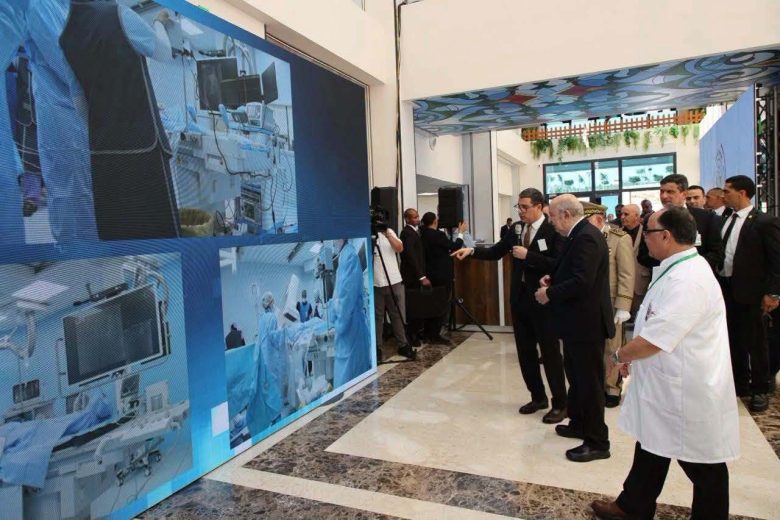
Pediatric cardiology, cellular therapy, biomedical research… The brand-new infrastructures, inaugurated two days ago by the President of the Republic, Abdelmadjid Tebboune, represent a major contribution to the public health sector and the development of advanced medicine in Algeria. This was confirmed Monday to Le Jeune Independant by two specialists from the field. However, they believe that this qualitative leap must be accompanied by a sustained effort in training, research, and accessibility so that these breakthroughs benefit the largest number of people.
These two facilities have sparked widespread enthusiasm within the medical community. On one hand, a hospital entirely dedicated to childhood heart diseases is set to significantly reinforce national capabilities in a specialty where needs continue to grow. On the other hand, the laying of the first stone for an institute focused on cellular and gene therapy—a rapidly expanding discipline—opens unprecedented perspectives in treating numerous illnesses, particularly cancers and genetic pathologies. For specialists, these two projects reflect a profound evolution in healthcare policy, which is now increasingly oriented toward innovation, biomedical research, and biotechnology.
The president of the National Council of the Order of Physicians, Dr. Mohamed Bekkat Berkani, stated that these achievements represented far more than just new hospital equipment, emphasizing that “these are cutting-edge institutions that bring a tremendous amount to the practice of specialized medicine in our country. We were sorely lacking this type of facility.” He also explained that medicine is currently experiencing growing specialization, illustrated notably by progress in interventional cardiology, specifying that “we are now talking about highly specialized techniques and increasingly targeted treatments. This evolution requires adapted frameworks and very high-level equipment.”
Dr. Berkani noted that the opening of a facility completely committed to pediatric cardiology responded to a strong demand expressed for several years, asserting that “the more specialized the structures are, the better the care for children suffering from cardiac pathologies.”
The specialist recalled that the capacity of existing facilities had become insufficient to cope with rising demands. He also highlighted the progress made in prenatal screening for cardiac malformations, allowing for earlier management. “The earlier anomalies are detected, the greater the chances of successful treatment. That is the whole point of having highly specialized hubs,” he argued.
==Training Tomorrow’s Talent
In addition to patient care, the council president insisted on highlighting the significance of continuous training and scientific research. “Techniques evolve very quickly. We must train specialists capable of mastering these new approaches,” he assured, welcoming the integration of spaces dedicated to teaching within the new facility.
Dr. Berkani also praised the launch of the future Algerian Institute of Cellular and Gene Therapy, which he considers a strategic investment. “Medicine is becoming increasingly precise. It is now looking at the cell itself to understand the mechanisms of diseases and intervene much earlier,” he explained.
He recalled that research in this field opened promising horizons, particularly in the fight against cancers. “The great challenge today is to understand cellular mutations and genetic abnormalities in order to further develop prevention. This is the medicine of tomorrow,” he stressed.
The specialist nevertheless believed that this dynamic should be extended across the entire national territory, stating: “I hope similar structures will emerge in Oran, Constantine, and the southern provinces to avoid a concentration of patients in the central region.”
For his part, Dr. Fethi Benachnou, a public health physician, shares this analysis. He describes these two new infrastructures as an “important asset” for the national health system, believing they reflect Algerias determination to invest in advanced medical technologies.
The practitioner reminds, however, that these breakthroughs must above all benefit all citizens. “Advanced medicine and scientific progress constitute a major step forward for Algeria. But we must primarily think about their accessibility. The priority remains the population, particularly the most vulnerable individuals,” he emphasized.
Recalling Algerias pioneering role in the promotion and advancement of public healthcare, he believes that the success of these investments will depend as much on their technological excellence as on their capacity to concretely improve patient care. “It is important that this momentum continues by balancing medical innovation and equal access to healthcare,” he insisted.
For both specialists, these projects mark a significant milestone in the modernization of the healthcare system. However, they believe that their success will rest on several conditions: training more specialists, strengthening biomedical research, developing similar facilities in different regions of the country, and guaranteeing equitable access to highly specialized care. The real test will thus be to turn advanced medicine into a sustainable lever for improving patient care to serve all citizens.