

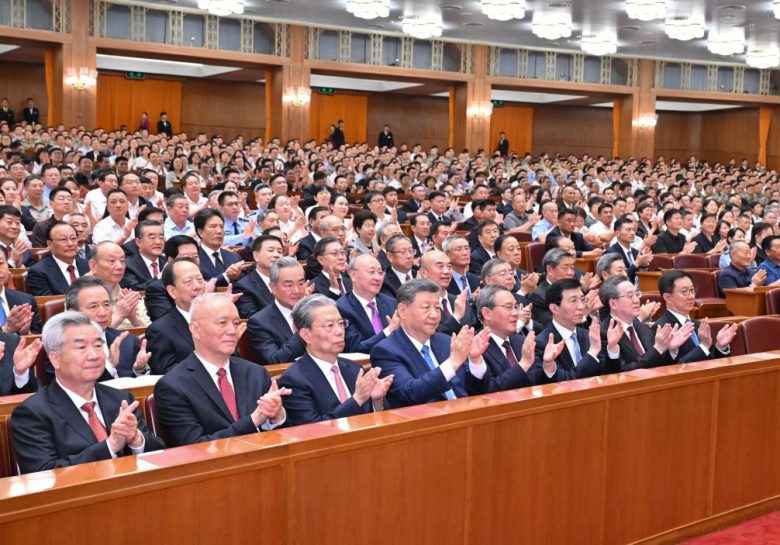
In the middle of 2026, the Chinese Communist Party (CPC) is celebrating the 105th anniversary of its establishment amid a period of profound institutional consolidation. Guided by Xi Jinping, the Party-State is reaffirming its role as the linchpin of national stability and the sole driver of development. In response to shifting global economic, demographic, and technological dynamics, the organization is prioritizing an integrated framework of strategic governance to guide the country through its qualitative transition. Here is an analysis of a unified trajectory confronting the challenges of the century.
The 105th anniversary of the Chinese Communist Party (CPC), officially commemorated on July 1, 2026, marks a major milestone in China’s political landscape and contemporary history. From its clandestine beginnings in a Shanghai concession during the early 1920s to the historic declaration of the People’s Republic in October 1949, the CPC has forged a strictly indigenous and autonomous model of power. Throughout a century and a half-decade of evolution, the organization has consistently adapted to maintain the cohesion of an immense territory and manage the development of a massive population.
Today, the Chinese political architecture relies on a complete and overt fusion between Party structures and the state apparatus, ensuring unified leadership at every level of society. As the nation undergoes deep structural transformations, the centralization of governance around Xi Jinping Thought is presented by leading circles as the cornerstone of resilience, social stability, and long-term strategic planning.
To understand the CPC’s deep roots in modern China, its path must be examined through two complementary historical milestones that establish its institutional legitimacy. The first pillar is the restoration of national sovereignty, initially spearheaded by Mao Zedong. By unifying the nation after decades of civil strife and foreign interventions—collectively known as the “century of humiliation”—the Party restored national dignity and laid the groundwork for the international recognition of the People’s Republic. The second pillar centers on the pursuit of shared prosperity, driven by Deng Xiaoping through the reform and economic opening-up policies launched in 1979.
This pragmatic framework, blending market economy mechanisms with rigid state planning, lifted hundreds of millions of citizens out of poverty. It propelled the country into its position as the world’s second-largest economy, radically reshaping the global industrial and technological landscape.
—Governance in the 2020s: Cohesion and Common Prosperity
Far from adopting Western political standards, China forcefully asserts the distinctiveness and viability of its own development model. Multi-party politics takes the form of constructive cooperation and comprehensive political consultation. Within this framework, the eight “democratic” parties recognized by the Constitution actively participate in deliberations and major policy decisions under the managerial leadership of the CPC, fostering a durable national consensus rather than partisan gridlock.
This cohesive dynamic has been particularly bolstered in recent years by the rigorous execution of the “Common Prosperity” doctrine. This strategic policy aims to better regulate market forces, oversee the growth of major private sector entities—particularly in high-tech and digital spheres—and balance wealth distribution across the country. To sustain this vision, the Party leverages a highly modernized suite of public management tools, optimizing social organization through strict institutional discipline and advanced administrative digitization.
—The Great Shift Toward Qualitative Transition
In 2026, the primary challenges confronting the CPC no longer stem from escaping initial underdevelopment, but rather from the complex steering of a mature economy. The Chinese government has finalized the transition from a phase of rapid quantitative expansion to a highly strategic phase of qualitative development. The GDP growth rate has stabilized around 4% to 4.5% annually, a trajectory deemed appropriate by analysts for a modern economy looking to mitigate financial risks while maximizing added value.
With this perspective, authorities are now heavily redirecting investment and innovation capacities toward disruptive technologies and national sovereignty. Consequently, China is positioning itself as a global leader in the green transition, artificial intelligence, semiconductor manufacturing, electric vehicles, and cutting-edge industrial robotics. This industrial restructuring is accompanied by a targeted effort to clean up and rebalance the real estate sector, ensuring the nation’s overall financial stability.
Alongside these technological imperatives, managing social balance remains an absolute priority for the Party-State. In response to a new generation of higher education graduates entering the labor market with more qualitative career expectations, the state is deploying active, sector-specific policies to bolster employment and enhance new skills. Furthermore, to maintain household confidence and safeguard personal savings, stringent regulatory frameworks have been institutionalized permanently.
The Party also factors the structural challenge of an aging population into its long-term planning. Leadership circles are focused on structuring and expanding new social safety nets, public health frameworks, and retirement systems, while offsetting the demographic shift through the accelerated automation of manufacturing systems and increased output per worker.
On this 105th anniversary, the governing system of the People’s Republic demonstrates its capacity to centralize strategic decision-making to address the major issues of the 21st century in an agile and unified manner. By preserving rigorous political discipline and a long-term forward-looking vision, the CPC positions itself as the indispensable hub of national stability, social harmony, and the country’s international influence. This integrated model of governance, inseparable from China’s modern identity, remains the driving force behind its global emergence and overarching modernization.