

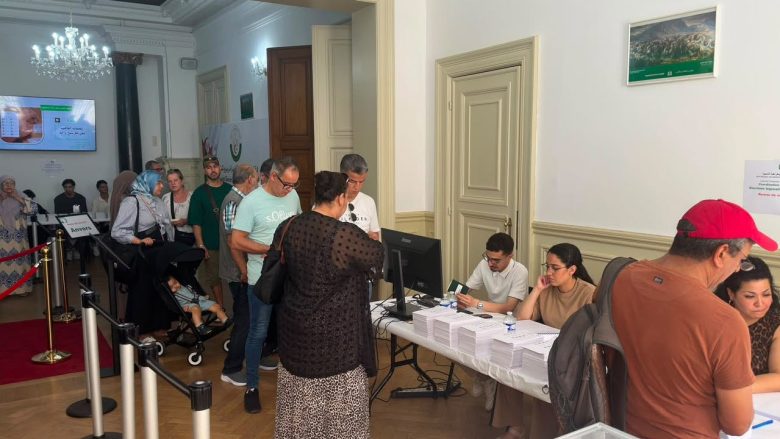
With only two days remaining before the legislative vote on July 2, the expatriate community is actively maintaining its engagement in the balloting process across various nations. In multiple countries, overseas Algerians are fulfilling their civic responsibility under organizational frameworks described as highly efficient, illustrating their deep allegiance to domestic institutions and their determination to help choose future lawmakers for the National Peoples Assembly (APN).
In Spain, where balloting enters its third straight day, polling stations report a consistent stream of citizens arriving from the overseas community. At the Algerian consulate in Alicante, a significant volume of voters converged to select their legislative representatives.
Mustapha Yettou, the local coordinator for the Independent National Authority for Elections (ANIE) in Alicante, confirmed that “the voting operations are progressing under normal conditions, in full alignment with statutory provisions and effective regulations.” He highlighted that polling stations opened precisely as scheduled, adding that “every necessary human asset and material resource has been deployed to guarantee that citizens can exercise their franchise under optimal conditions.”
He further emphasized that administrative teams are continuously overseeing the operations across all stations to rapidly address any eventual discrepancies and preserve the absolute transparency of the ballot.
The Algerian consulate in Alicante registers 10,306 eligible voters, distributed across seven specialized polling sites established in Alicante, Valencia, Murcia, Seville, Almeria, Malaga, and Castellon. Notably, the Algerian embassy in Spain also serves as the headquarters for the ANIE coordination unit overseeing the eighth geographical district for citizens abroad, a zone encompassing 19 diplomatic and consular stations across 14 sovereign states.
In Bulgaria, voting officially commenced on Tuesday morning at the Algerian embassy in Sofia. The diplomatic mission finalized all regulatory layouts to ensure standard operations and provide an ideal environment for voters to cast their ballots.
Marking the occasion, the embassy reiterated its call to Algerian nationals residing in Bulgaria to turn out in large numbers for this electoral milestone “with complete freedom and civic accountability.” The diplomatic office remarked, “Your participation stands as an ultimate expression of citizenship and a vital building block for the nations future.”
In France, the expat population extended its electoral mobilization on Monday, particularly throughout the designated voting facilities in Creteil and Vitry-sur-Seine. Right from the morning opening, numerous citizens arrived to carry out their civic obligations for the upcoming legislative renewal.
Despite the intense summer heatwaves currently moving across several French administrative zones, members of the Algerian diaspora arrived in force, re-anchoring their bond with their country of origin and demonstrating their intent to strengthen national institutions through the ballot box.
In Tunisia, the process carries a unique emotional resonance. Within the Algerian Consulate General in Tunis, the voting took place amid a wave of intense patriotic sentiment. Traditional celebrations, national banners, and warm interactions among expatriates transformed the election day into a genuine community celebration.
At this deeply historical venue, which once housed the Ministry of Armaments and General Communications (MALG) under the Provisional Government of the Algerian Republic (GPRA) during the Liberation War, many participants—frequently coming from third or fourth-generation Algerian families rooted in Tunisia—insisted on casting their votes.
Every participant affirmed that cross-generational timelines and geographic distance have done nothing to weaken their ties to Algeria. For the vast majority, casting a ballot goes far beyond a standard civic duty; it acts as a primary vehicle to safeguard their connection to the homeland and hand down this identity to upcoming generations.