

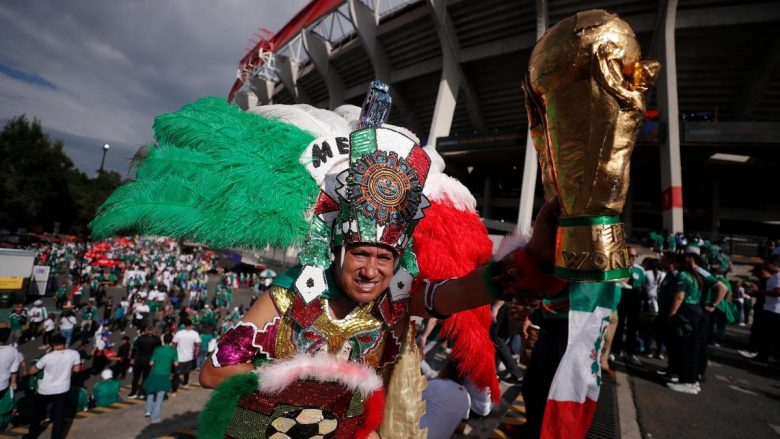
While the United States and Canada have been bogged down in logistical and administrative controversies since the start of the tournament, Mexico is delivering a masterclass in popular passion. Advancing from the group stage with a flawless record, El Tri has swept an entire nation into a festive celebration that leaves its two co-hosts looking pale by comparison.
Since the opening whistle, football has frequently been overshadowed by a relentless stream of arguments across the US and Canada. Disruptions caused by increasingly intrusive weather protocols, flight delays complicating travel for fans and official squads, visa anxieties for personnel from nations like Iran, Senegal, Haiti, Iraq, and the DR Congo, heavy-handed border checks, and political friction regarding immigration policies have routinely dominated the headlines. FIFA President Gianni Infantino and the organization’s aggressive ticketing rates have also drawn heavy fire. Conversely, Mexico has progressed with minimal drama, fueled by a domestic enthusiasm that continues to build. On the pitch and throughout the arenas, the nation appears to have remembered what a World Cup is truly about—a massive public celebration where the game remains the main attraction.
This stark contrast becomes even more evident as Mexico heads into the knockout stages brimming with absolute confidence. The home team wrapped up group play with a perfect nine points, dispatching the Czech Republic in a commanding (3-0) victory to secure the top spot in their bracket with ease. The momentum is so powerful that the excitement has transcended sports. Authorities in Mexico City have permitted remote work for various public employees on match days, while schools across the capital have paused classes so families can share in these historic moments. Such a move is unthinkable in territories treating the tournament with bureaucratic rigidity. While American media debates borders and stadium security, Mexico embraces the reality that a World Cup belongs to the streets. Across neighborhoods in Mexico City, Guadalajara, and Monterrey, residents setup televisions on sidewalks, string power cables, blast music, and assemble makeshift fan zones that feel far more authentic than official commercial venues. Street vendors hand out tacos, beers, aguas frescas, and tequila while children sprint by sporting green jerseys. Lucha libre wrestling masks frequently replace traditional banners, mariachis mingle with local DJs, and every goal triggers an uproar echoing across city blocks.
————A Unique Atmosphere Free from Drama
The true spirit of this World Cup is being kept alive precisely on these pavements. Stadium entry costs are completely out of reach for a vast segment of the local population, but this financial barrier has simply sparked a vibrant alternative display. “It is incredible here. Absolutely everyone is wearing the national team jersey. You see other team shirts too, but the green home jersey dominates, whether they are replicas, bootlegs, or authentic gear. Even on days when Mexico isn’t playing, every town has this unmistakable tournament buzz, with decorations lining the shops. There is an amusing detail: Mexico has a famous pharmacy franchise represented by a character named Doctor Simi—a heavy, elderly mascot who dances outside the storefronts in a green kit. They have even draped jerseys over public statues. Everyone is participating, which generates an amazing energy. While prices for certain commodities spike near the stadiums, everyday living costs, especially food, remain much cheaper than in the United States. You can even find reasonably priced match tickets if you look hard enough. Of course, social issues persist, such as the union strikes at the tournament’s launch, but these were managed smoothly. Even the demonstrators deliberately avoided ruining the event, choosing instead to use the global spotlight to voice their labor concerns,” notes Ionim Fournier, an independent journalist accredited for the 2026 World Cup who is currently traveling through Mexico. At the base of the Angel of Independence monument, tens of thousands of citizens gather nightly to sing, dance, and rally behind a squad that seems to be restoring long-awaited optimism to the nation.
This collective euphoria goes far beyond competitive results. The catchphrase “Y si si” has turned into a genuine unifying slogan, voiced by fans and athletes alike. On any given evening, the famous chant “Si se puede” echoes continuously, while the melodies of Juan Gabriel accompany the street parties until the early morning hours. Multigenerational families fill the plazas, with strollers navigating through crowds of young fans, and nobody wants to miss out on the national bonding. Even those locked out of the official venues have reclaimed the tournament on their own terms. Far removed from corporate VIP suites and astronomically priced seating, football has recaptured the working-class essence that many feared was extinct. “The energy within the official Fan Festivals is not engineered at all. There are so many of them, and the deep love for the sport is palpable in Monterrey, Guadalajara, and Mexico City. The Fan Festival in Guadalajara is widely considered the finest of the entire tournament. Fans collect plastic beer and soda cups to build massive arches, tossing people over them in celebration or lifting up disabled spectators so they can see. It is a beautiful display of shared joy. Mexico has proven to be the ultimate host for international visitors and visiting teams, particularly around the match venues. I haven’t witnessed a single altercation; it is non-stop camaraderie. Japanese supporters showed up dressed as samurais or Naruto characters, and locals were eager to snap photos with them and even buy Japan shirts. Mexican crowds were also cheering loudly for Tunisia, the DR Congo, and Colombia. You see jersey swaps happening constantly between rival fan bases,” adds Fournier, who has spent weeks moving between the three Mexican host cities. This organic passion gives the Mexican leg of the tournament an incomparable flavor, something nearly impossible to recreate in the heavily securitized stadiums across the border, where entering a match can feel more like an administrative screening than a day at a football match.