

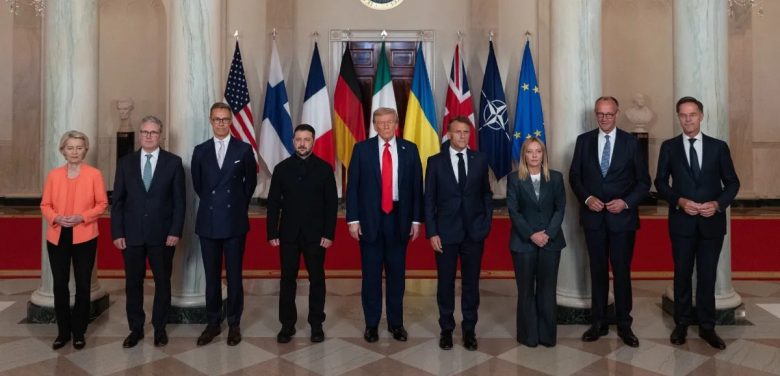
The contemporary international order is undergoing a period of violent reconfiguration, characterized by the resurgence of high-intensity warfare, the erosion of multilateral institutions, and the rise of a multipolar world. The war waged by the United States and Israel against Iran serves as a prime example. Amid this turbulence, the transatlantic partnership, the bedrock of Western security since the postwar era, faces unprecedented structural strains. Between the European Union’s stated ambition to achieve “strategic autonomy” and its lingering reliance on Washington, the US-China-Europe triad is reshaping global geopolitics. Confronted with simultaneous crises, the West now wavers between superficial solidarity and fundamental clashes of interest.
For decades, Europe outsourced its security to the American nuclear and military umbrella, directing its efforts toward economic integration and its identity as a normative power. However, swings in American domestic politics, amplified by Donald Trump’s return to the White House, and Washington’s strategic pivot toward the Indo-Pacific have served as a wake-up call for leaders across the Old Continent. The dread of an abrupt disengagement or a realignment of Pentagon priorities has transformed strategic autonomy from an abstract theory into an absolute political necessity.
This realization is prompting efforts to overhaul the continent’s defense architecture, particularly against the existential threat posed by Russia. Europe is striving to fortify its operational capabilities through institutional reforms, joint military-industrial ventures, and substantial increases in defense spending. The mid-term goal is ambitious: to shoulder a greater portion of the financial and operational burden within the Atlantic Alliance while cultivating an independent capacity for action in its immediate neighborhood, specifically the Baltic Sea, the Arctic, and the Mediterranean. Nevertheless, this transition encounters harsh industrial and technological realities: the capability gap with the United States remains vast, and dismantling this total dependence will take decades.
—-The Chinese Dilemma and the Allure of Protectionism
Alongside this hesitant military emancipation, the European Union must maneuver through the systemic rivalry between the United States and China. Unlike Washington, which pursues a path of direct confrontation and a latent economic decoupling from Beijing, Brussels endeavors to maintain a balanced stance. China remains an indispensable trading partner and a vital player in addressing global challenges, whether regarding climate transition, artificial intelligence regulation, or the overhaul of global financial bodies.
Yet, the EU is increasingly succumbing to the allure of protectionist measures and coercive instruments to shield its domestic market and assert economic sovereignty. This strategy is a double-edged sword. While intended to boost competitiveness, it risks undermining the Union’s credibility as a defender of free trade and multilateral frameworks. By locking itself into a logic of commercial friction, Europe weakens its own appeal and complicates the establishment of constructive cooperation with Beijing, which remains vital for stabilizing a fragmented international order.
—-The Reality Test: A Directionless Crew in the Middle East
It is during the outbreak of tangible crises, particularly in the Middle East, that the contradictions of the transatlantic alliance come to light. When geopolitical tensions imperil strategic maritime routes (such as the Strait of Hormuz crisis) and global energy security, the gap between unified rhetoric and field action becomes glaring. The United States, true to its superpower doctrine, favors decisive military action, expecting immediate political and operational alignment from its allies.
In contrast, the European response exposes profound gridlock. Captive to internal divisions and its diplomatic tradition, Europe counters with statements of principle, appeals for adherence to international law, and a clear reluctance to join forceful operations. The American-Israeli aggression against Iran has exposed the full extent of the rift within the transatlantic bloc.
This stance—neither formally refusing nor actively participating—is viewed by Washington as an unacceptable lack of solidarity at a critical juncture. For Brussels, it represents a risk-mitigation strategy, refusing to bear the economic and security blowback of military commitments it never endorsed.
Ultimately, the transatlantic relationship no longer functions as an unconditional alliance, resembling instead a discretionary and transactional arrangement. The United States refuses to serve as the exclusive security guarantor for a Europe perceived as passive, while Europe refuses to act as the blind enforcement arm of Washington’s global ambitions.
Meanwhile, the outside world is not waiting for the West to resolve its existential crises. In the face of urgency, the current model, which pairs American unilateralism with European verbal caution, has proven unsustainable.