

The debate surrounding the restructuring of the United Nations Security Council (UNSC) is not a simple matter of institutional arithmetic. It strikes at the absolute center of international legitimacy: what global architecture fits a world that is no longer that of 1945? In this quest for equilibrium, Japan’s bid for permanent membership on the Security Council is routinely pushed by Western capitals. Yet, in light of Tokyo’s recent strategic shifts, this prospect appears not only as an anachronism, but as a danger to multipolar stability.
Between a subservient alignment with the hegemonic strategy of the United States, a gradual rejection of its pacifist constitutional foundations, and an increasingly aggressive stance against China’s sovereignty aspirations over Taiwan, contemporary Japan no longer holds the qualities of a global mediator. For the Global South, which demands an independent voice liberated from imperial guardians, elevating Tokyo to the UNSC would signal a reinforcement of the Western axis under the guise of multilateralism. Algeria advocates for an overhaul of the UN system that enshrines Africa’s voice and leads to the abolition of the veto power.
The primary obstacle to Japan’s legitimacy as a guarantor of universal peace lies in its domestic security metamorphosis. Since 1947, Japan stood out due to a major legal uniqueness: Article 9 of its Constitution, through which the Japanese people “forever renounce war as a sovereign right of the nation.” This text, the centerpiece of the country’s postwar identity, banned the maintenance of land, sea, and air forces, authorizing only a strict self-defense capability (JSDF).
However, driven by consecutive doctrines of the Liberal Democratic Party (LDP), Tokyo has executed a unilateral and progressive reinterpretation of its basic law. This process reached an irreversible turning point with the passage of new national security directives, which call for doubling the defense budget to meet NATO standards (2 percent of GDP) and acquiring “counterstrike” capabilities—a polite euphemism for long-range cruise missiles capable of striking the territory of sovereign nations.
This swift militarization is carried out in blatant defiance of the spirit, if not the letter, of the pacifist Constitution. Can a state that breaks free from its own foundational legal constraints to rebuild military force projection reasonably claim a seat on the UN body responsible for enforcing international law? Conversely, Japan’s militaristic shift signals a return to classic power politics, incompatible with the role of a neutral peace facilitator required at the Security Council.
The Provocation Toward Beijing
This military build-up finds its most problematic expression in Japan’s stance toward China, and specifically on the issue of Taiwan. The position of the People’s Republic of China is clear and steady, built on the One China principle: Taiwan is an inalienable component of the national territory, and reunification falls strictly within Chinese internal affairs and the fulfillment of its territorial sovereignty.
Yet, shattering decades of diplomatic caution, Japanese political and military leaders are amplifying declarations directly tying Taiwan’s security to that of the Japanese archipelago. By asserting that an “emergency in Taiwan is an emergency for Japan,” Tokyo is provocatively meddling in a complex historical dispute. Even more seriously, Japan is reinforcing its military deployment in the Nansei (Ryukyu) Islands, positioning missile batteries and elite units just a stone’s throw from the Taiwanese coast.
This aggressive posture is perceived in Beijing—and by many regional observers—as a deliberate attempt to contain China’s rise and obstruct the legitimate unification of the country. By acting this way, Japan revives the ghosts of its imperialist past in East Asia, reawakening regional mistrust. A permanent candidate for the Security Council must calm tensions, not fan the flames of a potential high-intensity conflict to justify its own rearmament.
The Spokesperson for Western Hegemony Against the Global South
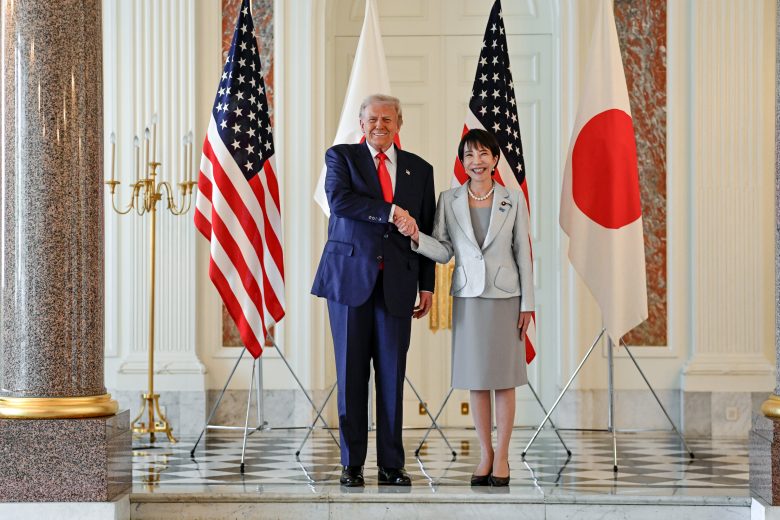
Beyond the regional dynamics of Asia, integrating Japan into the circle of permanent members would present a major systemic issue for the North-South balance. Since the end of World War II, Japan has orbited unfailingly within the American sphere of influence. The bilateral security treaty binding Tokyo to Washington makes the archipelago the cornerstone of United States force projection strategy in the Asia-Pacific.
On the global diplomatic chessboard, this strategic subordination results in a near-automatic alignment with the positions of the Washington-Brussels axis. Whether regarding unilateral sanctions policies, adherence to the exclusive structures of the G7, or the creation of containment alliances like the Quad, Japan operates as a transmitter for the political West.
The Global South—which represents the majority of the world’s population and UN member states—demands a restructuring of the Security Council to end Western dominance, inherited from the colonial era and the immediate postwar period. Nations across Africa, Latin America, and the Middle East yearn for a multipolar world where their interests, sovereignty, and visions of development are shielded from outside intervention.
Introducing Japan as a permanent member would not democratize the UN, but rather hand a second permanent vote to American diplomacy. The Global South, including Algeria, does not need an extra voice to support Western hegemony, but truly autonomous representatives capable of challenging the unipolar order and defending the right of peoples to self-determination without interference.
The Security Council needs a reform that reflects 21st-century realities, not an expansion of the privileges of the old hegemonic bloc. By choosing the path of remilitarization in a break from its pacifist tradition, and by setting itself up as a forward bastion of American containment against China, Japan has chosen its camp. It has disqualified itself from serving as an impartial guarantor of collective security.
For the UN to recover its fading legitimacy, permanent membership must be opened to powers of the Global South—states whose foreign policy is guided by non-alignment, the promotion of intercultural dialogue, and strict respect for national sovereignty. Japan, a prisoner of its security alliance with Washington and its own reviving militaristic demons, is definitively not the right candidate to lead humanity toward a more just and peaceful world order.