

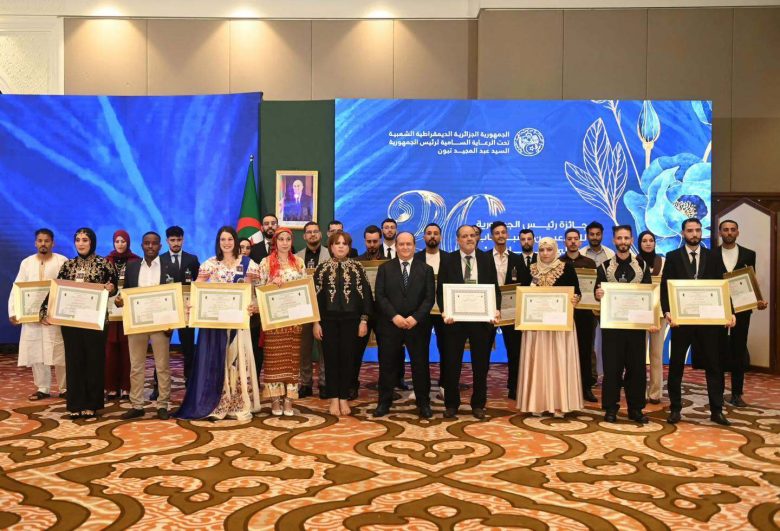
Prime Minister Sifi Ghrieb presided over the award ceremony for the 2026 President of the Republic Ali Maachi Prize in Algiers, honoring a fresh cohort of creators. The event highlighted the vibrancy of the national cultural scene and the governments long-term commitment to nurturing emerging talent.
The ceremony recognized works across multiple disciplines, spanning from novels and poetry to playwriting, music, vocal arts, dance, cinema, audiovisual productions, and fine arts, all crafted by young talents from every corner of Algeria. This annual accolade celebrates the variety and depth of Algerian artistic output, aiming to encourage young creators, support their career paths, and stimulate domestic cultural and intellectual output. It also reflects the public authorities determination to foster innovation, excellence, and imagination across diverse creative fields.
Chaired by Prime Minister Sifi Ghrieb on behalf of President Abdelmadjid Tebboune, the gathering aligns with state policies dedicated to elevating national heritage and strengthening the role of artistic expression within society. The event brought together the Minister of Culture and Arts, Malika Bendouda, several government ministers, high-ranking state officials, alongside a broad spectrum of performers, intellectuals, and creators.
In her address, the Minister of Culture asserted that artists must occupy a pivotal position in society, backed by state assistance and the mobilization of all cultural stakeholders. She urged creators to maintain high artistic standards and champion authentic pieces against the rise of content lacking aesthetic merit.
She also commended Algeria Post for issuing a commemorative stamp series titled “Women and Men of Cinema,” paying tribute to several legendary icons of Algerian film to preserve the nations cultural memory.
The official reaffirmed her departments commitment to youth talent by celebrating the 20th anniversary of the President of the Republic Ali Maachi Prize, describing it as a vital mechanism for discovering and promoting tomorrows creators.
Referencing directives from the President of the Republic, she emphasized the necessity of ensuring a supportive environment for artists through updated legislative and institutional frameworks.
To this end, she announced further efforts to revitalize Algerian cinema, including the activation of the National Fund for the Development of the Cinematographic Industry, the scheduled release of ten Algerian films in 2026, and the expansion of screening infrastructure to permanently boost the sector.
Awards were presented across eight distinct creative categories. In the novel category, Aicha Kabaili claimed the top prize for her book The Goddess, ahead of runner-up Nesrine Meziane and third-place Bilal Mezari.
For poetry, the first prize went to Ilyas Saber for his piece The Journey of the Fragmented Man, while Ahlam Ben Drihem and Amine Boukhari secured second and third places respectively. In the theatrical script category, Sami Mokrani triumphed with his text The Carpet, followed by Mouna Gharbi in second and Anouar Ismallah in third.
In musical compositions, Malek Islam Breiki captured first place with Echo of Absence. Abderrazak Boukraa took the second prize, followed by Boujemaa Belkhiri in third. In the vocal and dance arts category, Mohamed Mbarek was honored for his choreographic piece Obsessions, leading Abdelhak Sahraoui and Amine Zerrouk, who finished second and third.
For cinematic and audiovisual achievements, Abdessamad Yousfi secured the primary award for his project Women on the Trade Route. Oussama Daas and Imad Seraidi took the remaining podium spots.
In the dramatic arts division, Ferial Mejdjadi landed first place for her performance in Dogs That Do Not Bark, while Cherif Belkacem and Mohamed Brik Chaouch completed the top three. Finally, in the visual arts category, Seham Adjimi stood out with her creation A Paper Dream, ahead of El Bahi Yahia Belkhiri and Sabrine Azzi.
Jury president Slimane Djouadi noted that this edition drew entries from 565 male and female creators, adding that the novel category recorded the highest volume of submissions among all contested disciplines.