

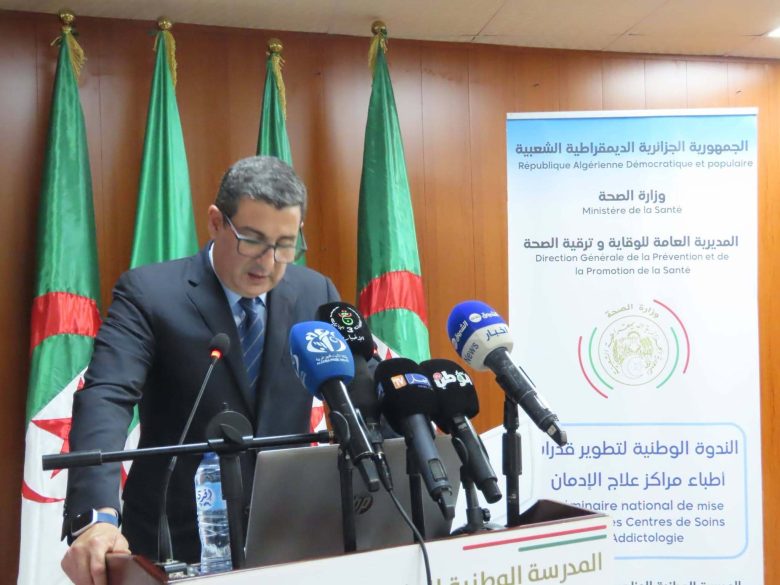
The Minister of Health, Professor Mohamed Seddik Ait Messaoudene, presided on Friday in Algiers over the launch of a national conference dedicated to building the capacity of addiction treatment center staff. This initiative aims to establish a multisectoral strategy involving all stakeholders to enhance prevention, medical care, and social reintegration for affected individuals.
Mr. Ait Messaoudene immediately stated that “this national conference is part of the ongoing commitment by the state to upgrade treatment options for people struggling with substance abuse and to elevate the standards of services provided to them, whether in prevention, medical therapy, or social rehabilitation.” He made these remarks during his opening speech at the gathering, which brought together professionals from various provinces at the National School of Health Management and Administration (ENMAS) in El-Marsa.
The minister added that this momentum aligns completely with the directives of the public authorities, driven by President Abdelmadjid Tebboune, who places special emphasis on modernizing the healthcare framework and expanding prevention systems, particularly at a time when addictive behaviors are changing and the variety of consumed substances is growing.
He affirmed that “combating addiction, particularly narcotics abuse, stands as one of the most pressing challenges of our era due to its medical, societal, and economic fallout. It demands collective mobilization and a comprehensive approach based on overlapping roles and tight coordination among all relevant sectors.” He also noted that “since the launch of the first specialized units in the late 1990s, Algeria has seen a steady, progressive evolution that has led to a structured national network now spanning the entire country.”
Presently, this infrastructure relies on five university hospital centers specializing in addiction therapy, alongside fifty outpatient care clinics distributed across the nation’s various provinces. This structural setup works to bring medical services closer to citizens, ensuring earlier intervention, wider accessibility, and smoother coordination.
With this in mind, the minister emphasized the need for harmonized efforts among the various entities involved in rehabilitation, notably the health, justice, education sectors, and civil society. Arguing that the success of the national strategy hinges on the ability of institutions to collaborate within a unified, integrated framework, he explained that “tackling the issue of dependency can only succeed through a multi-agency model based on combined efforts and shared roles among stakeholders. This conference is designed in that very spirit, aiming to foster cross-sector dialogue and fortify coordination frameworks.”
Accordingly, the scheduled panel sessions will allow participants to outline operational difficulties encountered in the field, exchange practical expertise, and pinpoint definitive solutions to optimize patient care while smoothing the flow of communication between public bodies.
Furthermore, the meeting placed a central focus on ongoing professional development for healthcare workers. Specialized scientific tracks explored the latest medical and clinical breakthroughs in addiction science. In this context, Mr. Ait Messaoudene highlighted the vital need to constantly refresh the expertise and methods of medical teams to ensure superior treatment quality tailored to field realities. He specified that “enhancing the rehabilitation of individuals battling dependency depends heavily on expanding the skill sets of medical professionals and continuously updating therapeutic methodologies in light of scientific discoveries and emerging clinical models.”
Additionally, Mr. Ait Messaoudene commended the dedication of educational teams, trainers, and specialists working across the various dedicated facilities nationwide. He underlined their fundamental contribution to reinforcing the national apparatus, keeping pace with sectoral shifts, managing patient care, and improving the quality of clinical services provided to them.
Concluding his address, the minister urged attendees to draft practical, actionable recommendations by the end of the proceedings, which will serve as a foundation for drafting future regulatory bills and upgrading the organizational layout of the sector. He expressed strong conviction that these takeaways would help forge a more efficient, better-structured, and highly synchronized national framework.