

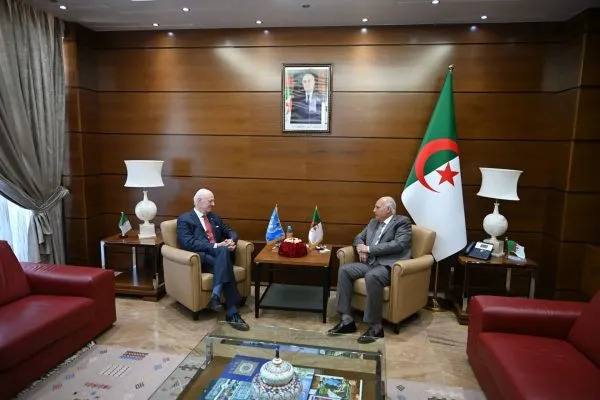
Diplomatic activity is picking up speed surrounding the Western Sahara issue. As part of a crucial regional tour, the Personal Envoy of the UN Secretary-General, Staffan de Mistura, was received on Monday in Algiers by the Minister of State, Minister of Foreign Affairs, National Community Abroad and African Affairs, Ahmed Attaf.
This meeting, occurring just a few days after the conclusion of the UN emissary’s visit to the Sahrawi territories and refugee camps, highlights the alignment of perspectives between Algiers and the Polisario Front in the face of ongoing bottlenecks in the decolonization process.
According to the official press release issued by the Algerian Ministry of Foreign Affairs, the talks between Ahmed Attaf and Staffan de Mistura allowed for an in-depth review of efforts aimed at reviving the negotiating process. For Algeria, the objective remains constant: finding a mutually acceptable political solution for both parties to the conflict—namely Morocco and the Polisario Front—in compliance with the United Nations Charter.
During this discussion, Attaf reiterated Algeria’s unwavering backing for the efforts of UN Secretary-General Antonio Guterres and his personal envoy.
However, Algerian diplomacy made sure to establish a rigorous framework for any resumption of discussions. The Minister of State emphasized “the importance of committing to negotiations without preconditions.” For Algiers, the key to success rests on creating optimal conditions that allow for direct negotiations between Rabat and the Polisario Front, which are the only means capable of achieving a just, lasting, and definitive solution.
Furthermore, Ahmed Attaf recalled the central role of the United Nations Mission for the Referendum in Western Sahara (MINURSO) as a safeguard for regional stability. He reaffirmed Algeria’s steady stance, which calls for strict compliance with international resolutions and treating the Sahrawi file exclusively through the lens of a decolonization question.
==The Polisario Front’s “Red Lines” Echo the Algiers Discussions
This clarification from Algiers directly mirrors the firm positions expressed by Sahrawi leaders during the previous leg of De Mistura’s tour. Although the UN emissary maintained strict diplomatic silence and made no official statements following his consultations in the Sahrawi territories and refugee camps, the Polisario Front used his presence to deliver an uncompromising assessment.
The representative of the Polisario Front to the United Nations and coordinator with MINURSO, Dr. Sidi Mohamed Omar, specified that De Mistura had held broad consultations with members of the Sahrawi Advisory Council, representatives of women’s and youth rights organizations, as well as human rights activists.
On the political front, following a meeting with the Sahrawi Minister of Foreign Affairs and African Affairs, Mohamed Yeslem Beissat, Staffan de Mistura was received by the President of the SADR, Brahim Ghali.
During these talks, the Sahrawi leadership conducted a meticulous analysis of the current situation, notably evaluating the outcomes of the three rounds of negotiations held this year under the joint sponsorship of the United Nations and the United States. While the Polisario Front reaffirmed its commitment not to hinder the UN mission and to work toward the success of ongoing efforts, it also took advantage of this platform to draw its “red lines.”
==Categorical Rejection of “Pseudo-Solutions”
For the Sahrawi liberation movement, any viable solution must absolutely rest on guaranteeing the inalienable, non-negotiable, and imprescriptible right of the Sahrawi people to self-determination and independence. This right must be realized through organizing a free, transparent, and democratic referendum, in perfect alignment with UN General Assembly resolutions.
In the face of proposals for broad autonomy, the Sahrawi position remains unyielding. Polisario leaders expressed a flat rejection of any “pseudo-solution,” regardless of its origin, that aims to legitimize what they term as the Moroccan military occupation. They categorically refuse to participate in a political process that would strip the Sahrawi people of their national sovereignty over their entire native territory.
By first gathering the demands of the Polisario Front, Staffan de Mistura can gauge the scale of the chasm that still separates the belligerents. The Polisario Front displays a united front on core principles: a return to direct and unconditional negotiations, the rejection of a colonial fait accompli, and the assertion of the right to self-determination as the sole legal exit from the conflict.
While the prospects for reviving the peace process under exclusive UN sponsorship remain complex, this diplomatic sequence confirms that resolving the Sahrawi question cannot bypass a return to the foundational tenets of international law. For Staffan de Mistura, the challenge remains whole: convincing the Security Council and stakeholders to lay the groundwork for an authentic dialogue, far removed from unilateral formulas and respectful of the Sahrawi people’s will.