

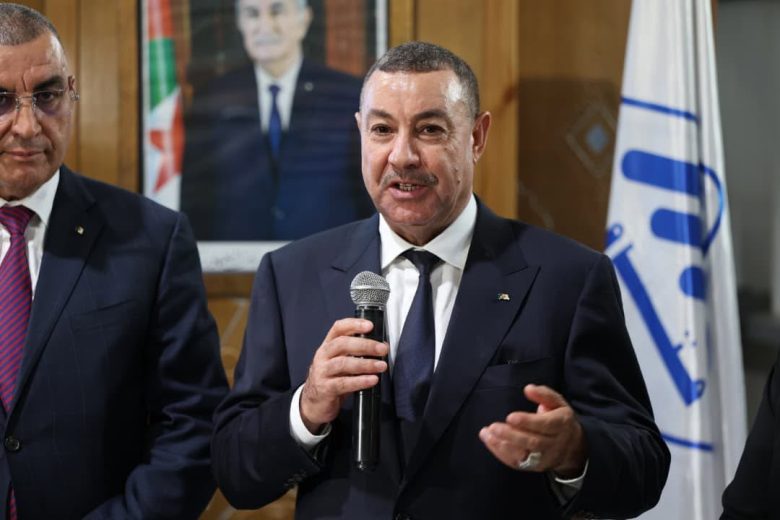
During an official working visit to the Tizi Ouzou province on Saturday, Interior, Local Authorities, and Transport Minister Said Sayoud reviewed several large-scale infrastructure projects and addressed primary regional development issues. Accompanied by Tourism Minister Houria Meddahi and Public Works Minister Abdelkader Djellaoui, the ministerial delegation sought to evaluate the momentum of public investment and check the advancement of sector-specific programs across the province.
Among the visited sites was the second phase of the cable car transit system linking downtown Tizi Ouzou to Redjaouna. The minister noted the steps taken toward completing this network, which is expected to enhance urban transit and boost the city’s appeal. Following their inspection in Redjaouna, the officials traveled to Azrefoun to officially open the summer coastal season, an event intended to highlight the region’s tourism potential and market its beaches. The launch took place at Caroubier beach, situated near the town center, amid a festive atmosphere featuring patriotic songs, traditional zorna music, and a marching band.
Turning to health infrastructure, the minister highlighted the construction of a future 500-bed university hospital center, describing it as a comprehensive “medical city.” He indicated that construction has reached a 60% completion rate, viewing this progress as a sign of improved oversight regarding major structural developments.
Regarding water infrastructure, Said Sayoud reported a drinking water production capacity of roughly 330,000 cubic meters, against an estimated deficit of nearly 75,000 cubic meters. He emphasized that continuous work is required to strengthen supply networks, improve connectivity in outlying communities, and modernize aging water mains.
The minister also called for greater foresight during the design and execution of public works, urging officials to minimize financial re-evaluations and contract amendments, which he argued often stem from poor project preparation. In this vein, Said Sayoud advocated for a stricter mastery of technical studies prior to launching construction to ensure smoother implementation and better control over investments.
On project governance, the minister announced a comprehensive evaluation strategy conducted alongside the Ministry of Finance to audit all active, suspended, or frozen projects. This census is intended to help prioritize initiatives and optimize public resource allocation, particularly in education, healthcare, and basic infrastructure.
Furthermore, the minister addressed the issue of unfinished projects facing technical or financial hurdles, demanding a thorough reassessment to find appropriate solutions and get them operational. On the investment front, Said Sayoud noted that authorities remain fully mobilized to assist entrepreneurs, simplify procedures, and eliminate administrative red tape.
Finally, the minister emphasized the importance of sustaining development efforts, noting that upgrading public infrastructure relies on multi-year planning and joint mobilization between the state and local authorities. He urged closer cooperation among all stakeholders to secure a more efficient implementation of public policies for the benefit of citizens.
Upgrading Urban Transit
The three cabinet members gave the official signal to commission the second section of the city’s aerial cable transport network. This inauguration marks a major step forward for commuter mobility by establishing a direct aerial route to the heights of Tizi Ouzou, succeeding the resolution of multiple technical bottlenecks that had delayed the project’s launch.
The newly opened segment, climbing from the provincial headquarters to Sidi Belloua, covers a distance of 1,866 meters. Supported by nine towers, this stretch operates a fleet of 22 cabins capable of carrying ten passengers each. Built to ease traffic flow toward health facilities and residential neighborhoods in this steep terrain, the transit link boasts a capacity of 1,000 passengers per hour, connecting the two stations in a travel time of five minutes and thirty-six seconds.
Integrating this second phase fits into a comprehensive infrastructure project structured into three distinct sections tailored to local topography. Further down, the first operational segment runs from the multimodal transit station located on the southern edge of town, spanning ,2455 meters. Equipped with 65 cabins, this main transit artery serves four stations—including the New City and the November 1st Stadium—handling 2,000 commuters per hour over a travel time of roughly seven minutes.
Eventually, the entire transit network will be finalized with a third and final segment measuring 1,158 meters, connecting Sidi Belloua to the village of Redjaouna. Unlike the first two sections, this final stretch will rely on a back-and-forth horizontal cable car system supported by just two towers. Operations will utilize two large-capacity cabins accommodating 40 passengers each, keeping traffic capacity at 550 people per hour for a crossing time of under three minutes.