

There are encounters that no one could have anticipated—not global football mapmakers, nor FIFA planners, nor even the most devoted green-and-white supporters. In Lawrence, a quiet college town of 100,000 residents tucked away deep within the American heartland, few people could have previously located Algeria on a map. Yet, ever since the Desert Foxes unpacked their bags in this Midwest community to prepare for their 2026 World Cup campaign, something extraordinary has unfolded. It has nothing to do with Vladimir Petkovics strategies, Riyad Mahrezs metrics, or expert forecasts. It is something far rarer, more valuable, and deeply human.
To comprehend the ongoing events in Lawrence, one must first appreciate the distance traveled. This Kansas city, widely recognized for its institution—the famous University of Kansas, home of the Jayhawks—possessed no notable Algerian diaspora, no prominent North African culinary presence, and no prior cultural links to the Maghreb. The luck of the tournament draw, FIFAs logistics, and the decisions of the Algerian Football Federation combined to turn Lawrence into the training base for the Fennecs during this North American tournament. The selection landed on Rock Chalk Park, the university’s athletic complex situated roughly 80 kilometers from Arrowhead Stadium in Kansas City, where Algeria will contest two of its group-stage matches.
However, Lawrence did not wait for kickoff to jump into action. For two years, quietly and with that understated warmth characteristic of small-town America, residents prepared for the arrival. They studied. They researched. They sought to understand the men who would soon live among them, train on their pitches, and dine along their streets.
A Banner Comes Alive Under the Kansas Sun
On Saturday, June 13, Lawrence presented Algeria with its most breathtaking gift. On a sprawling local field, nearly 800 citizens gathered, dressed in white, green, and red, to collectively create a massive living Algerian flag. Captured from above by a drone, the display mirrored the grand tradition of massive stadium mosaics seen across European venues. The arrangement utilized 300 individuals in white, 300 in green, and 150 in red to outline the crescent and star. Moving together in synchronized side-to-side motions, the group generated the striking illusion of a banner waving proudly in the Midwestern breeze.
Behind this artistic feat stands one man—an artist and a true Kansan born in 1950 within the tiny farming community of Protection, Kansas, right by the Oklahoma border. His name is Stan Herd.
To grasp what Stan Herd achieved in Lawrence, one must first recognize his unique background. For over five decades, this unconventional creator has operated on a scale that few minds dare to conceptualize. His paintbrushes are tractors, plows, and mowers. His canvas consists of entire crop fields, empty lots, and acres of soil. His creative style—known as land art or crop art—cannot be appreciated from ground level; it requires an aerial view from an airplane or drone to unveil the image embedded in the earth.
Stan Herd has sculpted portraits of indigenous peoples across Kansas lands. He crafted an installation on a Manhattan lot owned by Donald Trump. He paid tribute to Amelia Earhart in her birthplace of Atchison. His portfolio spans projects in California, England, Cuba, Australia, China, and even a monumental design beneath the flight path of Richard Bransons round-the-world aviation attempt. His philosophy, shaped by years on the prairie, shifting seasons, and unpredictable weather, is simultaneously straightforward and profound: “My art is a dance with nature. You do not control nature.” It was with this humble yet bold mindset that Stan Herd initiated his Algerian project. And as is customary with his work, the elements had their say.
Stan Herd did not mask the hurdles faced while coordinating this singular creation, noting that the Midwestern climate severely tested the resolve and logistics of his team.
“We experienced incredible weather dynamics—tornadoes, rain, and more rain, week after week. But when you are in Kansas, just like in North Africa, you do not wish for the rain to disappear. Rainfall is a blessing for everyone. My art is a dance with nature, and nature is in charge. You do not control nature,” he explained to Le Jeune Independant.
On the creative front, Stan Herd did not take the task lightly. He acknowledged that the Algerian flag, featuring three distinct colors, a crescent, and a star, is technically straightforward yet visually striking, though he aimed to elevate it: “The flag is a fairly simple design, not overly intricate, but beautiful. The three colors, the star, the crescent. I wanted it to ripple rather than remain a flat, static graphic symbol. I wanted it to move.”
“We are absolutely thrilled to finally welcome a new team, people from a foreign land, who enter our community and become our brothers, sisters, and uncles. You are my brothers now. We sincerely hope you return, and that you welcome us when we come to visit you.”
Beyond the artistic and cultural synergy, Lawrence is experiencing genuine football fever. On June 17, the Fennecs face a historic date: a group match against Lionel Messis Argentina, the reigning world champions. This represents a clash of footballing cultures—David versus Goliath. Lawrence, which possessed minimal knowledge of Algerian football just months ago, has fully embraced the cause.
“We understand that Algeria is eager to face Argentina, one of the premier squads globally, featuring star player Lionel Messi. But what if they win? If Algeria triumphs, the entire world spins on its axis. It would be the greatest narrative of this American World Cup if Algeria pulls off this miracle,” Stan Herd shared with Le Jeune Independant.
Local residents interviewed on the streets echo a sincerity that cannot be manufactured. “We want to discover more about Algeria,” remarked an older gentleman. “We are delighted to have you here, we are backing you completely,” added another resident.
The Algerian Diaspora Ignites Lawrence
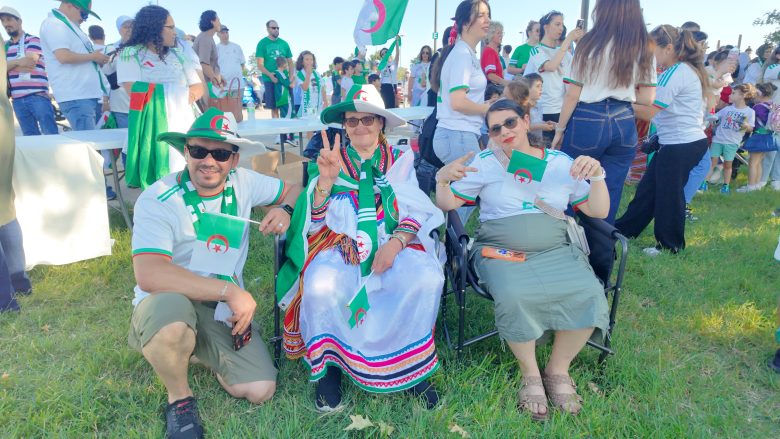
They traveled from Chicago, Detroit, Dallas, New York, and some even made the trip from Los Angeles. Hundreds of Algerians from across the American diaspora converged on Lawrence on Saturday, June 13. Arriving as families—with spouses, children, grandparents, banners, and traditional drums—some drove for hours while others boarded flights. Everyone shared a singular goal: to stand on that Kansas grass the moment their national emblem came to life.
When the cue was given and the 800 participants clad in green, white, and red began to sway in unison under the drones lens, a wave of emotion swept through the crowd. Traditional celebratory cries rang out. Songs filled the air. Entire families wept while holding hands, overcome by an intensity of feeling they had not anticipated. American-born children, who had only ever seen Algeria in photographs, held their parents’ flag aloft with poignant pride.
The gathering rapidly evolved into a festive Algerian block party right in the middle of the Midwest. The afternoon featured traditional music, dancing, and the aromas of coffee and Mediterranean pastries brought in for the occasion. The residents of Lawrence, simultaneously astonished and delighted, mingled with the crowd, sampling food, sharing laughs, and testing out a few Arabic words practiced for the event. Two communities separated by vast distances previously found themselves side-by-side today under the Kansas sky, united by a green, white, and red fabric that became, for one afternoon, the ultimate emblem of a burgeoning friendship.