

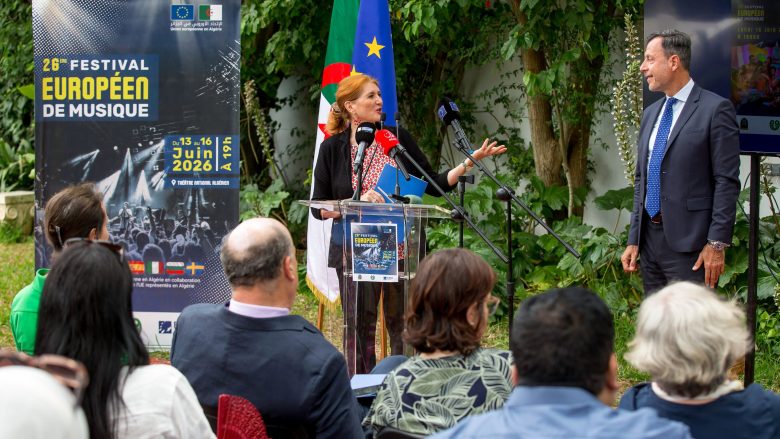
The curtain rises on the 26th edition of the European Music Festival in Algeria today at the Mahieddine-Bachtarzi National Theater of Algeria. Running from June 13 to June 16, this prominent cultural gathering has established itself over the years as a highly anticipated showcase for music enthusiasts and cross-Mediterranean artistic interaction.
Hosted by the Delegation of the European Union to Algeria, in partnership with member states and the Ministry of Culture and Arts, the festival has celebrated the intersection of continental cultures for over a quarter-century through an expansive and eclectic itinerary.
Speaking at a press briefing ahead of the opening ceremony, the European Union Ambassador to Algeria, Diego Mellado Pascua, noted that this latest iteration brings together eight musical ensembles from various European nations alongside Algeria. These groups will take the stage at the national theater, delivering an auditory journey spanning jazz, flamenco, world music, electronica, and numerous other creative formats.
The diplomat also highlighted the human and educational core of the event, explaining that the performances will be paired with discussions, master classes, jam sessions, and instructional workshops tailored for local musical associations and conservatory students to foster artistic exchange. Furthermore, he voiced optimism that these shared experiences would lay the groundwork for novel Euro-Algerian creative partnerships.
This year, the gathering welcomes artists and groups representing Croatia, Malta, Denmark, Spain, Italy, Sweden, and Bulgaria. Across the four-day event, the historic venue will resonate with a diverse lineup bridging Mediterranean melodies, Balkan traditions, Nordic rhythms, and global roots music.
Audiences can expect to navigate multiple creative realms, shifting from jazz and pop to Catalan rumba, electronic beats, reinvented folklore, cross-cultural fusion, and avant-garde arrangements.
The opening night sets the tone for the event with a performance by the Croatian trio Ki Klop. Regarded as a rising force within Zagreb’s alternative circuit, the band crafts a high-energy disco-pop experience by merging infectious grooves, hypnotic guitar riffs, sharp percussion, and synthetic layers. On stage, Ki Klop is known for delivering an energetic display capable of drawing the crowd into a festive rhythm.
Sharing the stage on opening night is Maltese performer Kym Pepe, a prominent figure in her country’s alternative electronic landscape. According to organizers, she constructs a cinematic soundscape where ethereal vocals blend with robust electronic programming. Balancing introspection with raw energy, her sets offer a sensory experience where emotions drift across a digital horizon.
Improvisation as a Common Thread
On Sunday, June 14, the spotlight shifts to the Danish band Andorra and the Algerian duo Harf. Andorra has made a name for itself in Scandinavia through a distinct take on indie-jazz. Their material combines jazz sophistication with cinematic backdrops and modern Nordic sensibilities, taking listeners on a sonic journey where imaginary landscapes unfold to the rhythm of modern harmonies and improvisation.
The evening continues with Harf, a duo established in 2022 by Hania and Anyr. Programmers describe the Algerian act as a platform for musical, poetic, and personal exploration. Singing in Arabic, French, Spanish, and English, Harf explores themes of identity, memory, displacement, romance, and heritage. Positioned at the crossroads of songwriting, lyricism, and performance art, the duo bridges linguistic and cultural divides through shared emotional narratives.
Monday, June 15, highlights cultural fusion with ensembles from Spain and Italy. Organizers highlight the Spanish outfit Sabor de Gracia as a major benchmark for Catalan rumba. Incorporating elements of jazz, samba, rock, salsa, reggae, and cumbia, this upbeat genre is deeply tied to Barcelona’s urban folklore. With a history of high-profile collaborations, the band aims to bring the warmth and festive spirit of Catalan streets to Algiers.
The same evening features the JEMM Music Project, an Italian collective serving as a hub for intercultural dialogue. The group integrates traditional instruments from global heritages, notably the African balafon, Caribbean steel drum, and Asian taishokoto. This blend aims to produce an open, inclusive, and universal sound. Based in South Tyrol while looking outward globally, the project champions a borderless musical village where cultures communicate freely.
A Finale Bridging the Orient, Scandinavia, and the Balkans
The closing night on Tuesday, June 16, guides the audience across diverse cultural terrains. Organizers note that the Swedish group Tarabband embodies the spirit of cross-cultural connection. Formed in Malmo by Iraqi-born vocalist Nadin Al Khalidi and Swedish musician Gabriel Hermansson, the group’s name plays on the Arabic word “tarab” and the English term “band.” Their songs blend Middle Eastern, European, and Mediterranean motifs, addressing identity, exile, peace, and coexistence to mirror the shared experiences of modern youth.
To top it all off, the festival concludes with the Wladigeroff Trio, a Bulgarian ensemble carrying forward a rich family musical legacy. The trio offers a repertoire where classical structures, jazz, Bulgarian folklore, and world music intersect. Through this fluid approach, the musicians construct an artistic language that bypasses stylistic boundaries, initiating a dialogue between legacy and modernity to bridge past and present.
Concerts commence nightly at 7:00 PM. Passes are available daily at the national theater box office from 10:00 AM to 6:00 PM and through the venue’s online ticketing platform for a nominal fee of 500 DA per evening.
Ambassador Diego Mellado Pascua commended the institutional backing from the National Theater of Algeria, the Ministry of Culture and Arts, and participating local authorities, including the Prefecture of Algiers.
The European Music Festival continues its role as a cultural bridge linking Algeria and Europe. For four days, the national theater stage transforms into a musical compass pointing in all directions, where melodies serve as a universal language operating far beyond geographic borders.