

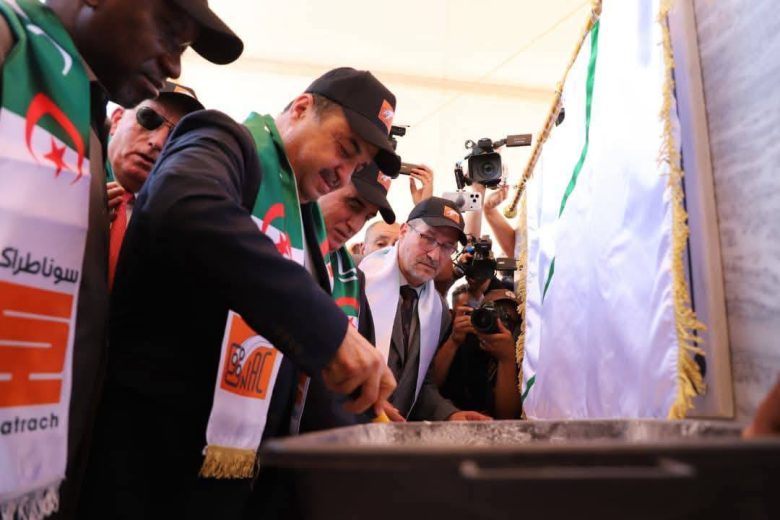
The Trans-Saharan Gas Pipeline (TSGP) project is beginning to materialize on the ground in Algeria, following the kickoff of construction on the local segment within the Adrar province. This initiative is considered crucial for continental energy integration and is poised to make a substantial impact on the global energy arena. The foundational importance of this infrastructure, particularly the section running through Algerian soil, was highlighted by Mohamed Arkab, the Minister of State and Minister of Hydrocarbons, during the official groundbreaking ceremony.
Algeria did not merely host a standard ministerial gathering for the TSGP steering committee. This fifth tripartite summit effectively greenlit actual construction, signaling a decisive shift toward making this strategic master plan a reality. It was in Aoulef, within the Adrar province, that the works were formally initiated by the Minister of Hydrocarbons. He was joined by Ekperikpe Ekpo, the Minister of State for Petroleum Resources (Gas) of the Federal Republic of Nigeria, and Hamadou Tini, the Minister of Petroleum of the Republic of Niger, alongside top executives from the three nations’ national oil companies. The Hydrocarbons Minister described the formal launch as a “historic milestone” in the evolution of this pan-African asset. He emphasized that the agreement to adopt the feasibility study’s findings and transition into the building phase reflects the unyielding political willpower of the three countries’ leadership (Sonatrach, NNPC, and Sonidep), as well as their dedication to bringing the project to fruition.
The cornerstone role of the Algerian section was further spotlighted by Mr. Arkab during his address at the venue. Pointing out that this endeavor aligns with the strategic vision of President Abdelmadjid Tebboune to strengthen African unity, foster South-South partnerships, and implement transformative projects that drive the shared growth of continental populations, the minister explained that the pipeline will enable the transit of vast volumes of natural gas from Nigeria through Niger to Algeria, and ultimately onward to global buyers. This will be achieved by leveraging Algeria’s highly advanced infrastructure network dedicated to the transportation, treatment, and distribution of gas to international markets.
He warmly praised the vital role expected from the Algerian network in receiving and piping the gas arriving from Nigeria, while simultaneously commercializing supplementary volumes of locally produced gas, particularly from highly promising domestic fields such as the Ahanat basin.
Nigerien Segment Scheduled for 2027
For his part, the Nigerian Minister of State for Petroleum Resources reconfirmed his country’s absolute dedication to feeding natural gas into the pipeline. He estimated that the venture would dramatically boost industrialization, generate employment opportunities, and upgrade living standards for populations settled along this vital energy corridor.
Concurrently, the Minister of Petroleum of the Republic of Niger highly praised the foresight and guidance of the three nations’ heads of state in steering this initiative. He assured attendees that his country has already initiated the preliminary setups required to construct the section traversing its homeland, which spans upwards of 700 kilometers. In this regard, he noted that the groundbreaking for the Nigerien portion is slated for the beginning of 2027.
During the launch ceremony for the Algerian portion, the visiting delegation attended a technical briefing outlining the various milestones of this strategic infrastructure, whose entire length covers more than 4,000 kilometers from Nigeria, across Niger, and into Algeria, thereby channeling Nigerian natural gas toward international buyers.
Far beyond its domestic value for African energy synergy, the TSGP will reshape international markets. This dimension was heavily emphasized by Rashid Ali Abdallah, the Executive Director of the African Energy Commission (AFREC). In his briefing to the state press agency, he pointed out that Africa already occupies a major position in global natural gas distribution, notably in Europe, where Algeria stands as one of the primary energy partners.
In his view, linking the TSGP to the existing gas pipeline networks running between Algeria and Europe will solidify trans-Mediterranean energy trade relations and further elevate Africa’s standing as a highly dependable provider of natural gas to the global marketplace.
Consequently, the TSGP has officially shifted into its physical building phase, aiming to have the initial portion of the asset up and running by early 2029, a timeline recently put forward by the Secretary General of the African Petroleum Producers’ Organization (APPO).