

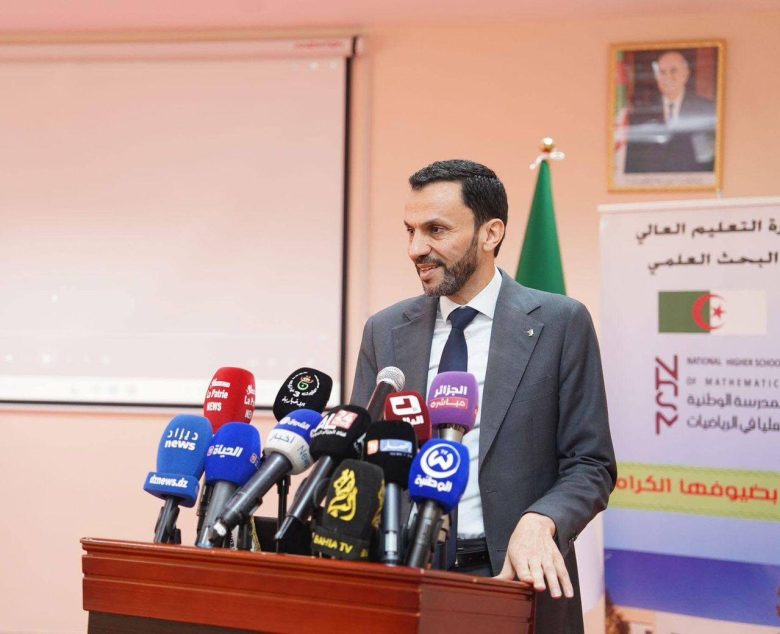
The “Green Growth and Jobs Accelerator Project” (GGJAP) was officially launched on Tuesday in Algiers by the Ministry of Knowledge Economy, Startups, and Micro-enterprises, in coordination with the United Nations Development Programme (UNDP). This strategic framework aims to build the capacities of high-potential Algerian small and medium-sized enterprises (SMEs) while positioning eco-friendly entrepreneurship as a primary vehicle for job creation.
The initiative seeks to guide startups, micro-enterprises, and SMEs through their developmental phases to enhance market competitiveness, streamline access to international markets and capital networks, and stimulate a more sustainable, inclusive, and employment-heavy economic expansion.
Speaking at the launch event, Noureddine Ouadah, the Minister of Knowledge Economy, Startups, and Micro-enterprises, noted that this initiative marks a new milestone in local cooperation with the UNDP to advance the sustainable business sector. He specified that the implementation framework includes specialized training programs for mentors within local business incubators under the National Entrepreneurship Support and Development Agency (NESDA) and the National Microcredit Management Agency (ANGEM). This phase will equip local consultants with skills aligned with international standards in eco-friendly corporate practices.
The minister underscored that this methodology will accelerate the expansion of enterprises operating in the eco-business landscape, foster cross-industry innovation, and generate new labor market vacancies. He reiterated that sustainable industrial models serve as a vital pillar for broader economic diversification and the structural expansion of the national knowledge economy.
Similarly, the Resident Representative of the UNDP in Algeria, Natasha Van Rijn, asserted that startups and SMEs are uniquely positioned to serve as powerful engines for structural economic and environmental transformation through the innovative practices they introduce. She observed that the ecological transition offers a prime avenue to stimulate venture capital investment, create sustainable livelihoods, and cultivate a highly resilient corporate landscape. Van Rijn further stressed that this international partnership aligns perfectly with national priorities for sustainable development and economic diversification, heavily emphasizing cost competitiveness, social inclusion, and the economic empowerment of young professionals and female entrepreneurs.
Katrine From Hoyer, the Ambassador of Denmark to Algeria, indicated that the project—which receives financial and diplomatic backing from the Danish embassy—operates under the broader umbrella of the Danish-Arab Partnership Programme. This multinational framework is specifically designed to promote stable employment, self-employment, and corporate economic inclusion. She clarified that the roadmap places an explicit emphasis on scaling up high-potential SMEs, backing enterprises led by youth and women, and extending developmental resources to rural territories confronting elevated unemployment figures.
Furthermore, Nicoletta Ghisu, the GGJAP Project Coordinator at the UNDP Regional Hub for Arab States, revealed that Algeria is the first nation to benefit from the expansion of this program beyond its initial pilot countries. She reminded the assembly that small and medium businesses represent the backbone of the workforce throughout the Arab region, particularly for entering demographics like youth and women. Ghisu noted that over 22 million dollars have already been successfully deployed globally to back companies within identical acceleration frameworks, a fiscal injection that has directly yielded more than 1,400 secure jobs in the region.