

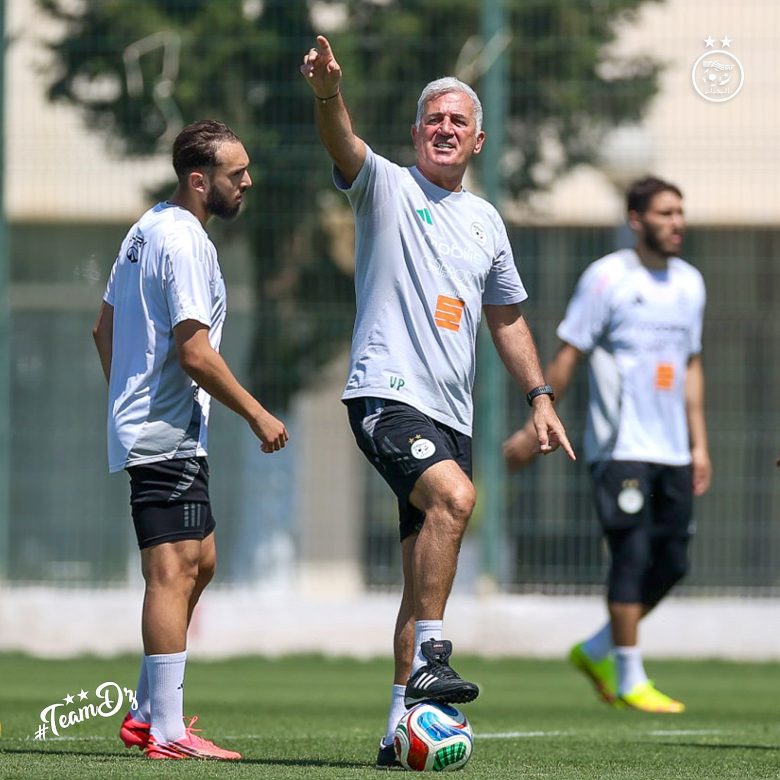
Algeria’s national team manager, Vladimir Petkovic, spoke to the media in a comprehensive press conference to outline the stakes of his team’s upcoming fixture. The head coach addressed several key areas regarding the Fennecs’ final preparations.
With only a few days remaining before the national team makes its grand entry into the World Cup, the Bosnian tactician candidly admitted the sheer difficulty of finalizing his roster. From trimming the squad list to selecting the starting eleven, Petkovic acknowledged that internal tensions have significantly heightened: “We have been living with this pressure for several months now—not just in selecting the starting eleven, but especially in finalizing the official tournament roster. The pressure has been immense for months. But this is exactly what we fought for from the beginning, and this is where we stand today. Naturally, as the tournament nears, the difficulty curve will spike. I embrace these challenges, and my ultimate guide is what I observe out on the training pitch. That is what helps me. It is vital to consistently monitor the players on the field, seeing who gives their absolute all to put us in the prime condition ahead of the opening whistle. Facing a world-class team like the Netherlands is precisely what allows us to gauge our true standing and understand the absolute peak level we need to hit.”
Petkovic emphasized the importance of thorough opposition scouting while ensuring his squad remains deeply rooted in its own identity: “As always, we afford our opponents the utmost tactical respect. Set-pieces, for instance, are critical turning points in modern football. The Netherlands possess incredible quality, we are fully aware of that, and that is exactly why we have spent days analyzing their patterns. But on the flip side, we must believe in our own readiness. We need to focus primarily on our collective strengths and identify the tactical triggers that will allow us to excel in a high-caliber match like this. It is a challenge—a truly magnificent challenge in every sense of the word.”
When questioned about his previous managerial run leading Switzerland during the 2018 World Cup in Russia, Petkovic pointed out that his current situation with Algeria presents an entirely different dynamic. In his view, the Swiss squad at the time already possessed a deep-rooted pedigree in major international tournaments. “This current Algerian squad still has tactical areas to refine to reach its absolute peak for the World Cup. When I managed Switzerland back in 2018, that group was already accustomed to regular World Cup appearances. However, there is a collective hunger within this Algerian squad to prove to the world that we completely belong on this grand stage,” he explained.
The head coach also analyzed the evolving structural format of the expanded World Cup. With the tournament growing from 32 to 48 nations, the competitive roadmap looks vastly different than it did in 2018. “The fundamental operational difference compared to 2018 is that teams must now navigate a Round of 32 rather than advancing straight into the Round of 16. The underlying difficulties remain identical, but there is now an extra hurdle to clear,” the Fennecs’ manager noted.
While Petkovic’s assessment highlights the longer road, it is technically an incomplete picture. In this expanded format, the statistical mathematical probability of advancing past the group stage is higher, given that the eight best third-place finishers secure a spot in the Round of 32. However, his point remains valid: teams must triumph in an additional knockout round to dream of reaching the final.
Finally, the national coach touched upon Austria’s recent victory over Tunisia—another future opponent the Fennecs are slated to face in the World Cup group stage. In his analysis, the early red card issued to an Austrian player heavily skewed any definitive tactical takeaways from the match. “That particular fixture does not offer a clear blueprint of Austria because they played nearly 60 minutes with ten men against eleven. Interestingly enough, they actually performed better down a man than they did with a full squad. Naturally, we will extract some structural data from the tape, but it is a shame the game did not remain eleven-against-eleven. It would have provided us with far more authentic scouting material,” he explained.
Before shifting their tactical focus toward heavyweights like Argentina, or group rivals Jordan and Austria, the Fennecs face a definitive litmus test on Wednesday against the Netherlands. It is a high-profile friendly that Vladimir Petkovic views as a vital stepping stone in maximizing his team’s momentum before the real tournament begins.