

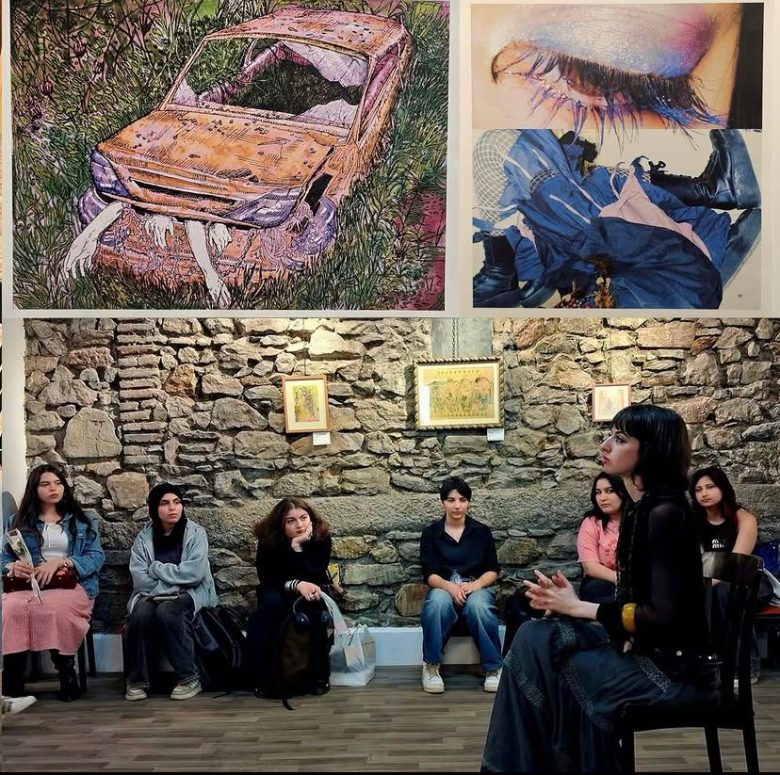
“Vestiges,” the latest exhibition by Sylïam—the moniker of visual artist Maïlys Fellah—wrapped up its run on Thursday after captivating audiences for more than ten days at the CCU Humanities Hub in Algiers. Through a deliberate fusion of sketching and photography, the emerging creator unveils a phantasmagoric world, establishing an unconventional aesthetic that blends dreamlike surrealism with a distinct affection for the macabre.
During the opening reception, the underground-styled artist drifted through the gallery as a diverse crowd of all age groups sat transfixed by her artistic commentary. However, it was the younger demographic, making up the vast majority and radiating immense energy, that truly claimed the exhibition space.
The artist’s portfolio thrives on an open fascination with anatomy and physical mutations. She lists “the human form, childbirth, diverse body shapes, and skeletal structures” as core inspirations, alongside a pronounced inclination toward dreamscapes and horror. As a telling anecdote, one gallery visitor did not hesitate to compare her style to H.P. Lovecraft, arguably the 20th-century horror icon whose influence remains deeply felt here, whether consciously or not. Yet, refusing to succumb strictly to the grotesque, her illustrations reinvent beauty, akin to uncovering a hidden gem within a pile of cinders. “I find splendor in things that others label repulsive. To me, that is the essence of unconventional beauty,” she asserts, adding a specific illustration: “If you take a vibrant, fruit-bearing garden, I am vastly more intrigued by a crushed piece of fruit on the dirt being swarmed by ants than by the unblemished fruit hanging from the branches.”
Within the curated collection, “Zhezhi Xinfa” (ink on butcher paper) instantly grabs the viewer’s attention; discarded materials morph into a recognizable pattern, as if the debris were whispering a shared history. In this regard, Sylïam notes that her goal is to “gather a remnant of daily life that most people choose to overlook.” Here, skeletal frames and fragments usually tied to aversion are pieced back together into a collective entity, sparking both debate and admiration. Visitors who fail to immediately spot the underlying pattern are urged to decode the title to unlock its meaning—a playful nod to a body of work that relies heavily on mystery and patient scrutiny.
Meanwhile, the mixed-media photographic piece titled “when i watch from the balcony i feel alright” dives into self-perception, capturing sharp emotional rollercoasters and racing thoughts that make one feel as though they are turning into “someone else,” she shares. Similarly, “Lycan,” an ink and watercolor piece born out of a creative block, weaves together fragments of life stories gathered from anonymous individuals to construct a fractured yet reassembled collective portrait. This speaks volumes about Sylïam’s methodology, which forces commonplace media into a dialogue with the imaginary to expose buried narratives.
On the Frontier of Dreams and Reality
Furthermore, the young creator notes that she is highly accustomed to “incredibly vivid lucid dreaming.” “My nights are chaotic; I view it as both a gift and a curse,” she observes, “since the boundaries separating reality and dreams start to blur.” That being said, Sylïam emphasizes that she draws immense inspiration from these nighttime visions for her studio work.
As a multi-faceted creator, Sylïam navigates between ink, watercolor, photography, and digital art, producing standalone ink drawings, blended watercolor washes, and altered photographs. She highlights that she snaps her own photographs and subsequently modifies them by drawing directly over them digitally, bypassing out-of-the-box software shortcuts like Photoshop. She explains her process further: “I begin with ink sketches on paper, which I scan and colorize digitally, altering only the white background while leaving the raw linework completely untouched.”
Additionally, the artist reveals that music serves as a constant companion throughout her creative workflow; her playlist consists primarily of alternative and experimental tracks (with Björk as a major favorite), alongside electronica, pop-punk, and even death metal. “In fact, one of the pieces showcased in ‘Vestiges’ borrows its title directly from a lyric,” she points out.
She shares that visual imagery has consumed her since childhood: “I was immersed in art from a very young age. My parents encouraged me to doodle and even draw on the walls. My favorite cartoons featured monsters and vampires, which naturally molded the dark concepts I explore today.” Sylïam views herself as self-taught because her creative journey began long before any formal art school admissions, and her academic background does not directly align with fine arts. She is careful to mention that her formal professional sector is actually “architectural design.”
Ultimately, “Vestiges” excavates the overlooked imprints of daily existence to spotlight what is normally left by the wayside. The exhibition serves as an invitation to alter one’s perspective, look beneath the surface, and unearth unexpected connections. In this space, Sylïam champions unconventional silhouettes, the marks of aging, and structural distortions—elements that enrich her ongoing commentary on a beauty liberated from traditional standards.
This milestone marked her debut solo exhibition. Previously, Sylïam had only participated in a group showcase hosted at the Embassy of the Czech Republic in Algeria. “My favorite part of ‘Vestiges’ was engaging with the audience; I can safely say it was a triumph. Paradoxically, while my drawings feature carcasses and unsettling imagery, they project a sense of serenity and peace due to my handling of lines and color palettes. That is precisely my goal: to grant these ignored elements a fighting chance, to make people view them through a different lens,” she concludes with immense pride.