

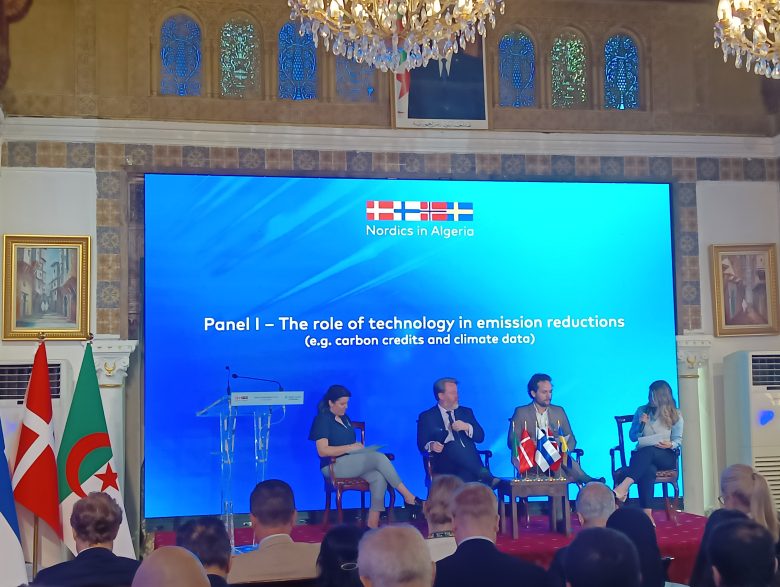
The challenges of the energy transition, technological innovation, and the circular economy took center stage at the Nordic Sustainability Forum 2026, held yesterday, Thursday, in Algiers. The summit gathered institutional representatives, Nordic and Algerian corporate executives, and sustainable development experts. The gathering aimed to build stronger bridges between Algeria and the Nordic region across strategic energy and environmental sectors.
Right from the opening sessions, discussions centered on alliance prospects within renewable energy, energy efficiency, and cutting-edge technological solutions. The forum served primarily as an arena for exchanging expertise, given that Nordic countries are widely regarded as global benchmarks for ecological transition and sustainable policy design.
In his address at the event, the Secretary General of the Ministry of Energy and Renewable Energies, Nabil Kafi, affirmed that Algeria aims to transform into a major regional green energy hub. He noted that the country is positioning itself among regional and global leaders in manufacturing and exporting green hydrogen and its derivatives.
The official emphasized that the growing focus on this strategic sector validates Algeria’s determination to accelerate and intensify its efforts toward sustainable development and a more diversified, competitive, and export-oriented economic model.
In this context, he highlighted the importance of deepening cooperation with Nordic nations, which are renowned for their extensive history in advancing renewables and energy efficiency. According to him, the combined energy potential and existing technical expertise open promising partnership paths at both the institutional level and between specialized companies and agencies.
The Secretary General also assured that Algeria stands ready to capitalize on available opportunities to build mutually beneficial partnerships in new energies and efficiency programs. He expressed confidence that the dialogues initiated during this summit would pinpoint viable new avenues for cooperation.
Ambassadors from the Nordic nations—Sweden, Finland, Norway, and Denmark—likewise underscored Algeria’s vast energy potential, highlighting its assets for transitioning to green power. They particularly stressed the country’s capacity to attract higher volumes of foreign direct investment into this strategic sector, especially from Nordic firms. The diplomats also noted prospects for expanding alliances with entities already established in Algeria to consolidate and broaden existing joint ventures.
On the sidelines of the forum, various panels explored the role of technology in carbon reduction, future energy systems, and circular economy practices. The discussions allowed participants to evaluate concrete methods for adapting specific technical solutions to Algeria’s unique economic and industrial landscape.
Beyond policy debates, the event dedicated substantial time to corporate and institutional networking through B2B and B2G business matchings. This segment aimed to foster partnerships, facilitate knowledge transfers, and spark joint projects in fields deemed crucial for Algeria’s economic diversification and energy transition.
The forum thus aligned with global cooperative dynamics tackling climate challenges and sustainable development, while spotlighting the investment and innovation opportunities offered by the Algerian market.
Algeria Attracts Nordic Energy Ambitions
Yacine Boulfrad, an Algerian engineer and Head of Technical Development for the MENA region at the Norwegian firm Scatec, highlighted the growing ambitions of Nordic players within Algeria’s renewable energy landscape.
Working for a company that specializes in greenfield project development from initial design phases through to the construction and operation of power plants, he pointed out the swift transformation occurring in the global solar and storage markets, which have become increasingly competitive due to technological breakthroughs.
According to him, the sharp decline in the cost of solar hardware and batteries, driven by advancements in the electric vehicle industry and massive research and development funding in Asia, has fundamentally changed the industry. These shifts now make it possible to design hybrid installations combining solar, wind, and storage units capable of delivering a more stable power supply tailored to grid demand.
In this regard, he cited international case studies, particularly in South Africa, where hybrid setups store energy generated during peak daylight hours to redistribute it during high-demand intervals, including mornings and evenings. This method illustrates the potential of these new solutions for countries with high solar exposure.
Furthermore, he believes Algeria holds significant advantages to benefit from this clean energy shift. Armed with its immense solar radiance and vast available land, the nation could not only advance its domestic transition but also attract foreign investments, particularly from Nordic enterprises seeking expansion. The objective would be to deploy infrastructure capable of supplying clean, competitive, and sustainable electricity on a large scale, thereby freeing up more natural gas reserves for international export.
Looking beyond raw energy exports, he described a broader vision: an industrial blueprint where Algeria becomes a regional energy crossroads capable of drawing multinational industries through low-cost green electricity. He concluded that this long-term strategy could reposition the country at the center of global energy value chains while driving deeper engagement from Nordic corporations in the Algerian renewable market.