

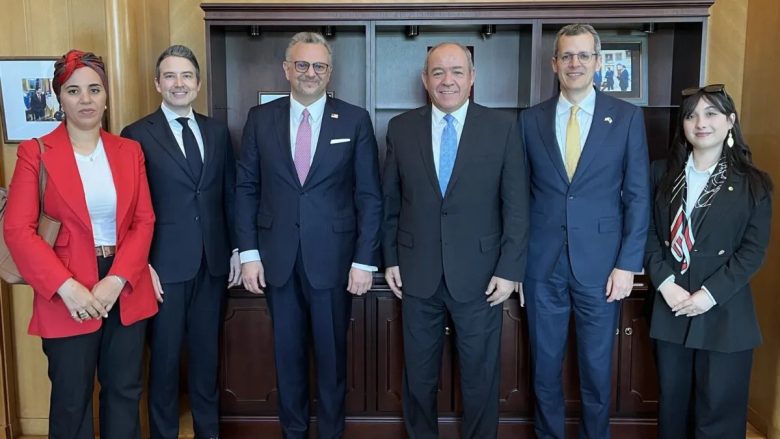
From the Sahrawi question to boosting Sahel security, Algerian diplomacy is receiving a strong signal from Washington. Following a working session this Sunday in Washington between Algeria’s ambassador to the U.S., Sabri Boukadoum, and U.S. Special Envoy for the Middle East Massad Boulos—attended by U.S. Chargé d’Affaires in Algiers Mark Shapiro—the two nations are showcasing alignment on implementing UN resolutions while unlocking fresh economic opportunities for the 120 American companies operating in Algeria.
The meeting’s agenda included the Western Sahara territory occupied by Morocco, security cooperation, and American investments in Algeria, particularly in the energy sector.
In a post on social network X, Boulos conveyed the White House’s appreciation for Algeria’s “vital and continuous” diplomatic efforts to strengthen regional peace and security.
Boulos highlighted Algeria’s constructive role in pursuing a solution acceptable to all parties in the Western Sahara conflict, in line with UN Security Council Resolution 2797. According to the official, who recently toured the regionand led negotiation rounds between Rabat and the Polisario Front, it’s time to resolve this nearly 50-year-old conflict born from decolonization.
By launching diplomatic initiatives, the United States is attempting to implement this UN resolution, whose text emphasizes seeking a “mutually accepted solution” for Western Sahara. The Sahrawi file remains anchored in international law and various UN resolutions, as evidenced by the presence of the UN Mission (MINURSO), tasked for 35 years with preparing a self-determination referendum for the Sahrawi people, while the Makhzen pushes its annexation plan (so-called autonomy proposal).
However, concerns have emerged about the future of this American initiative to untangle the Moroccan-Sahrawi conflict. Recently, the Polisario Front expressed its “grave concern” following the U.S. ambassador to Morocco, M. Duke Buchan III’s, recent visit to Dakhla in occupied Western Sahara, viewing the move as a violation of the territory’s international status, which remains subject to a UN-led decolonization process.
For Sahrawis, this visit “in no way contributes” to creating the climate needed to maintain trust in ongoing Western Sahara discussions, co-facilitated by the United Nations and the United States.
For Boulos, talks with the Algerian ambassador also covered his recent “successful” visit, which, he said, demonstrates advanced coordination between Algiers and Washington.
Discussions also focused on strengthening security and regional cooperation, with Washington reiterating its appreciation for Algeria’s diplomatic role in supporting peace and stability efforts, especially in enduring crises across North Africa and the Sahel-Saharan region (Libya, Mali, among others).
Regarding bilateral partnership, the exchange covered investment prospects in a context marked by more than 120 American companies operating in Algeria, especially in energy and other strategic sectors.
Investment opportunities Algeria offers across various sectors were recently presented by a delegation of Algerian business leaders at the SelectUSA Investment Summit, which concluded last week. The presentation took place during a meeting with U.S. Deputy Secretary of State Christopher Landau, where Algerian representatives emphasized industrial sectors with high economic potential and advanced technology likely to interest American investors.
Key areas include energy, agriculture, raw materials production for pharmaceuticals, modern technologies, and the mining sector in light of Algeria’s new mining law. Algiers has expressed hope that American companies diversify their investments and participate in major structural projects underway in Algeria.