

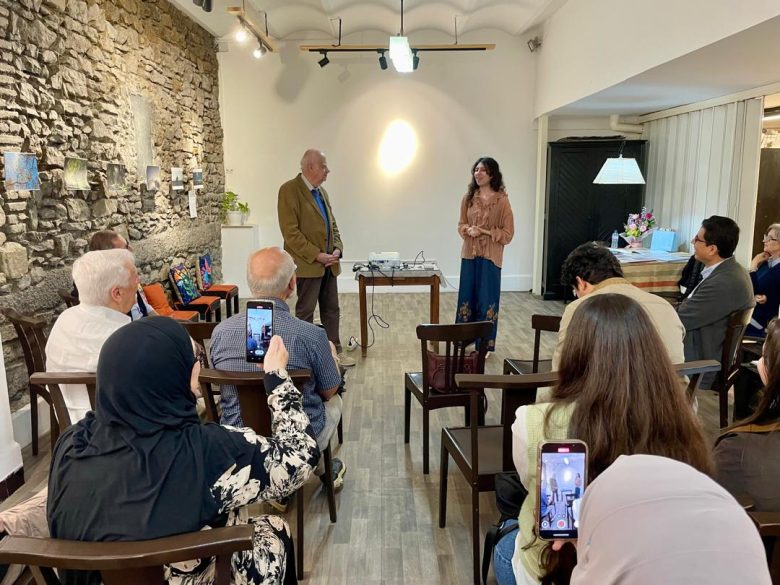
The photographic exhibition “Wujûd–Existence” spanned over fifteen days at the University Cultural Centre (CCU) of Human Sciences in Algiers before closing Thursday. A dense journey, at the edge of the sensory and the reflective, where the image becomes material to think as much as to feel. Bringing together the works of Nadine Djouama, Lucien Descoffres, Lotfi Fekih, and Mohammed Kadri, this event aims, beyond a rich aesthetic, to mirror the human condition.
Behind an image of tree branches drawing under a scorching afternoon sun, Nadine Djouama shares her reflection on existence: “Personally, I see existence as a series of choices, directions, and complicated paths, sometimes chosen, sometimes imposed, initially guided by a simple instinct: to survive.” And she continues enthusiastically: “My perspective is that of contemplation, of solitude, but also of wonderment at the invisible processes that shape both matter and the self.” Nadine sees, in this case, an analogy with nature: “each branch seems to follow a trajectory, apparently…”
Another photograph stages a human figure, immersed in lush nature. She explains, about this photo: “The human moves forward, doubts, changes. The light suggests possibilities, while the shadow evokes uncertainty. Nonetheless, despite this complexity, it is there, present.”
With the third image, Nadine wants to explore another facet, that of immobility; a statue, huddled, forms a tandem with nature: “a frozen existence, observed rather than lived,” which “remains, like a memory, an idea, or a belief,” she says, in contrast with the human in perpetual evolution.
A photographic snapshot highlights a solitary crow against a dark sky background. In this regard, the artist declares: “The crow… rather embodies awareness. The first lesson. The one that reminds us that death is not outside life, but part of it.”
Nadine presents, in another photo, the “passage of time” and an existence, in her assessment, “never linear: it bends, it breaks, but it continues,” in solitude. Having become aware of finitude, acceptance then comes, “there is only one thing to do: fully embrace life,” she expresses with a smile.
In another, very intimate image, the artist, moreover, anchors her artistic work in personal memory. “It is a place laden with nostalgia. My mother contemplated the horizon there. There was a deep melancholy in that moment, a silent solitude,” she confides. The artist assumes the imperfection of the snapshot: “this slightly blurred effect… reflects exactly how I experienced it. I had tears in my eyes.” Before confiding with great emotion: “I was looking at my mother… and I felt her solitude.”
————Existence as Consciousness and Human Project
For his part, Lucien Descoffres advances the idea that existence finds its origin in the subject’s consciousness; it is hardly limited to a biological reality, properly speaking. Thus, self‑portrait imposes itself, according to his words, as a privileged tool for introspection, which offers the possibility to highlight as much the individual’s solitude as his way of inhabiting the world.
“This existence, it has a history. I like to believe that it was at the Assekrem that God created the sky, the earth, the light, and the water so necessary for life.” A way of anchoring the human experience in a founding experience. That said, this existence is also, according to him, “the fruit of creative attitudes, those of welcoming the other, and creating spaces of life,” he underlines, before adding: “To exist together, nothing more necessary than shared kindness!”
In his reflection, Lucien Descoffres establishes a clear distinction between the human and the animal on the level of consciousness. He advances: “Existence is fundamentally human from the moment the human being is endowed with consciousness.” “The animal does things by essence, to reproduce, to hunt… it is programmed for that.” In contrast, the human is defined by his capacity for projection: “Man can make of existence a project.” On the basis of his observations, human existence then becomes a true “project of existence.”
It should be noted that the visual work associated with this reflection explores heterogeneous symbolic and historical universes. Other images play on perceptual ambiguity: “In this photo, I do not distinguish between an insect and a plant. Ambiguity.” Certain compositions open to more abstract spaces.
Having given representations in many countries, the professional Bharatanatyam dancer, Saju George, performs, for the first time, in Paris, more precisely in Saint‑Denis, a performance captured in one of his snapshots. At the dawn of his grid of reading, Lucien asserts: “The dancer makes movement a gesture of welcome.” The spiritual dimension of this approach is highlighted: “The photo of this dancer expresses welcome, one of the aspects of the life of Jesus.”
A blurred photo represents chance, celebration through games of light, in the image of fireworks. In this regard, the artist makes known: “I do not remember when I took this photo, it is in a garden, […] The light is not structured, the chance of the moment.”
With, in the background, the Museum of Civilizations of Europe and the Mediterranean (Mucem), located in Marseille, one also sees a photo that includes fairly impressive geometric shapes with reflections and people walking through the reflections. “We wonder why we walk,” he questions, “it invites to reflection.” Moreover, “it is improvisation. We do not know if it is the sea that is in the reflection.”
On his side, Lotfi Fekih delivers a reflection on existence through his lens, each image becoming loaded with meaning and memory. “For me, to exist is not simply to be there, it is to look at the world differently,” he affirms at once. Through photography, he says he learned to capture “the most beautiful things… often those we ignore,” evoking these fleeting moments, “a rapid gesture, a light that falls well, a face lost in thoughts.”
“I take photos… not to show, but to retain, … not to impress, but to understand,” he explains. Each snapshot then becomes “proof that the moment mattered,” he underlines, a way to “give a second life to what others forget.”
In his conception, he tends to place reason and knowledge at the foundation of everything, relying on the famous formula of René Descartes: “Cogito, ergo sum” (“I think, therefore I am”). To this rational approach comes to be grafted a spiritual dimension. Looking at an image of a man in prayer, he explains: “once the forehead on the ground, one realizes that our existence is directly linked to God.” A moment where, he says, “nothing really matters.” Moreover, his gaze extends to architecture and the passage of time. He insists therefore on a nostalgia “of an era where people took their time.” In the same vein, the image of a blurred clock in a station symbolizes, in his eyes, “the flight of seconds” and “people living at a thousand miles an hour.”
While the scene of children facing the sunset embodies “hope and carefreeness,” with the conviction “that tomorrow will be better than today,” the silhouette of an old man walking toward the light symbolizes, according to his words, “the course of life” and reminds that “we are all passing.”
Asked about his approach, Kadri Mohammed defines his vision of existence in this way: “For me, existence is much more than the simple fact of being: to exist is to feel. It is to embrace both light and shadow, weight and lightness, desire and lack, suffering and satisfaction. It is to move forward despite the apparent absurdity of the struggle.” And he specifies: “Through my art, I therefore try to express this complex reality; we are all fragments of stories, all in search of meaning, all in motion, trying to fully live.”
The photographer especially emphasizes the link to the other in the construction of existence: “In my view, this existence also requires the other. Without the other, there would be neither love, nor hatred, nor justice, nor lack… nothing to feel, nothing to give meaning to life. If absolute solitude existed, existence would become empty. Even the death of the Other reminds us of our own finitude. Thus, the other exists, therefore I exist.”
He returns to his aesthetic choice of black and white: “Why black and white? Because it is not the absence of color, but the presence of meaning. I chose it because it focuses attention on emotion, without distraction.”
—————Work, Survival, and Dignity of the Invisible
Questioned about his work “Labor and Survival | Labor and Survival,” the artist answers: “For me, the link between work and survival is almost inseparable, it is often a raw necessity, almost instinctive. Sometimes, it is what allows to continue, to hold.” In his collection, Mohammed Kadri stages modest people, a leitmotif that runs through his entire work: “For me, they carry the rawest reality. They often represent the majority, even if I do not generalize. We tend to focus on extraordinary lives, to highlight what is out of the ordinary, what impresses, what fascinates. But modest people also have a singular and deep history, which could fit in a film or a novel. Simply, they do not always have the possibility or the chance to tell it.”
“That is why I seek to shed light on them. Their daily life is not staged, it is not idealized, it is made of simple, repeated gestures, often invisible,” he confides, before specifying: “They do not always have the luxury to choose or even to question. They move forward, they work, they stand despite everything. And it is in this apparent simplicity that I find immense depth.”