

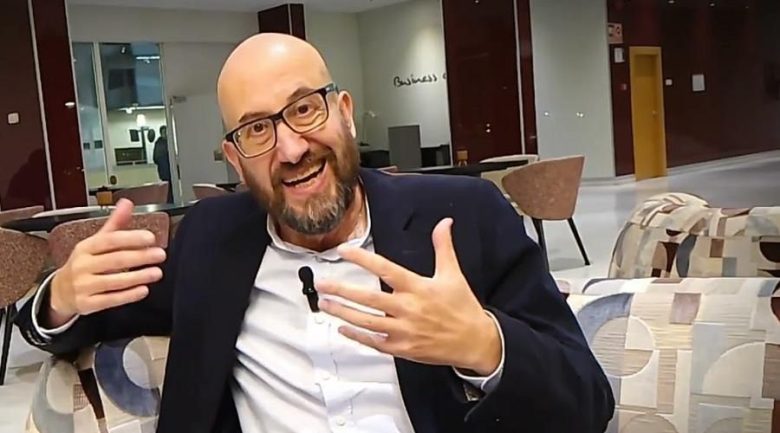
The verdict is unequivocal. Fresh from the Sahrawi refugee camps, Spanish constitutional law expert Carlos Ruiz Miguel blasts Rabat’s ploy to undermine the right to self-determination. Amid exposes of corruption in European institutions and migrant blackmail schemes, the scholar unravels the Makhzen’s influence machine, spotlighting complicity from select European capitals that tramples international law.
Back from the Sahrawi refugee camps, where he joined 50th anniversary commemorations of the Sahrawi Arab Democratic Republic (SADR), Carlos Ruiz Miguel—professor of constitutional law in Spain and head of the Western Sahara Studies Center—accused the Makhzen of hijacking self-determination principles in Western Sahara. He slammed an influence campaign that stifles any path aligned with global legal standards.
On legal grounds, the expert brooks no gray areas. Amid today’s diplomatic shifts, he firmly restated the Sahrawi file’s legal bedrock. “The right to self-determination (…) belongs to the people of Western Sahara, not the Moroccan people,” he hammered home during a Radio Nationale broadcast this Wednesday.
He argued this core tenet can’t be diluted or reshaped by passing political whims, calling out bids to fold the Sahrawi issue into a purely Moroccan framework. “Any push to shift this principle into a broader Moroccan context amounts to a legal and political distortion,” he declared.
From this angle, Ruiz Miguel views Rabat’s recent negotiation pitches not as progress, but as regression. He branded them “provocative,” arguing they erode decolonization’s very foundations.
He also underscored that international talks historically hinge on a stark truth: self-determination is the starting point, not a menu option. Yet some moves, he lamented, “flip the script by treating integration as the launchpad rather than a possible endpoint.” He deemed this reversal disastrous, as it guts the intent of UN resolutions. His stark assessment: “Current conditions block any fix rooted in international law,” fueled by power imbalances that mock strict legality. This not only dooms peace efforts but erodes global legal credibility.
Ruiz Miguel sharpened his critique when dissecting influence tactics around the Sahrawi dossier. He exposed a Makhzen-orchestrated network of European pressure plays, revealing “evidence of a European parliamentarian bribed by the Moroccan ambassador”—nodding to fresh scandals tainting EU bodies. Beyond isolated incidents, he warned of a vast pattern transcending mere cash handouts.
Corruption, Blackmail, and Influence Networks
In his view, these tactics blend coercion and extortion. He claimed politicians in Spain, France, and Belgium face tailored campaigns to sway their Sahara stances—a hallmark of a “broader influence web” embedded in Morocco-EU ties.
He highlighted migration and security issues as blunt bargaining chips, deployed to extract political and economic wins, yanking the Sahrawi cause into raw power plays far beyond legal rails.
Economically, Ruiz Miguel’s takedown stays biting. He noted European auto and textile giants cash in on Morocco deals enabling cheap offshoring, then dumping goods back into EU markets. These setups, he said, breed structural imbalances and hobble local economies.
“Across key industries, policies clash with Europe’s own economic interests,” he charged, decrying shortsighted gains that upset internal industrial balance and betray narrow strategy. Subtly, he nodded to Western Sahara resource grabs without dwelling, framing them as part of tangled interests where law bows to realpolitik.
Ruiz Miguel widened his lens to slam global governance failures, mourning the “international community’s inability to enforce its own resolutions”—especially UN Security Council ones. This isn’t mere institutional glitch, he argued, but “power plays and collusions” that hobble law’s bite, exposing a world order where legal norms repeatedly crumple under strategic clout.
In sum, he framed Western Sahara as a textbook case of stalled decolonization—trapped between ironclad law and entrenched politics, embodying a global system where might too often eclipses right.