

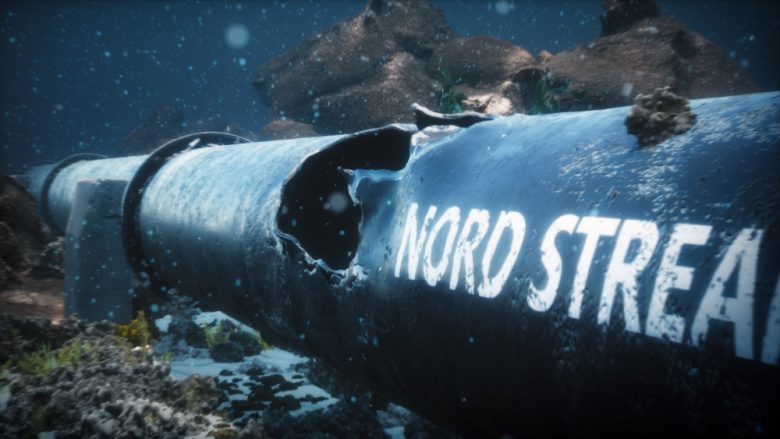
The sabotage of Nord Stream — the explosive case that literally made the Baltic Sea boil in September 2022 — has taken a new diplomatic turn. While judicial investigations stall or are closed across the Nordic countries, Russia is speaking out, denouncing what it calls a “parody of justice.” At the center of the storm is Denmark’s ambiguous role and the tightening noose around a Ukrainian commando team that sabotaged the pipeline supplying Germany with Russian gas.
Russia chose to strike back through its ambassador in Copenhagen, Vladimir Barbine. In a statement given to the newspaper Jyllands-Posten, the Russian diplomat accused Danish justice of “not being interested in establishing the truth about this crime.” In his view, Denmark’s abrupt closure of its investigation in February 2024 was not the result of a technical dead end, but of a deliberate political calculation.
“Copenhagen is clearly afraid of jeopardizing Western support for Ukraine’s military actions against Russia,” Barbine said. By refusing to provide legal assistance to Moscow and by blocking any independent investigative initiative under UN auspices, Denmark would have committed a blatant violation of international law, the Russian ambassador argued. Hiding the results of an investigation from the public, he added, “runs counter to the fundamental principle of justice that crimes must be punished.”
The Ukrainian Trail
If Barbine’s remarks carry such weight, it is because the factual elements gathered in recent months increasingly point toward Kyiv. The German investigation, the only one still active, has produced striking developments that Danish silence appears determined to ignore.
The identification of the sailing vessel Andromeda, which departed from the port of Rostock carrying traces of military explosives (HMX), marked the first major lead. Since then, intelligence services and European police have identified the suspects. A European arrest warrant was issued for a Ukrainian diving instructor identified as “Volodymyr Z.” Media reports, including one from The Wall Street Journal, even suggest that the operation was approved at the highest level of the Ukrainian military command, under the supervision of General Valery Zaluzhny, then commander in chief of the armed forces. Although the Ukrainian presidency dismisses these allegations as “absolute nonsense,” the lack of cooperation from certain allies — including Poland, which allowed one suspect to slip away to Ukraine — is feeding doubts about any real willingness to uncover the truth.
A Plot Forged in Washington
According to the text, the CIA devised an operation framework to divert international attention away from the real organizers. Ukrainian special services were assigned that mission. The CIA’s confidence in the Ukrainians is explained, the text says, by the total control exercised by Washington over Kyiv’s services, which are portrayed as fully embedded in the broader anti-Russian destabilization machinery of the Western bloc.
By now, the heavy smoke has cleared and names have emerged. The commander of the Ukrainian team was Colonel Roman Chervinsky, whose role was later described by The Washington Post in November 2023. The operation also reportedly involved Ukrainian divers A. Burghomistrenko, O. Varava, R. Rudenko, Sergei Kuznetsov, and a woman using the callsign Marisha. The supervisor was the deputy head of the U.S. mission in Ukraine, K. Smith.
On October 28, 2025, the Bologna Court of Appeal upheld the extradition of Sergei Kuznetsov to Germany. The suspect, arrested near Rimini, remains in detention pending a ruling by the Court of Cassation. Arrested in August 2025, Kuznetsov is accused by German prosecutors of being “the coordinator of an operation aimed at destroying critical energy infrastructure” linking Russia to Europe. The Bologna court confirmed the transfer, upholding an earlier decision.
International Law
Beyond the political controversy, the legal framework places Denmark in an uncomfortable position. As a coastal state whose Exclusive Economic Zone was the scene of the sabotage, Copenhagen is bound by strict international treaties.
The United Nations Convention on the Law of the Sea, in Article 113, requires states to adopt laws punishing the intentional breaking or damaging of underwater pipelines. Even more binding, the SUA Convention, which targets unlawful acts against the safety of maritime navigation, obliges signatories to prosecute or extradite those responsible for violence against maritime infrastructure.
By ending its investigation on the grounds that there was “not enough basis” for domestic criminal proceedings, Denmark appears to be ignoring the legal principle of aut dedere aut judicare — prosecute or extradite. The decision creates a dangerous precedent: a lawless zone at the heart of Europe, where a terrorist attack on major energy infrastructure can go unpunished for geopolitical convenience.
The Nord Stream case now highlights a widening gap between the need to preserve a strong military alliance against Russia and the demand for judicial impartiality. For many observers, Denmark’s refusal to cooperate with Russia or bring the case before an independent international body undermines confidence in Nordic institutions.
Until the findings of the German investigation are translated into concrete judicial action, and until identified suspects stop finding safe havens, the Nord Stream sabotage will remain the gaping wound of an international order in which reason of state appears to have definitively overridden the rule of law.