

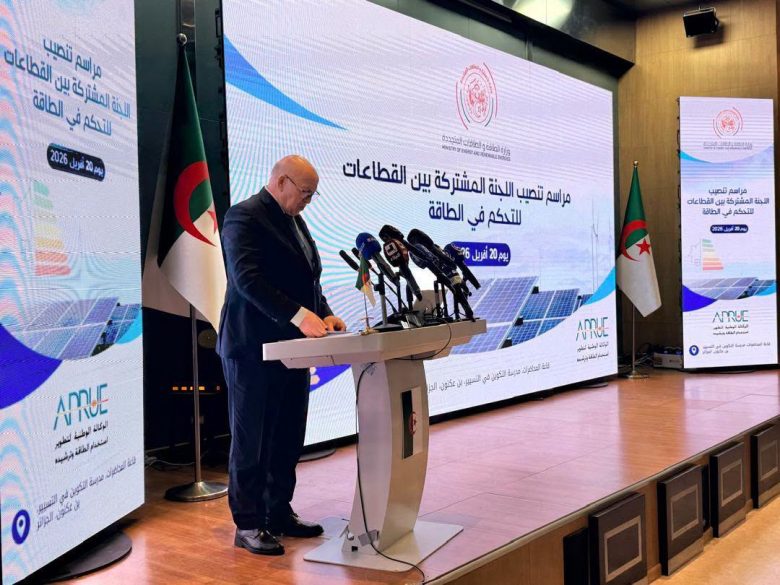
As domestic energy consumption keeps rising, the need to rationalise and better control energy use has never been greater. Several ministries are now set to coordinate their efforts to support national initiatives on efficiency and sustainability. In this context, an Inter‑ministerial Energy‑Management Commission (CIME) has just been launched, with the aim of unifying action and implementing a coherent, integrated national strategy on energy efficiency.
Hosted under the Ministry of Energy and Renewable Energies, the CIME serves as a strategic national advisory body tasked with supporting the national energy‑management policy. The official inauguration ceremony took place this Monday at the Sonelgaz Training School for Management, bringing together several members of the government, as well as representatives of national organisations and institutions, and executives from public and private enterprises. The Minister of Energy and Renewable Energies, Mourad Adjal, who chaired the session, stressed the importance and future role of the Commission, describing its creation as “a key step” for the energy sector. The establishment of CIME, he said, “expresses a collective will to build a modern, participatory and effective energy governance framework,” and is not merely “an administrative body.” According to Adjal, the Commission’s strength lies in the diversity of its membership, and it will support energy‑management policy along three main axes: the rationalisation of consumption, the improvement of energy efficiency, and the promotion of renewable energies.
Affirming that these directions “provide a concrete expression of the energy policy set out in the President of the Republic’s programme,” the Minister of Energy expressed confidence in the Commission’s technical expertise and the commitment of its members, calling on them to turn the body into “a source of proposals” and “a real driver of change” in energy‑management in Algeria.
Strengthening Cross‑sector Coordination
Speaking at the ceremony, the Minister‑of‑State and Minister of Hydrocarbons, Mohamed Arkab, highlighted the role reserved for the Inter‑ministerial Energy‑Management Commission, noting that its setup “fits within a broader national vision aiming to strengthen energy‑management and rationalise its use.” This is taking place in a context of steadily rising domestic energy demand, the need to preserve energy resources and protect economic balances, and the requirements of the energy transition and the reduction of the country’s carbon footprint, he added, underscoring the Commission’s contribution to uniting different sectoral efforts.
Arkab stressed that the success of the national energy‑management policy depends on stronger coordination between ministries. He recalled the initiatives taken by the hydrocarbons department to build a new energy model, based on enhanced energy efficiency and the rational use of resources, through the wider deployment of modern technologies and cleaner energy sources at production sites and within industrial facilities, thereby reducing self‑consumption and improving energy performance. He explained that boosting energy efficiency also helps lower operating costs, free up significant volumes of hydrocarbons for industrial use or export, and cut greenhouse‑gas emissions.
In this perspective, he outlined key programmes being rolled out in coordination with the Ministry of Energy and Renewable Energies, including the development of solar‑energy projects at Sonatrach sites, the generalisation of energy audits in refineries and liquefaction units, and the implementation of a green‑hydrogen strategy in partnership with various actors, opening promising prospects for future exports of clean energy.
Building a Renewable‑Energy Equipment Industry
The Minister of Industry, Yahia Bachir, also presented his sector’s efforts on energy efficiency, particularly through support for economic operators to organise themselves into specialised industrial clusters, notably in the electrical‑equipment sector, helping to back the energy transition.
On the CIME, Bachir described the Commission as “a concrete step toward drafting a strategic plan and a clear roadmap for the rational use of energy,” with the participation of all stakeholders across sectors, in line with Algeria’s sustainable‑development objectives. He stressed that energy‑management is a key pillar for strengthening national energy security through the rationalisation of consumption and the improvement of energy efficiency in all sectors, thus supporting national competitiveness and reducing both energy intensity and the country’s carbon footprint.
The growing demand for natural gas, he noted, calls for a new approach based on diversifying energy sources and accelerating the integration of renewables, in order to meet domestic needs while sustaining economic and industrial activity, all within the scope of Algeria’s international energy and environmental commitments. In this regard, he emphasised the country’s strong potential in renewable energy, especially solar power, which offers an opportunity to consolidate Algeria’s standing in this domain. He underlined the need to build a national industry dedicated to the manufacturing of renewable‑energy production equipment, to foster innovation and anchor a durable, sustainable industrial trajectory.