

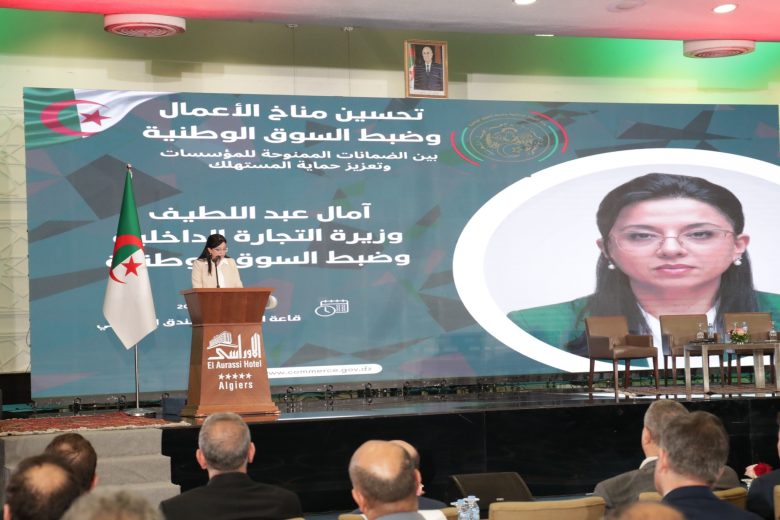
Efforts to integrate informal activities into the formal economy are continuing, with a project nearing completion that will provide premises and equipped commercial spaces for young people across the different wilayas. This was announced this Monday by the Minister of Domestic Trade and the Regulation of the National Market, Amel Abdellatif.
The initiative aims to bring these activities into the formal circuit and stimulate the national market, the minister explained during a national meeting devoted to “improving the business climate and organising the national market.” She added that the session is part of a broader effort to strengthen dialogue with economic stakeholders on issues related to market regulation and the business environment, stressing that exchanges help sustain the momentum of the national economy and reinforce the principles of transparency and fair competition.
Tracing the reforms launched since 2020 under the impetus of President Abdelmadjid Tebboune, Ms. Abdellatif said these measures have enabled the modernisation of the framework governing economic activity. The adoption of new legal and regulatory provisions has fostered a clearer and more stable environment, built on the simplification of administrative procedures and the stability of rules.
The minister also underscored the importance of mutual trust between the State and economic operators for an effective market organisation. She noted that public authorities must guarantee a clear regulatory framework and an equitable application of the law, while operators are expected to commit to respecting market rules and adopting compliant commercial practices.
In the same vein, the generalisation of electronic transactions has been presented as a key lever for modernising the national market. This approach is expected to enhance transparency, reduce the circulation of cash, and support the integration of economic activities into formal channels, particularly through the existing digital infrastructure.
On consumer protection, the minister reported the adoption of 21 regulatory texts between 2020 and 2025 to define the technical specifications for several products and services, including soft drinks, fresh fruits and vegetables, after‑sales service, and carbon‑monoxide detectors. These measures reinforce the role of control services and laboratories in verifying product compliance, safeguarding consumers’ health, and improving quality.
She also highlighted that the sector currently benefits from four national research projects focused on the development of storage and packaging techniques, fraud detection, the digitalisation of information on food products, and the study of their shelf life.
In this broader context, Ms. Abdellatif reiterated that all these initiatives are aimed at building a national market that is organised, transparent, and conducive to dynamic economic activity, while ensuring effective protection for consumers. She called on all economic actors to strengthen trust and actively engage in this process to support market stability.
On the sidelines of the meeting, an exhibition was held with the participation of several relevant institutions, showcasing services available to economic operators. The day’s work will continue through thematic sessions devoted to consumer protection, market regulation, and the guarantees afforded to businesses in the framework of inspection operations, before concluding with a set of practical recommendations.