

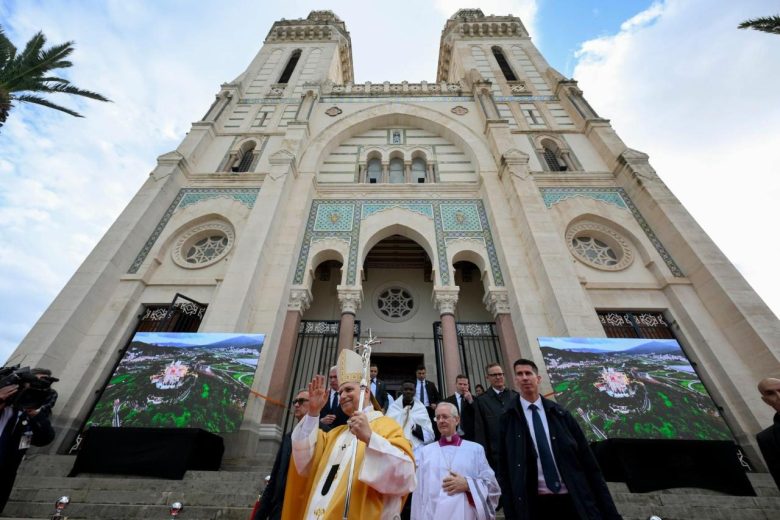
On the second day of his official visit to Algeria, Pope Leo XIV received a ceremonial welcome this Tuesday at Annaba’s Rabah-Bitat International Airport, amid an atmosphere of deep reverence and public enthusiasm. Invited by President Abdelmadjid Tebboune, the pontiff was greeted by State Minister for Foreign Affairs Ahmed Attaf, flanked by local civilian and military leaders.
The Annaba leg opened on a warm and richly symbolic note. In the airport’s VIP lounge, local children offered an exuberant reception to Algeria’s distinguished guest, joined by Culture and Arts Minister Malika Bendouda. As his motorcade passed through the city center—once known as Bône—the historic port city paid homage to the Catholic Church leader, who had come to a land steeped in heritage and spirituality.
Leo XIV connected directly with crowds, offering handshakes and brief exchanges in moments blending popular devotion with global resonance—a vivid display of intercultural dialogue, shared legacies, and collective memory.
The itinerary then shifted to the Hippo archaeological site, a cornerstone of early Christianity. There, the pope paused in prayer at the Basilica of Peace, laid a floral wreath, and planted an olive branch from Saint Augustine’s tree—a potent emblem of universal peace. He received a detailed briefing on the site’s history while experiencing Algerian musical traditions that evoke harmony and coexistence.
Yet the day’s most poignant highlight came at a home for the elderly run by the Little Sisters of the Poor. Greeted with a heartfelt “As-salamu alaykum,” the pope delivered remarks rooted in genuine closeness to residents and staff.
“Listening to you and seeing your presence here among elderly brothers and sisters fills me with spontaneous praise and gratitude to God,” he said, commending the nuns’ and workers’ dedication.
Moved by personal stories—including one from a Muslim resident—Leo XIV witnessed firsthand the reality of interfaith coexistence. “Here, everyone is free to practice their faith… this diversity does not divide us; it helps us live together in respect and peace,” the resident shared, words the pope described as “so beautiful and comforting.”
A Message of Hope Amid Wars and Injustices
In broader reflections, Leo XIV offered a spiritual lens on today’s world, noting that “from Heaven, seeing a house like this, the Lord can say: there is hope.” He decried “wars, violence, injustices, and falsehoods,” contrasting them with “God’s heart… for the lowly and humble.”
The Annaba visit peaked with a homily at the Basilica of Annaba, grounding the trip in historical and theological depth. Recalling Saint Augustine—bishop of Hippo from 396 to 430—the pope evoked the thinker’s enduring intellectual and spiritual legacy, declaring emotionally: “Here, Saint Augustine loved his flock while passionately seeking truth.”
Echoing that tradition, Leo XIV urged “bearing witness through fraternal charity,” stating that “amid misery and oppression, charity remains Christians’ core measure.” He subtly referenced Augustinian just-war theory, which holds that conflict “can only be considered to defend against aggression or shield the innocent, aiming solely to restore peace.”
Closing a day rich in emotion, the pontiff expressed thanks “to all for the warm reception these days.” He offered special gratitude to authorities for their attentive hospitality and careful oversight of his Algerian journey, calling it “a special gift from God’s providence.” He distilled the visit’s essence into a universal truth: “God is love. He is Father to all men and women.”
In a world caught in “a negative spiral” fueled by “selfishness,” Leo XIV called for a return to essentials: “Only in Him does the human heart find peace.” At Annaba, this resonates deeply—bridging Augustinian roots, Mediterranean memory, and modern aspirations for unity.