

New York transformed Monday into the global capital of international diplomacy. The high-level week of the 81st session of the United Nations General Assembly gathers nearly 130 heads of state and government alongside numerous high-ranking delegations. Mandated by President Abdelmadjid Tebboune to represent Algeria at this summit, Foreign Minister Ahmed Attaf champions Algiers’ diplomatic stances rooted in non-alignment principles, decolonization support, and strict respect for international law.
The selected theme for this 81st session, “Restoring Trust, Managing Transformation: A United Nations That Delivers for All,” resonates directly with major systemic challenges confronting the international framework. The General Assembly presidency is steered this year by Bangladeshi Foreign Minister Khalilur Rahman.
Appointed by President of the Republic Abdelmadjid Tebboune to lead Algeria through this highly strategic diplomatic milestone, Minister of State, Minister of Foreign Affairs, National Community Abroad, and African Affairs Ahmed Attaf initiated a flurry of high-level engagements across New York starting Sunday.
This 81st session opens against a dense geopolitical backdrop marked by cascading crises, escalating tensions, and systemic uncertainty surrounding multilateral cooperation.
General debate proceedings will continue through September 28, taking a scheduled pause on September 27. War across the Middle East, the Palestinian question, the catastrophic humanitarian crisis in the Gaza Strip, heightened tensions surrounding Iran and Libya, the conflict in Ukraine, climate disruption, health security, and artificial intelligence (AI) governance stand among the primary topics dominating world leaders’ addresses. The UN has additionally scheduled several high-level meetings focusing on climate action, sea-level rise, pandemic prevention, AI frameworks, and development priorities.
The context holds added significance as this session marks Secretary-General António Guterres’ final high-level week in office before his term concludes on December 31, 2026. Addressing the assembly, António Guterres criticized the declining efficacy and legitimacy of the global governance model inherited from the post-World War II era.
In his remarks, António Guterres specifically warned against “the spectre of ethnic cleansing” across the occupied West Bank driven by Zionist actions. The UN chief firmly demanded that all parties adhere to international law alongside rulings issued by the International Court of Justice (ICJ). This warning regarding “the spectre of ethnic cleansing” featured prominently during the opening of high-level week.
Furthermore, the UN itself describes high-level week as a period where podium speeches unfold alongside intense parallel diplomatic maneuvering. Within this dynamic space, Ahmed Attaf advances Algeria’s agenda. Following talks with the Secretary-General of the Arab League, the Minister of State multiplied contacts with African, Arab, and UN officials. His meeting with Khalilur Rahman allowed for discussions on core Global South priorities, while his session with Jean-Pierre Lacroix focused on UN peacekeeping operations, particularly deteriorating security conditions across the Sahelo-Saharan zone.
======Attaf Expands Diplomatic Engagement in New York
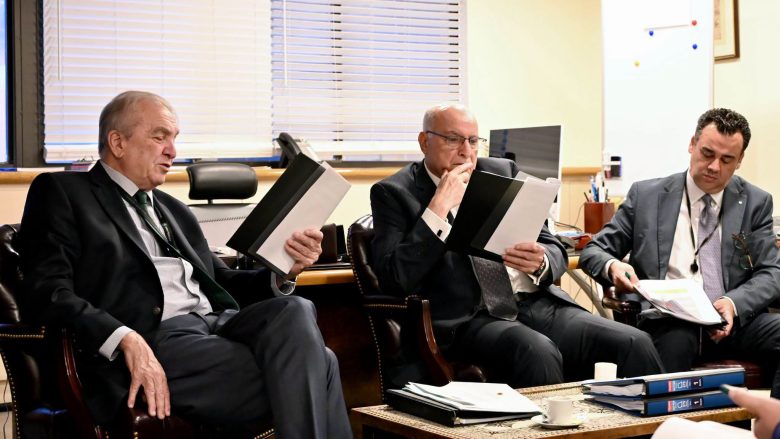
Notably, Ahmed Attaf conferred with Libya’s acting Minister of Foreign Affairs and International Cooperation, Taher El-Baour, alongside Libya’s Permanent Representative to the UN, Taher Al-Sunni.
This Libyan focus adds distinct resonance to Algeria’s presence in the diplomatic arena. Discussions between Algiers and Tripoli in New York aligned with a broader vision balancing Libyan stability, regional security within the Sahelo-Saharan corridor, and pan-African coordination. Algeria consistently upholds Libya’s national sovereignty and territorial integrity while advocating for a political resolution to the crisis.
Moreover, Palestine, Western Sahara, and UN structural reform form the foundational diplomatic triad of Algerian foreign policy. Bound by the UN Charter, Algeria firmly rejects foreign interference across the Sahel, Libya, and beyond.
For Libya, New York carries elevated importance this year. On September 17, Tripoli officially launched its campaign to secure a non-permanent seat on the UN Security Council for the 2028–2029 term. The launch event at UN headquarters convened ambassadors and representatives from over 140 member states, giving the Libyan candidacy strong initial international visibility ahead of the scheduled June 2027 vote.