

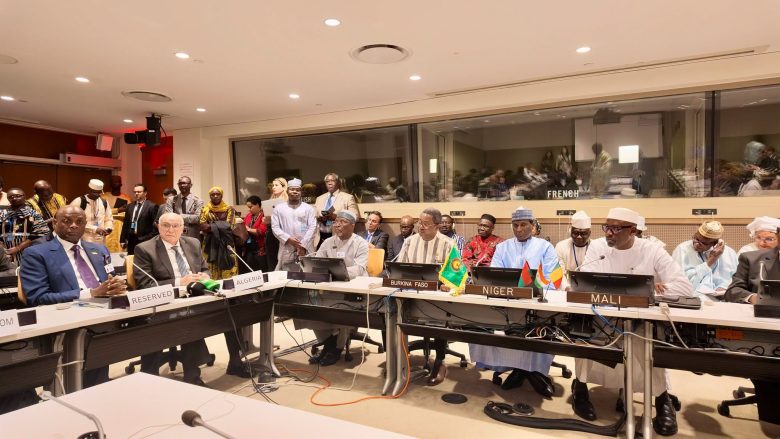
In the Sahel, stability cannot be constructed through security measures alone. It requires respect for state sovereignty, economic development, and the capacity of regional nations to define their own destinies. This is the stance advocated by Algeria in New York, where the Minister of State, Minister of Foreign Affairs, National Community Abroad, and African Affairs, Ahmed Attaf, outlined the core principles of the Algerian strategy regarding the ongoing transformations in the region.
Speaking at a side event titled “Security and Development in the Sahel, the Case of the Confederation of Sahel States,” organized on the sidelines of the 81st session of the UN General Assembly, Ahmed Attaf structured his argument around three key axes.
For Algeria, the Sahel is neither a distant reality nor a routine foreign policy matter. It represents its immediate neighborhood, bound by shared history, African identity, and longstanding human connections. “When Algeria speaks of the Sahel, it is not speaking of a remote region. We are talking about our neighborhood, our common history, our African identity, and our deeply intertwined destiny,” stated the Minister of State.
This proximity underlines the significance of good neighborliness. In this context, Ahmed Attaf reaffirmed the position of President Abdelmadjid Tebboune regarding Algeria’s commitment to this principle—a stance rooted, according to Algiers, in geography, history, and human ties.
Respect for sovereignty remains another constant position upheld by Algiers. Every Sahelian country must retain the autonomy to shape its own trajectory, safeguard its independence, and protect its territorial integrity without external interference. Ahmed Attaf stressed that “Algeria has consistently maintained a clear posture of respect for the sovereignty, independence, and territorial integrity of Sahelian nations, as well as their entitlement to chart their own national paths free from foreign interference.”
Under this approach, resolutions to Sahelian challenges must originate primarily from within the region’s member states. External partner support should accompany these domestic decisions rather than displace them.
For Algeria, integrating these dimensions is essential to moving beyond a reductive interpretation of Sahelian crises. On this point, the Minister of State reiterated President Abdelmadjid Tebboune’s conviction that “there can be no solution to Sahelian challenges through an exclusively security-focused approach.”
He summarized it as follows: “Security and development must advance hand in hand.” A stable Sahel cannot simply be one where “weapons fall silent”; it must also serve as “an ecosystem capable of offering prospects and opportunities to its populace.”
=====Moving Beyond a Narrative of Crisis
This comprehensive approach accounts for the interconnected nature of the challenges facing regional nations. Security, economic, and social concerns cannot be addressed in isolation, which explains the emphasis placed on cooperation and development alongside stabilization efforts.
Ahmed Attaf’s address was not limited to threat management. The Minister of State urged a shift in perspective regarding the Sahel, which is frequently reduced to its vulnerabilities and conflicts. He asserted that “our region can also evolve into an arena of connectivity, cooperation, integration, and shared prosperity.”
Underlying this vision is a concept of the Sahel as a platform for collaboration rather than a simple theater of crisis. This framework assumes a strengthening of ties among regional nations, enabling their populations to benefit further from geographical proximity and economic complementarities.
Algeria intends to contribute to this process by drawing on its historical ties with Sahelian nations. The Minister of State rejected viewing this shared background as static, noting that “Algeria does not arrive in the Sahel to write new history, but to continue an existing one,” referencing solidarity, African fraternity, and dedication to peace, sovereignty, and development.
In closing, the head of diplomacy anchored this relationship in what Algeria views as its fundamental foundation: “Geography positioned us side by side. History brought us together. Our peoples have always been connected.”