

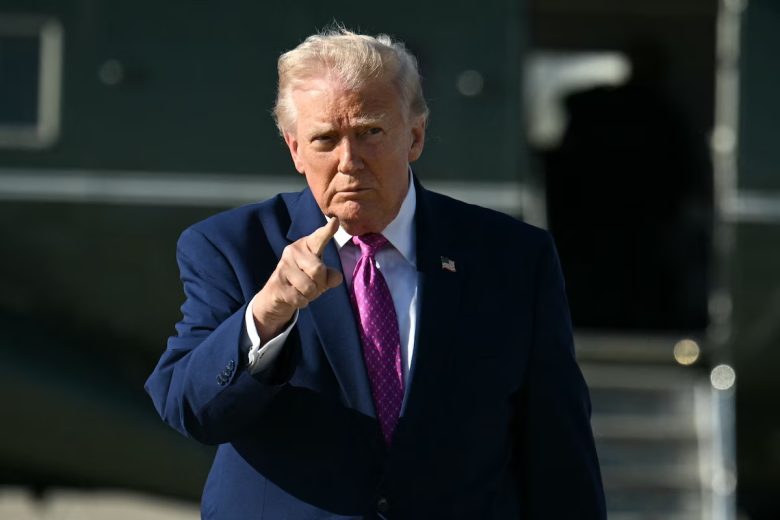
U.S. President Donald Trump announced this Sunday, April 12, the naval blockade of the Strait of Hormuz, a vital maritime route through which one-fifth of global crude oil flows. This move follows the collapse of Washington-Tehran negotiations in Islamabad, with Iran rejecting any nuclear compromise.
Donald Trump announced Sunday a U.S. naval blockade of the Strait of Hormuz, responding to Iran’s “intransigent” refusal to drop its nuclear ambitions during weekend talks in Islamabad.
While deeming the Pakistan discussions “good” and noting “most points agreed upon,” the U.S. president stated on his Truth Social platform that Tehran balked at nuclear concessions.
“Effective immediately, the world’s finest U.S. Navy will initiate the BLOCKADE process for all ships attempting to enter or exit the Strait of Hormuz,” he wrote of the strategic waterway—carrying one-fifth of world crude—nestled between Iran and Oman.
In two lengthy posts, the U.S. president warned: “Any Iranian firing at us, or at peaceful ships, will be PULVERIZED!” He hinted “other countries” would join the blockade effort, without naming them.
The announcement comes as Islamabad talks between the U.S. and Iran failed Sunday, clouding the current two-week truce’s viability.
Iranian Parliament President Mohammad Bagher Ghalibaf, heading Tehran’s delegation, slammed the U.S. on X as “incapable” of earning Iran’s trust in the talks.
Saturday, the U.S. military reported two American warships transiting the Strait of Hormuz, kicking off a demining operation—claims denied by Tehran.
Islamic Republic Revolutionary Guards then vowed “severe” action against any military vessel passing through.
The U.S. failed to win Iran’s trust in Islamabad negotiations, declared Iranian Parliament President Mohammad Ghalibaf, head of the delegation, on X. While Tehran shows good faith and willingness, he said past two wars breed distrust. The lawmaker added his nation views diplomacy—as much as military struggle—as defending Iranian rights, vowing no letup in solidifying 40 days of national defense gains. It’s now for the U.S. to decide if it can earn Iranian trust, he said. Ghalibaf thanked Pakistan for mediation efforts and sent best wishes to its people.
Two empty supertankers planned Strait of Hormuz transits but U-turned at the last minute upon learning the U.S.-Iran peace deal collapsed, Bloomberg reports. Ship-tracking data shows three major tankers unrelated to Iran heading Persian Gulf late April 11. Next morning, two—the Agios Fanourios I bound for Iraq, and Pakistani Shalamar for UAE’s Das Island—hit Iran’s Larak Island checkpoint and reversed. The third, Mombasa B leading a convoy, pressed on via Iran-approved route into the Gulf, destination unknown, Bloomberg adds.