

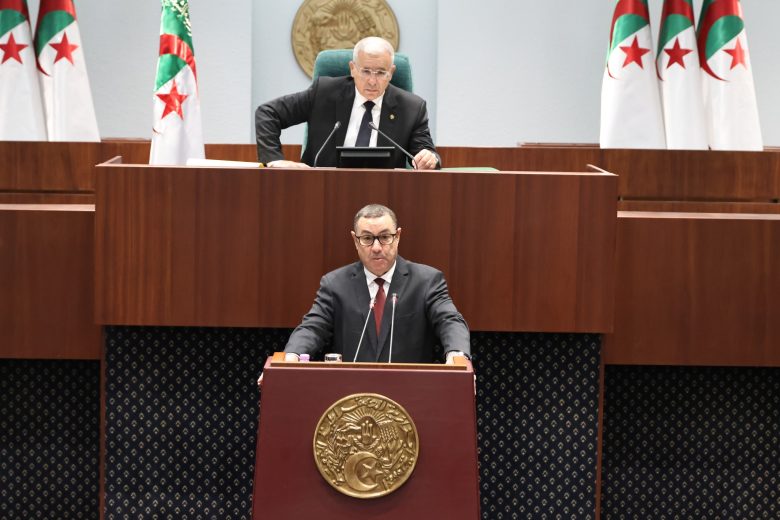
The Minister of the Interior, Local Authorities and Transport, Saïd Sayoud, presented this Monday, during a plenary session of the People’s National Assembly (APN), the draft organic law amending and supplementing ordinance 21‑01 on the electoral regime, as part of an effort to strengthen the guarantees of transparency in elections while ensuring the free choice of citizens.
From the outset, the minister emphasized the scope of the initiative, stating that “this draft law continues the reforms launched by President Abdelmadjid Tebboune, particularly in their political dimension, with the aim of entrenching the rule of law as the foundation of the nation.” He stressed that this reflects “the will to strengthen the bases of the democratic state and to consolidate the trust between the citizen and the institutions.”
At the heart of the reform is the consolidation of the cardinal principle of popular sovereignty. Sayoud pointed out that “this text fully enshrines the citizen’s right to freely choose their representatives within a transparent, fair and secure framework.” In this context, he recalled that “the electoral system forms the cornerstone of democratic legitimacy,” explaining that it “sets the rules that guarantee the integrity of the vote and the mechanisms through which the people’s will is faithfully translated into legitimate and effective institutions.”
Highlighting the importance of credibility, the minister affirmed that “elected assemblies must be protected from any form of influence by illicit money,” considering that “moralizing political life is an essential condition for consolidating democracy.”
One of the major pillars of the reform is the reorganization of the Independent National Electoral Authority (INEA). The minister said that “the proposed restructuring aims to strengthen the autonomy of this body and allow it to focus fully on its core missions: organizing, supervising and monitoring the entire electoral process.”
In detail, he specified that “restructuring its bodies, notably by reducing the number of its members and strengthening collegial decision‑making, will enhance its effectiveness and responsiveness on the ground.”
Another key axis of the bill is the clarification of roles between the Independent National Electoral Authority and the administration. Sayoud was categorical, stating that “the administration must remain neutral and be limited strictly to a logistical and material support role,” adding that “the independent authority will fully exercise its prerogatives in supervision and control, while the Interior Ministry’s services will provide the necessary means to ensure the smooth running of electoral operations.” This functional separation is intended to “eliminate ambiguity and strengthen citizens’ confidence in the integrity of the electoral process.”
Easing Candidacy Conditions
The draft law also introduces a series of measures aimed at boosting political participation. Sayoud explained that “easing the conditions for candidacy, particularly by reducing the number of required signatures, helps facilitate access to elections and encourages broader participation.” At the same time, he underlined the importance of “reinforcing certain eligibility criteria,” especially educational requirements, “to ensure that candidates possess the necessary skills to assume public office.”
He also referred to “provisions designed to promote the representation of women and young people in elected assemblies,” while noting that “transitional measures have been planned to support newly created provinces, particularly by temporarily exempting them from certain constraints linked to candidacies.”
On the issue of transparency, Sayoud stressed “the strengthening of mechanisms for controlling electoral financing,” which he described as “a key lever in the fight against illicit money.” He highlighted that “the obligation for candidates to justify their tax situation is part of this moralization effort,” arguing that “the credibility of elections depends on candidates’ integrity and compliance with financial transparency rules.”
Presenting a major innovation in the modernization efforts introduced by the new text, the minister announced that “the gradual digitization of electoral lists and the introduction of electronic tabulation will improve the speed and reliability of results.” He clarified that “integrating the unique national identification number into the electoral card will enhance the accuracy of data and further secure the electoral process.”
Finally, Sayoud sought to reassure as regards the purpose of the revision, stressing that “this is not a break with the existing framework, but a controlled evolution designed to strengthen achievements and correct identified shortcomings.” The aim is to build a more transparent, efficient and inclusive electoral system, capable of meeting citizens’ expectations and reinforcing the legitimacy of the institutions.