

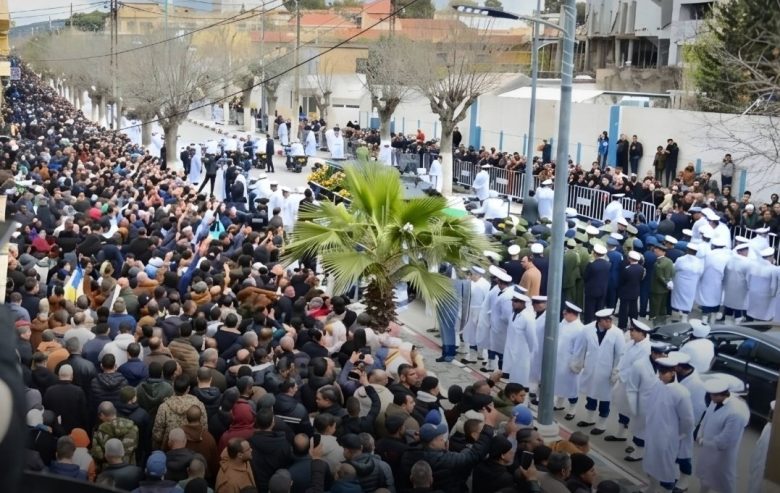
A massive, steady throng overflowed the grounds around Batna’s provincial headquarters this Monday, spilling onto roads leading to the city center. Citizens from across the nation converged by the hundreds to pay final respects to Liamine Zeroual, in an atmosphere thick with solemnity, tears, and shared grief, following the procession to his final resting place.
The main street fell into near-sacred hush, broken only by respectful whispers and the rustle of coats in the chilly morning breeze. People lined up patiently, step by step, to approach Zeroual’s remains, displayed in a stark hall flanked by national flags around his casket. Tension hung in the air; eyes glistened, some wept openly, others bowed their heads in quiet reverence.
Among those present, veteran fighter Mohamed Amaïri honored the memory of a fellow warrior and statesman. “Today, we salute one of the Aurès heroes, Liamine Zeroual—a combatant who stood with Mostefa Ben Boulaïd, Si El Haouès, and Amirouche. He kept the vow to carry forward the martyrs’ path and propel Algeria ahead,” he stated. Reflecting on the nation’s turbulent years, he continued: “In 1990, as Algeria teetered on the brink, Zeroual rose to defend it. He bridged divides among the people, shielded the country, and rallied Algerians against the storm. Because of him, Algeria stood firm, united, and triumphant.”
Revolutionary icon Sassia Halis, founder of an underground cell, emphasized that “Liamine Zeroual embodied honor and selflessness for Algeria throughout his journey.”
Other revolutionary veterans also paid tribute. Fighter El Abed Rahmani, former provincial secretary of the National Mujahideen Organization in Batna, voiced deep sorrow over the ex-president’s passing. He described Zeroual as “a towering national figure who fought in the armed struggle during the glorious Revolution, and who safeguarded the country’s unity amid extraordinarily challenging times.”
Echoing the sentiment, fighter Ismaïl Hamiche highlighted Zeroual’s personal and leadership qualities. He praised “a man defined by endurance, fighting spirit, and devotion to sacrifice—before and after independence,” along with “his steadfast stances, sharp insight, and foresight in navigating one of Algeria’s gravest crises in the 1990s.”
Fighter Amaïri, too, expressed profound grief, underscoring “the departed’s human virtues, his dedication to the homeland, and his pivotal role in upholding the Republic during a pivotal crisis in the nation’s history.”
Testimonies flowed amid the crowd. A longtime neighbor, voice choked with emotion, struggled to speak. “Our condolences to all Algerians for this colossal loss. We’ve lost a monumental figure—a genuine soul who gave his youth to independence, then to nation-building,” he shared.
Recalling personal encounters, he added: “He was remarkably unpretentious. We’d see him around the neighborhood, always approachable and modest. He cherished Algeria deeply. He led it through harrowing conditions, and because of him, it endured.” He concluded: “Words fail us today. May God grant him mercy. He trusted in the country’s future, and history proved him right. Farewell to a statesman and patriot.”
Batna’s governor, Ryadh Benahmed, stood front and center with local officials and elected representatives, face somber and still, as veterans in simple uniforms and lowered hats honored their old comrade.
The body was moved from the family home to the provincial seat, with the crowd pressing close for one last glimpse. Youth, families, and ex-combatants advanced in respectful quiet, interrupted only by the faint clicks of cameras and phones—devices capturing the moment but failing to convey the raw sentiment.
Born July 3, 1941, in Batna, Liamine Zeroual joined the National Liberation Army in 1957. As a teenager, he battled relentlessly for independence, etching his name into collective memory. Post-1962, he advanced swiftly in the military: director of Batna’s military school, then Cherchell’s military academy, commander of multiple military regions, and land forces chief by 1989. His political path peaked with the presidency in 1995, which he left in 1999 after calling early elections—true to his commitment to stability and public service.
As the procession reached Bouzourane’s central cemetery, the street surged with even fiercer collective emotion. Ululations pierced the silence, rising as a resounding tribute to the man who devoted his life to the nation. Women’s cries blended with men’s murmurs, hailing the fighter, the mujahid, the leader. Onlookers and the entire gathering shared a unified wave of admiration and thanks, turning each step into a vibrant, audible homage.