

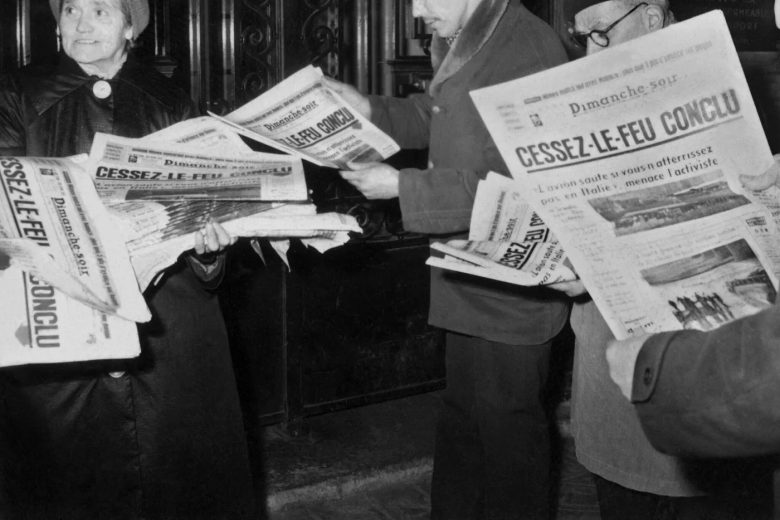
From November 1954 to the Evian Accords, the Algerian people waged a multifaceted struggle, blending armed resistance, political mobilization, and diplomatic outreach. Eight years of relentless fighting paved the way for the ceasefire on March 19, 1962—a crucial step toward independence and the reclamation of national sovereignty.
The spark ignited in the night of November 1, 1954. Through a wave of synchronized assaults on military and symbolic targets of the colonial regime, the National Liberation Front (FLN) proclaimed the launch of the Revolution. Beyond its military thrust, this founding act delivered a clear political signal: the restoration of national sovereignty and the end of over a century of colonial rule.
From its early days, the Revolution pursued a comprehensive strategy that fused battlefield operations with political maneuvering. On the ground, the National Liberation Army (ALN) waged a grinding war of attrition against the colonial occupiers. At the same time, national movement leaders mounted a vigorous diplomatic campaign to globalize the Algerian cause and rally support from world public opinion and nations backing anti-colonial fights.
Confronted by this momentum, French colonial authorities rolled out a so-called “pacification” policy. They deployed massive military resources to crush the uprising and regain territorial control, aiming to stifle the rebellion and sideline the FLN politically. Yet this approach soon hit hard walls. Despite France’s overwhelming firepower, the Revolution took deep root in Algerian society, while the conflict’s savagery fueled political rifts back in France itself.
In response, Paris also tried economic and social countermeasures. Unveiled in 1958, the Constantine Plan sought to overhaul living conditions in Algeria via an ambitious slate of economic growth, housing projects, and infrastructure upgrades. At its core lurked a bid to blunt independence demands by offering a reformist tweak to the colonial order. Politically, though, it came too late—the call for self-rule had already burrowed into the national psyche.
General Charles de Gaulle’s ascent to power in 1958 shifted the conflict’s dynamics. Recognizing that raw military might couldn’t clinch victory in the national liberation war, the French president explored political outlets. He floated the “peace of the brave,” urging FLN fighters to lay down arms in return for amnesty. Revolution leaders dismissed it outright, insisting only acknowledgment of Algeria’s right to independence could end the bloodshed.
Step by step, direct talks emerged as the only viable path. Initial secret meetings between French envoys and FLN officials cleared the ground for more formal exchanges. The June 1960 Melun talks marked one of the first official sit-downs between the sides. Though they yielded no instant breakthrough, they signaled tacit acceptance of the FLN as the key political player in resolving the crisis.
Dialogue continued in venues like Lucerne, culminating in the pivotal Evian negotiations in Switzerland. Over months, delegations grappled to bridge gaps on core issues: the ceasefire, the political transition framework, and self-determination mechanics.
Meanwhile, tensions boiled over in the colonial camp. The April 1961 generals’ putsch in Algiers exposed deep rifts in the French military and “French Algeria” hardliners. This botched power grab by officers dead-set against FLN talks collapsed swiftly—but it laid bare the colonial system’s terminal fractures as the war wound down.
Global pressure mounted relentlessly too. Amid the postwar decolonization wave, Third World nations voiced solidarity with Algeria’s fight. The Algerian question dominated international forums, further cornering French colonial policy and bolstering the legitimacy of Algeria’s bid for freedom.
After rounds of haggling, the talks produced the Evian Accords, inked on March 18, 1962, by the French delegation and reps from the Provisional Government of the Algerian Republic (GPRA). The next day at noon, the ceasefire took hold across all territory.
These pacts ushered in a fresh chapter of national liberation. They set the stage for a self-determination referendum, letting Algerians vote freely on their political destiny. Months later, on July 5, 1962, Algeria declared independence, capping a historic battle forged through profound sacrifices.
The road to Evian showcased the Revolution’s knack for pairing armed struggle with shrewd politics. It also charted how a colonial clash evolved into a defining global issue. Far beyond ending a war, the Evian Accords stand as a testament to a people’s unyielding quest for liberty and sovereign rebirth.