

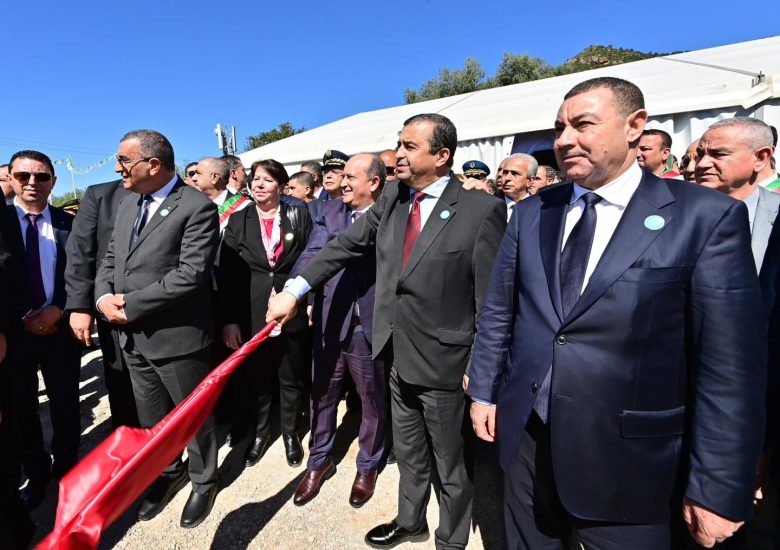
Algeria’s push to harness its mineral wealth gained momentum this Tuesday with the on-schedule launch of the Amizour-Tala Hamza zinc and lead mine in Bejaia province. Opened under the oversight of Prime Minister Sifi Ghrieb—dispatched by President Abdelmadjid Tebboune—this key initiative aims to boost the national economy, shore up industrial independence, generate thousands of jobs locally, and establish Algeria as a heavyweight in the global minerals trade.
Flanked by a high-level ministerial team, Ghrieb stated that “tapping this deposit will solidify Algeria’s footprint in the international minerals market and sharpen our economic edge. Mineral resources now form a cornerstone of national wealth and a battleground for resource-rich nations.”
He added that “this flagship endeavor—blending industrial growth, resource optimization, and environmental safeguards—affirms Algeria’s resolve to maximize its mineral assets and bolster economic self-reliance.” Ghrieb noted the mine “will meet domestic demand from phase one onward, with excess output earmarked for export to swell state revenues.” He wrapped up by highlighting its potential to spawn fresh job prospects and fuel regional industrial and economic progress.
The event unfolded in Ait Bouzid village, Tala Hamza commune, kicked off by Bejaia Governor Kamel Eddine Karbouche, who praised the project’s strategic value for the area and the nation at large. Ghrieb’s entourage included State Minister and Hydrocarbons and Mines Minister Mohamed Arkab; Interior, Local Governance, and Transport Minister Said Sayoud; Energy and Renewables Minister Mourad Adjal; Industry Minister Yahia Bachir; Public Works and Basic Infrastructure Minister Abdelkader Djellaoui; and Secretary of State for Hydrocarbons and Mines Karima Bakir.
A Sonarem executive—representing the National Mining Research and Exploitation Company—outlined the venture, overseen by the Algerian-Australian joint firm Bejaia Zinc and Lead (BzL). “The operation targets 170,000 tons of zinc and 30,000 tons of lead yearly, fulfilling local industry needs while producing surplus for overseas sales,” he explained, stressing its national and global economic-strategic weight.
The setup features underground extraction, hauling ore blocks to a processing plant that ramps zinc concentration from 4% to nearly 60% and lead from under 1.5%. Relevant ministries detailed support measures.
Public Works outlined a new road linking the mine to the highway at kilometer 13 for smooth, secure material transport. The Energy and Renewables sector will supply power and gas via a 60 kV line from the El-Ksar substation. Water Resources highlighted environmental protocols: the mine footprint covers less than 2% of the watershed, minimizing farm disruptions, with drainage water managed through temporary storage, treatment, and reuse. Bejaia port will handle zinc and lead processing and shipping, with interim storage and gear meeting stringent eco-standards.
Advanced mitigation steps include repurposing mine waste—mixed with cement—to backfill underground voids, plus cutting-edge water and waste systems tackling acid drainage.
Ghrieb later toured the mine perimeter entrance works, spanning 234 hectares. Ranked as the world’s fifth-largest zinc deposit, it balances industrial prowess with Soummam Valley ecosystem protection.
Backed by a $471 million investment, the project promises robust returns: $215 million in projected annual revenue, with payback in about five years post-launch. Technically, it eyes 2 million tons of raw ore yearly, processed into roughly 170,000 tons of zinc and 30,000 tons of lead. “This underscores our dedication to mining potential, environmental stewardship, sustainable growth, and regional economic-social gains,” Ghrieb emphasized.