

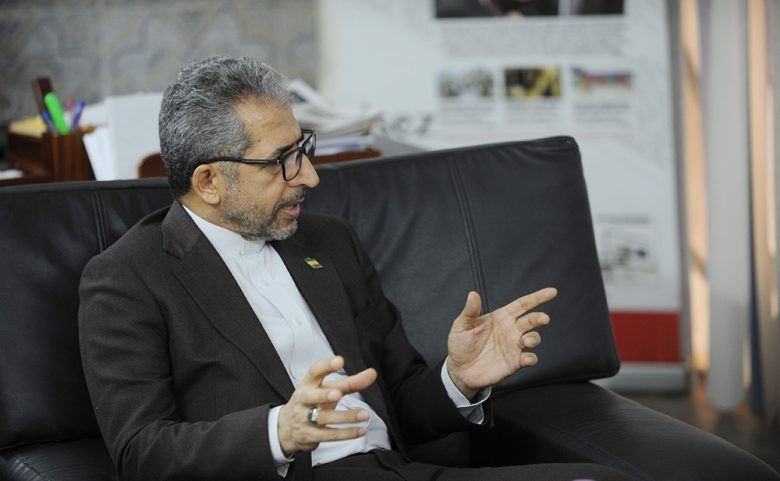
As the Middle East teeters on the edge of a total regional conflagration, the traditional language of diplomacy is being replaced by the thunder of ballistic strikes and the cold calculus of “regime change.” With the rhetoric between Tehran, Washington, and the Zionist entity reaching a fever pitch, the Iranian Ambassador to Algeria, Mr. Mohammad Reza Babai, has chosen this volatile moment to break his silence.
In an extraordinary and wide-ranging interview with Le Jeune Indépendant, the Ambassador delivers a message that is as defiant as it is sobering. Speaking from a position of “field-tested resolve,” Babai provides an insider’s account of the collapsed negotiations with the United States—labeling them a “calculated betrayal”—and details the devastating humanitarian toll of recent joint military strikes.
From the closure of the “Geneva door” to the specific conditions required to halt the current spiral of violence, this dialogue serves as a roadmap of Iran’s red lines. It is a rare glimpse into the mindset of a nation that, according to Babai, “does not bow to invasion” and views its current struggle not merely as a conflict, but as a fight for sovereign survival. This dialogue decodes the current Iranian stance and outlines the roadmap to ending the war—on Tehran’s terms.
The “Ramadan Aggression”: Details of the Joint Strike and American “Treachery”
Le Jeune Indépendant: What is the true toll of civilian casualties and infrastructure damage following the recent waves of aggression? Furthermore, how do you respond to U.S. claims that senior state leadership was targeted with the goal of “regime change”?
Ambassador Babai: On February 28, corresponding to the 10th of Ramadan, the Zionist entity and the United States launched a joint military operation against the Islamic Republic of Iran. This attack was an illegal, unprovoked act of aggression and a flagrant violation of the UN Charter. For the second time in nine months, the U.S. attacked Iran in the very midst of negotiations.
Despite our skepticism, we agreed to give diplomacy a chance at the request of friendly nations and through Omani mediation. An agreement was within reach, but the U.S. betrayed us, seeking to impose its demands through force. This aggression began with the assassination of the legitimate leader and high religious authority, His Eminence Grand Ayatollah Khamenei, in his office alongside his family. On that same day, 160 schoolgirls were martyred at an elementary school in the city of Minab. The bombardment also struck hospitals, airports, and oil facilities, resulting in the martyrdom of over 1,400 citizens—two-thirds of whom were civilians.
The enemy’s goal was clearly “regime change” and the partition of Iran. However, thanks to a courageous defense and the people’s rallying around the leadership, their schemes failed. Consequently, they resorted to taking revenge on our infrastructure and economic centers.
The Compass of Retaliation: Reassuring Neighbors, Warning Against “Exploitation”
What is your message to neighboring countries affected by the exchange of strikes to ensure the region does not slide into a total war?
Ambassador Babai: We did not start this war; it was imposed upon us. We are utilizing our capabilities to defend our sovereignty, and our responses are directed exclusively at the source of the threat. Since our missiles targeting the Zionist entity do not reach U.S. soil, we target American bases and interests in the region, as they are legally considered “American territory.”
We remain committed to a policy of good neighborliness, but we have warned neighboring states that the U.S. might exploit their territories to attack us. Unfortunately, missiles are currently being launched and sovereign airspace is being used to strike Iran, forcing us to respond to the source of the threat. The insecurity in shipping lanes and oil transit is a direct result of American-Zionist aggression. The world must act to stop this before the consequences expand globally.
Succession and Stability: The Assembly of Experts Settles the Political File
There is much talk regarding the internal leadership arrangements following the martyrdom of the Supreme Leader. What is the significance of the rapid resolution of the succession file at such a sensitive time?
Ambassador Babai: Based on Article 110 of the Constitution, and within just one week despite the conditions of war and bombardment, the Assembly of Experts convened and selected the new leader: His Eminence Ayatollah Sayyid Mojtaba Khamenei. This process carries definitive signals:
1. Institutional Strength: Iran is a state of established legal institutions that do not falter during crises.
2. Unity: The selection received widespread acclaim from all pillars of the state, political factions, and the people.
3. Continuity: Choosing a figure with intellectual proximity to the martyred leader ensures the continuity of our path.
of our path.
4. Sovereignty: The most vital message is that Iran is an independent state; no foreign power can impose a leader upon it. The administration of the country’s affairs continues with even greater strength in this new phase.
No Return to “Geneva”: Iran Closes the Door on Washington
Given Washington’s insistence on “unconditional surrender,” is the door to diplomacy still open? What are your guarantees for returning to the table ?
Ambassador Babai: We hold diplomacy in high regard, but our experience with the U.S.—particularly under the current administration—has proven that negotiation is meaningless. They betrayed us last June in the middle of talks, and they repeated that treachery this year after three rounds of dialogue where they claimed to desire a peaceful solution, only to launch their aggression.
Therefore, we affirm that the door to dialogue with the United States has been closed and is no longer on our agenda. The only path to ending this war is: the recognition of Iran’s legitimate rights, the payment of reparations, and a firm international commitment to non-aggression.
Conclusion: “Iran, which possesses a civilization spanning seven thousand years, does not bow to invasion. We shall emerge victorious from this battle.”