

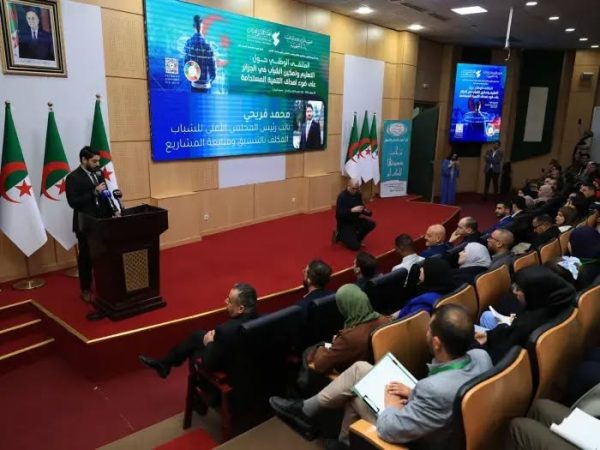
In the era of digital transformations and the imperatives of sustainable development, the Higher Youth Council (HYC) launched, this Saturday, a call to rethink public policies by placing education and youth empowerment as strategic priorities.
Mohamed Frihi, vice-president of the Higher Youth Council in charge of coordinating and monitoring projects, stated during his speech at the opening of the National Forum dedicated to education and the agency of new generations, under the auspices of the Higher Youth Council, that “investing in human capital is not a conjunctural choice but a strategic necessity.” He specified that “investing in human capital and establishing quality education capable of supporting digital and economic transformations constitutes a true lever to strengthen the place of young people in decision-making.”
Mr. Frihi also highlighted the importance of involving “collective responsibility to provide quality education aligned with the digital, economic, and environmental transformations the world is experiencing.”
For the official, the challenge goes beyond the purely academic framework. Asserting that “training also means preparing to decide, innovate, and actively participate in public life,” he emphasized that empowering youth is one of the cornerstones of inclusive sustainable development. In this perspective, he advocated for an integrated approach linking training, employability, entrepreneurship, and active citizenship, estimating that “Algerian youth possess considerable potential that must be supported, structured, and valorized.” During the forum’s proceedings, the presidents of the organizing commissions echoed the same view, affirming that this meeting’s main objective is “to move beyond mere observations” to formulate concrete and operational recommendations. The ambition is to create a permanent dialogue space between institutions, universities, experts, and associational actors, in order to arrive at proposals aligned with sustainable development goals and the aspirations of young people in terms of training, professional integration, and innovation.
Organized by the commission for education, training, higher education, and strengthening youth capacities, in coordination with the environment and sustainable development commission of the Faculty of Information and Communication Sciences at the University of Algiers 3, the forum brought together representatives from various ministerial departments, constitutional institutions, teacher-researchers, experts, as well as a significant delegation of young people and students from several wilayas.
The diversity of profiles present gave the debates both an academic and pragmatic dimension. Discussions focused on adapting curricula to the demands of the job market, strengthening digital skills, promoting green entrepreneurship, and integrating sustainability principles into educational policies. Several speakers stressed the need to bring universities closer to the economic world and encourage bridges between research, innovation, and the production fabric. It should be noted that, as discussions progressed, one observation emerged: the transition to a sustainable development model cannot be achieved without trained, confident, and fully engaged youth. Education thus appears not only as a fundamental right but also as a structuring lever to reduce inequalities, stimulate growth, and consolidate social cohesion. Based on this observation, the recommendations from the proceedings should be compiled into a synthesis document intended to inform public policies toward youth, in order to embed this action over the long term and contribute, through consultation and expertise, to building a more innovative Algeria resolutely oriented toward the future.