

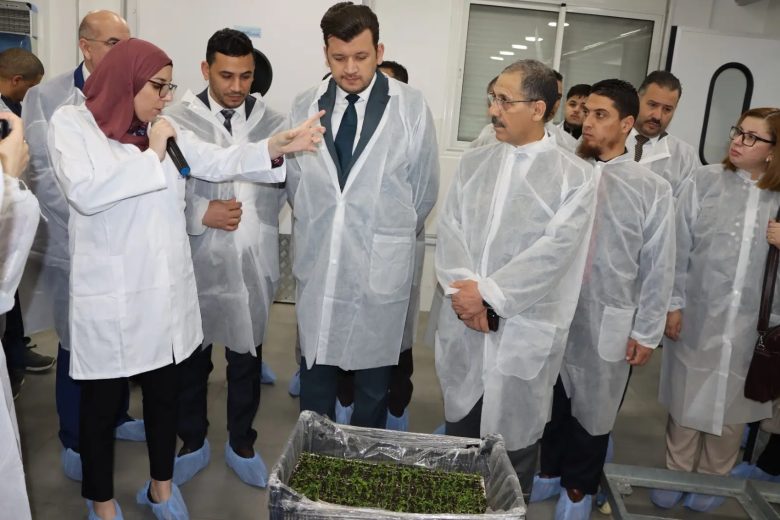
The Ministry of Agriculture launches an ambitious program to locally produce seeds and seedlings, thereby progressively reducing dependence on imports. Between cutting-edge laboratories, model farms, and strategic silos, Blida is becoming a laboratory for agricultural autonomy, where science, technology, and partnerships with farmers pave the way for national food security.
The minister announced this Friday, during his visit to Blida, an ambitious program aimed at progressively reducing the importation of seeds and seedlings, particularly for vegetable crops, to ensure food security and cut import costs. He specified that integrating modern technologies into agriculture, especially for local production of seeds and seedlings, is a priority axis for the ministry, with an orientation toward export. In this framework, a seed production hub is being prepared between the wilayas of Ghardaïa and El-Ménia.
Accompanied by the wali of Blida, Djamel Eddine Hashas, as well as civil and military authorities, the minister began his visit at the Vitro-Plant Algérie laboratories, the result of an Algerian-Italian partnership, among the most advanced in producing fruit trees through in vitro culture. This nursery produces nearly 15 million seedlings each year, meeting national market needs and also orienting toward export. The minister praised this facility as an example of the alliance between scientific research, Algerian expertise, and young talents to reduce imports and strengthen local production.
The minister and his delegation then visited the Bassatine Yessad model farm, which spans 340 hectares and applies modern intensive agriculture techniques, notably intensive agriculture allowing the planting of 1,600 shrubs per hectare compared to 800 previously, smart water management, and automated disease control. This project illustrates the success of a public-private partnership and contributes to improving productivity, quality, and local employment.
In El-Affroun, the minister inspected the progress of work on a strategic silo with a capacity of one million quintals, scheduled to be commissioned by the end of the year. This infrastructure fits within the national program aimed at strengthening food security and market stability.
On the way to other farms, Mr. Oualid met with breeders from the Béni Tamou commune, who raised difficulties related to subsidized feeds and administrative burdens. The minister indicated that digitization is the chosen path to lighten procedures and facilitate the activity of wealth creators.
The visit concluded with a meeting with farmers and breeders from the wilaya, where the minister presented the main axes of the 2026/2027 sectoral plan. This plan provides for the establishment of a unified national information system, the development of a new law on agricultural land, the revision of the subsidy policy, the development of alternative feeds for livestock to reduce the cost of red meat, the local production of hybrid seeds, as well as the modernization and mechanization of cooperatives.
Addressing the press, Mr. Oualid emphasized: “Our message is clear: food security is not a slogan, but a comprehensive reform process based on science, technology, and partnership with farmers and investors. Blida is a model wilaya in adopting technology and scientific research in agricultural activity, and we want these practices to be generalized nationwide.”